The power of documentaries in supporting the work of Transitioners / O poder dos documentários no apoio ao trabalho dos Transitioners
[Filipa wrote this article in Portuguese. Please find the translated version below]
— Lembro-me do dia em que fui de Bruxelas a Paris para participar no evento ChangeNow 2025, onde o Rob (Hopkins) iria intervir — disse eu à Esther.
Maeve Campbell apresentando Javier Peña e Rob Hopkins após a exibição do capítulo 2 na Change Now Summit, em Paris.
A Esther e eu estávamos numa reunião online para explorarmos a colaboração entre a Transition Network Internacional e os produtores do novo documentário HOPE! (ElGatoVerde). Eu continuei:
— Tínhamos combinado encontrar-nos sem especificar onde nem quando, e foi uma surpresa encontrarmo-nos mesmo no patamar inferior das escadas do metro que nos levaria à Avenue des Champs-Élysées, pertinho do Grand Palais. Assim que começámos a subir, olhei para cima e vi um homem parado, a olhar para nós. Quando o Rob olhou para ele, o rosto daquele homem grande e barbudo iluminou-se num sorriso rasgado e, com os dedos, formou um coração. A celebração que ainda estava viva pela surpresa do nosso encontro ampliou-se para incluir aquele homem desconhecido. Que momento tão bonito.
— Reconheceu o Rob? — perguntou Esther, de olhos muito abertos, numa expressão entre o espanto e a diversão. — Acontece muito o Rob ser reconhecido assim, fora de Inglaterra?
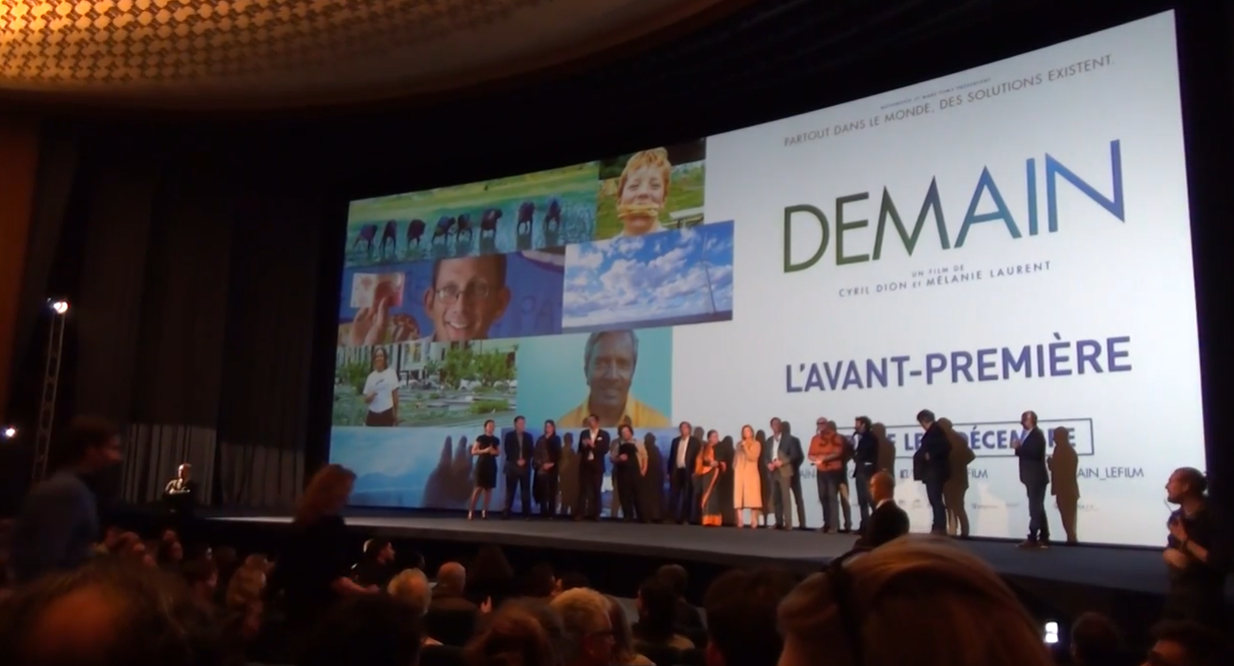
— Sim! — respondi — Acontece muito em França, na Bélgica e noutros países francófonos. Assisti muitas vezes a este fenómeno depois de o Rob se ter tornado uma celebridade com o sucesso incrível do documentário DEMAIN, que estreou durante a COP21, em 2015. Sabias que ganhou um César e teve mais bilheteira do que o Star Wars em França?
Demain e Transição na COP21. «8 dias na COP21» é o trabalho do cineasta Emilio Mula, que viajou para Paris com Rob Hopkins e a equipa da Transição
— Sim, lembro-me de ler sobre isso — disse Esther — e que teve um impacto enorme no Movimento de Transição nesses territórios francófonos: só na Bélgica, o número de grupos locais triplicou no ano que se seguiu ao lançamento do filme. É impressionante o poder que um documentário de qualidade pode ter no apoio ao trabalho que fazemos no terreno.
— Pode ser mesmo muito transformador um documentário deste tipo. — eu concordei — A Transition Network lançou alguns documentários com esse propósito: o Transition 2.0 (2012), por exemplo, foi muito utilizado no terreno pelos grupos locais. Ainda hoje o dou como exemplo do poder da ação coletiva: o filme é um agregado de imagens recolhidas em todo o mundo pelas Iniciativas de Transição, de forma descentralizada, e reunidas depois numa narrativa unificada. O documentário tem legendas em 25 idiomas — também esse foi um trabalho colaborativo, feito por membros do movimento espalhados pelo mundo, de forma voluntária. Importante também tem sido o documentário de Agustí Corominas e Juan Del Río (Transição Espanha) — ALTERNATIVAS — agora disponível para todos verem em espanhol, com legendas em inglês, alemão, italiano e português.
— Lembrei-me agora que o Rakesh (Rakesh Rootsman Rack) contribuiu para o projeto das Práticas de Transição (Practising Transition) da TNi — “Noites de Cinema para (re)lançar a Transição”. Sabias? — perguntou Esther.
 Rakesh Rootsman Rak
Depois de nos deixarmos levar pelos meandros da conversa e pelos muitos recursos existentes na internet, combinámos regressar ao assunto que era o foco da nossa reunião: o documentário HOPE!.
— Como dizia antes, Esther, fui ao evento ChangeNow, em Paris, e foi lá que assisti à exibição do episódio 2 do documentário. Tive a mesma intuição de potencial que tive com o documentário DEMAIN. O Rob Hopkins, uma das figuras principais deste episódio, e o realizador Javier Peña formaram um painel de discussão logo depois da exibição e responderam a perguntas do público. A sala estava cheia e sentia-se o entusiasmo geral. Foi logo depois que o Javier e eu começámos a imaginar como poderíamos colaborar - a equipa do documentário e a Transition Network Internacional.
— Percebo o entusiasmo que deve ter sido — disse Esther. — Entretanto, vi todos os episódios na TVE (a televisão pública espanhola). Fiquei muito emocionada com todos eles. Tem sido um grande sucesso em Espanha, com uma onda de interesse no tema da regeneração, na narrativa de que ainda há esperança e de que estamos a tempo. Todo o documentário é como uma viagem transformadora, guiada por Javier Peña, para conhecer um outro lado das alterações climáticas, com especialistas em ambiente de todo o mundo, filmado em 17 países e mostrando soluções reais para travar a crise ecológica global.
— Desde Paris, já fizemos várias coisas em conjunto: em outubro do ano passado, a TNi organizou uma sessão online de exibição do episódio 2 — “O Poder de Duas Palavras” — com uma conversa com o Rob Hopkins e o Javier Peña; e, em novembro, co-organizei e facilitei uma sessão em Bruxelas, quando vieram apresentar o documentário ao Parlamento Europeu.
Gravação da conversa que tivemos durante a exibição internacional online do episódio 2 de HOPE, no final de 2025
— Exato. E foi precisamente depois da sessão online, em outubro, na qual tivemos mais de 200 inscrições, que muitos participantes nos perguntaram como poderiam organizar exibições da série documental nas suas comunidades locais. É nisso que temos de trabalhar, Filipa — como organizamos isso? Como continuamos esta colaboração tão boa com os produtores da Gato Verde?
Continuámos a reunião explorando possibilidades e construindo sobre experiências passadas, tanto do lado da TNi como da nossa experiência pessoal enquanto membros de iniciativas locais. Reunimos várias vezes com os representantes do HOPE!, tecendo uma relação de colaboração comovente entre as duas equipas. Estamos agora preparadas, eu e a Esther, para partilhar:
A todos os membros desta família da Transição que queiram juntar-se a esta ONDA DE ESPERANÇA maravilhosa, organizando uma exibição desta série documental ou parte dela nas vossas comunidades, convidamos-vos a explorar todas a possibilidades e condições para o fazer: pensamos que aqui poderão encontrar tudo o que precisam.
Deem-nos notícias!
Translated version
— I remember the day I went from Brussels to Paris to attend the ChangeNow 2025 event, where Rob (Hopkins) was going to speak — I told Esther.
Maeve Campbell introducing Javier Peña and Rob Hopkins after the screening of chapter 2 at Change Now Summit in Paris
Esther and I had met online to explore collaboration between the Transition Network International and the producers of the new documentary HOPE! (GatoVerde). I continued:
— We had arranged to meet without specifying where or when, and it was a surprise to find ourselves on the lower landing of the metro stairs that would take us to the Avenue des Champs-Élysées, right by the Grand Palais. As we started going up, I looked up and saw a man standing there, looking at us. When Rob looked at him, that big, bearded man's face lit up in a broad smile, and with his fingers, he formed a heart. The celebration still alive from the surprise of our encounter expanded to include that unknown man. What a beautiful moment.
— Did he recognize Rob? — asked Esther, her eyes wide, in an expression somewhere between astonishment and amusement. — Does Rob get recognized like this often, outside England?
— Yes! — I replied. — It happens a lot in France, Belgium, and other French-speaking countries. I've witnessed this phenomenon many times since Rob became a celebrity with the incredible success of the documentary TOMORROW (DEMAIN), which premiered during COP21, in 2015. Did you know it won a Cesar Award and had higher box office numbers than Star Wars in France?
Demain and Transition at COP21. '8 days @ COP21' is the work of filmmaker Emilio Mula who, traveled to to Paris with Rob Hopkins and the Transition team.
— Yes, I remember reading about that — said Esther — and that it had a huge impact on the Transition Movement in those French-speaking territories: in Belgium alone, the number of local groups tripled in the year following the film's release. It's impressive the power a quality documentary can have in supporting the work we do on the ground.
— A documentary like this can indeed be very transformative — I agreed. — Transition Network released some documentaries for that purpose: Transition 2.0 (2012), for example, was widely used on the ground by local groups. I still cite it as an example of the power of collective action: the film is an aggregate of footage gathered worldwide by Transition initiatives, in a decentralized way, and then brought together into a unified narrative. The documentary has subtitles in 25 languages — that was also a collaborative effort, done by movement members around the world, on a voluntary basis. Also important has been the documentary by Agustí Corominas and Juan Del Río (Transition Spain) — ALTERNATIVAS — now available for everyone to watch in Spanish, with subtitles in English, German, Italian, and Portuguese.
— It just occurred to me that Rakesh (Rakesh Rootsman Rak) contributed to the TNi project "Practising Transition" with "Film Nights to (re)launch Transition". Did you know? — asked Esther.
 Rakesh Rootsman Rak
After letting ourselves get carried away by the intricacies of the conversation and the many resources available on the internet, we agreed to return to the subject that was the focus of our meeting — the documentary HOPE!.
As I was saying before, Esther, I went to the ChangeNow event in Paris, and that's where I watched the screening of episode 2 of the documentary. I had the same intuition of potential that I had with the documentary TOMORROW. Rob Hopkins, one of the main figures in this episode, and the director Javier Peña formed a discussion panel right after the screening and answered questions from the audience. The room was full and you could feel the general excitement. It was right after that Javier and I started imagining how we could collaborate — the documentary team and Transition Network International.
— I understand the excitement it must have been — said Esther. — Meanwhile, I watched all the episodes on TVE (the Spanish public television). I was very moved by all of them. It has been a great success in Spain — a wave of interest in the theme of regeneration, in the narrative that there is still hope and that we are in time. The whole documentary is like a transformative journey, guided by Javier Peña, to discover another side of climate change, with environmental experts from around the world, filmed in 17 countries and showing real solutions to halt the global ecological crisis.
Since Paris, we've done several things together: last October, TNi organised an online screening session of episode 2 — "The Power of Two Words" — with a conversation with Rob Hopkins and Javier Peña; and in November, I co-organized and facilitated a session in Brussels, when they came to present the documentary to the European Parliament.
Recording of the conversation we had during the online international screening of HOPE episode 2, at the end of 2025
— Exactly. And it was precisely after the online session in October, which had over 200 registrations, that many participants asked us how they could organize screenings of the documentary series in their local communities. That's what we need to work on, Filipa — how do we organize that? How do we continue this wonderful collaboration with the producers from Gato Verde?
We continued the meeting exploring possibilities and building on past experiences, both from TNi's side and from our personal experience as members of local initiatives. We met several times with the HOPE! representatives, weaving a touching collaborative relationship between the two teams. Esther and I are now prepared to share with anyone who wants to bring this documentary series to their communities.
We think you might find everything you need here.
Let us know how it goes!