Transition Governance - Not Perfect, But Precious
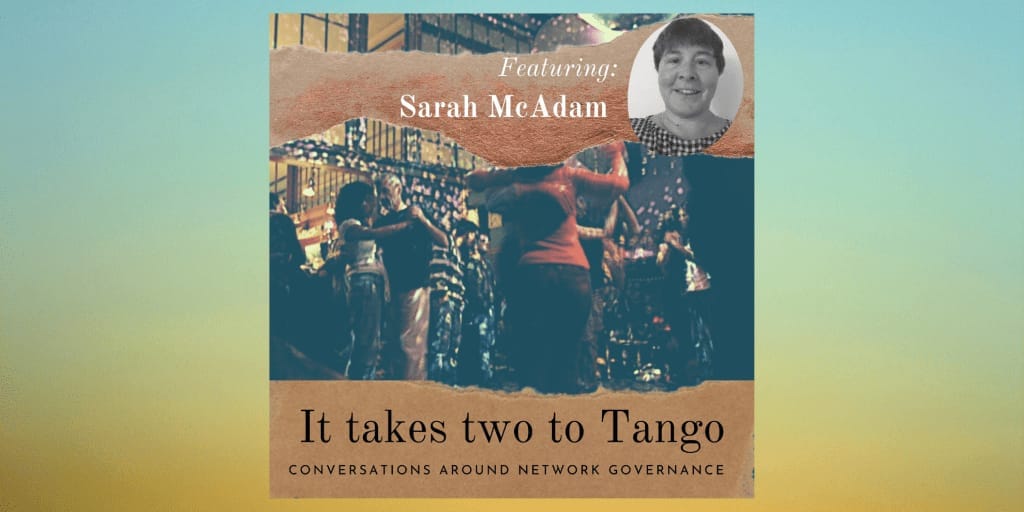
Sarah McAdam recently joined Pedro Portela on his podcast, It Takes Two to Tango - Conversations Around Network Governance. In the series he gathers stories of governance from movements, networks and organisations that are trying to solve some of the world's most wicked problems. Sarah has been part of the Transition Network team for over a decade. She first joined as a Trustee, became Delivery Director in 2013, and since 2016 has been a Team Member - working within the team as it transitioned from having a hierarchical structure to a flat one. Her learning, practicing and experimenting with transformational governance hasn’t only been within Transition Network, the charity. Over the past few years she has played an active role in the work of further distributing power, decision-making and resources across the wider Transition movement - working closely with Transition Hubs based in different parts of the world. Within the principles and practices of the Transition movement there is a clear theme that how we do things is as important as what we do. We think that the story of our shared governance model, and the journey that got us here, is an important one to tell. And we are grateful to Pedro for inviting Sarah to the dancefloor to do that. We’re sharing an abridged version of their conversation. You can listen to the full podcast, and other episodes, here:
https://soundcloud.com/pedro-portela-168791914/sarah-mcadam-transition-network
https://soundcloud.com/pedro-portela-168791914/sarah-mcadam-transition-network
Joining me today from the UK is Sarah McAdam from Transition Network. Transition Network is a charity established in the UK which works to inspire, encourage, connect, support and train communities worldwide as they self-organise around the Transition model.
Let’s start off by talking a little bit about Transition Network and how you became involved with it. And what the organisation, and this Transition model, is all about.
What Transition Network is, as you mentioned, it’s a small charity registered in the UK. Currently, there’s 13 members of staff and 7 trustees, which is a requirement by law in the UK. And I first came to it actually even before 2013. Initially I was a trustee, which I did almost as a sort of part time contribution. I thought the organisation sounded interesting and I was agreeing to go to a board meeting maybe four or five times a year to give them a bit of a strategic steer. And since then, we’ve really shifted the way we work. I joined the staff team, but we also completely shifted the way that we do our governance. So that role of a trustee is very different now.
And what is Transition all about for those three people in the world who haven’t heard about Transition?
Oh no, I’m sure it’s much, much more than three. So the Transition model is a model of, I would say, community resilience. It’s – how does a community, how do people get together with their neighbors, to work out what they want to shift in their community and feel that they have the energy and the power to do it? So that’s what the model is about. Started very much with a focus on the concept of peak oil and reducing our use of energy. But I would say it’s become more sophisticated and adapted as it’s spread around the world. And in each place, in each country, in each community, people are exploring for themselves – what are the key things that need to change to make the place where they live happier, healthier, more resilient, more sustainable? And that does look, of course, very different in very different places. But I think some of the values and principles apply across the whole movement.
The Transition movement or the Transition network, not the charity, but the actual global network – is an incredible story of how something that started off as an idea in a small town in the U.K. became very quickly a trans-local international network with Hubs all around the world and in many cities in many countries. I was personally involved in a couple of initiatives here in Portugal.
Yeah, it was something that spread, I would say, virally, according to where people went, where people saw the films, where they got access to the resources. And for me, that’s one of the joys of the movement – to see how it’s spread, but then also been adapted in different places. And we have a number of Hubs, as you mentioned. So groups of people in a particular territory that support Transition in that country, or maybe for the people who speak that language. And one of the areas where we’re really exploring different forms of governance is across that network of Hubs. Because it’s very important to us that those Hubs are not controlled from one place. They’re self-managing, they’re self-organising. But how do they come together to collaborate? That’s one of the questions for us.
Let’s talk about that. So when did your organisation, Transition Network the charity, which has this fundamental role of providing the scaffolding and support for the whole movement around the world. When did you decide to invest in governance? And I’m using the word invest purposefully. So it’s not only financial investment, but also time commitment of the people involved – sitting together and saying, “We’re going to think differently on how we’re going to work together”. Can you tell us the story of that?
Yes, I would say that the small charity, the organisation and the bigger movement was interested right from the start about how people, how groups work together. I mean, it’s pretty fundamental when you’re thinking about how to get together with your neighbors. It’s fundamental to the movement to find good ways of working together. And for me, that’s what governance is ultimately about. It’s – how do we come together in a group, agree on a shared endeavor, some common purpose that we’re trying to achieve together, and then find good ways to make decisions, to allocate resources, to be with each other, to resolve conflict or respond to conflict.
So I would say that we’ve been interested in that right from the start. And then as the international network of Hubs developed, I would say that there was quite an interesting challenge that arose from there. An interesting and useful challenge. This is just my perception. I’m sure different people would have different ways of telling the story, but I would say at the beginning Transition Network the little organisation, the charity, was maybe a bit careless about how we worked with those Hubs. I think we absolutely recognised that they needed to be self-managing and making their own decisions. But I think we were maybe a little unconscious in the way that we were using our power, the power that we were wielding because we were an organisation with some resources, because we were seen, you know, we were quite a visible part of the movement. So often the way we told the story had extra weight. And I think we became aware of that and people rightly questioned, challenged us a bit about that. And we started experimenting in the Hubs group with consent decision making, which draws from sociocracy. And I would say that initially it was that response of – “we want to be working in a different way that makes power more visible and then supports it to flow and to be distributed across the system”.
And then at the same time, Transition Network, the little organisation was, I would say, struggling with how we should work. We had a sort of technically hierarchical structure. We weren’t very hierarchical in the way we operated. But we had a board of trustees who, in the legal system that we work in, were in charge of our strategy and the staff were just there to carry out the strategy. And we knew that wasn’t real in terms of how we worked. So we experimented with various things. We struggled. And I think this relates to what you were just saying about investment. I would say up until 2016, we tried to deal with that a little bit on the margins of the work we were trying to do in the world. You know, we were trying to organise ourselves, but we didn’t have enough time to pay attention to it. And in 2016, we realised that this wasn’t good enough. It wasn’t helping us to do the work we needed to do. And at that point we decided to invest properly, and we were very lucky that we found a funder who was also interested in our experiment and was prepared to give us, not huge funding, but a bit of support to help us invest time, and to find people who could help us explore how we wanted our governance to change.
You mentioned that in the beginning you were a little bit careless with the Hubs. And you mentioned even there was the question of the power that your organisation was wielding unconsciously. Just because it started there, you’ve mobilised the resources and I guess the money for some initiatives. Could we spend five minutes talking about that phase? Because I think that’s an issue that interests both funders and grantees. People who are in a position to fund some of these movements, but also people who are on the receiving end of these funds. Understanding how these power dynamics or this friction eventually between funders and recipients of funds could be interesting… and how this leads them to the governance conversation.
Yes. I would say it was in the early days. We weren’t particularly operating as a channel for funding, and that probably in itself brought some friction. We were managing to secure some funding for our organisation. And of course, partly that was because of what we were doing as an organisation. But probably just as much it was about the excitement of the movement. You know, that was partly, of course, what funders were responding to and interested in was what’s happening in these different communities around the world. So I think there was a piece there where maybe we were a little complacent about the fact that actually some of these resources were coming to us almost on the backs of the work that was being done in a distributed grassroots network.
I mean I say complacent… I think we thought about it quite a lot. I think one of the enemies of all of this, you know, trying to do work in a way that is healthy and thoughtful is the busyness, isn’t it? So we were a busy, small team desperately trying to respond to all these different needs and potential and demands.
https://soundcloud.com/pedro-portela-168791914/sarah-mcadam-transition-network
Joining me today from the UK is Sarah McAdam from Transition Network. Transition Network is a charity established in the UK which works to inspire, encourage, connect, support and train communities worldwide as they self-organise around the Transition model.
Let’s start off by talking a little bit about Transition Network and how you became involved with it. And what the organisation, and this Transition model, is all about.
What Transition Network is, as you mentioned, it’s a small charity registered in the UK. Currently, there’s 13 members of staff and 7 trustees, which is a requirement by law in the UK. And I first came to it actually even before 2013. Initially I was a trustee, which I did almost as a sort of part time contribution. I thought the organisation sounded interesting and I was agreeing to go to a board meeting maybe four or five times a year to give them a bit of a strategic steer. And since then, we’ve really shifted the way we work. I joined the staff team, but we also completely shifted the way that we do our governance. So that role of a trustee is very different now.
And what is Transition all about for those three people in the world who haven’t heard about Transition?
Oh no, I’m sure it’s much, much more than three. So the Transition model is a model of, I would say, community resilience. It’s – how does a community, how do people get together with their neighbors, to work out what they want to shift in their community and feel that they have the energy and the power to do it? So that’s what the model is about. Started very much with a focus on the concept of peak oil and reducing our use of energy. But I would say it’s become more sophisticated and adapted as it’s spread around the world. And in each place, in each country, in each community, people are exploring for themselves – what are the key things that need to change to make the place where they live happier, healthier, more resilient, more sustainable? And that does look, of course, very different in very different places. But I think some of the values and principles apply across the whole movement.
The Transition movement or the Transition network, not the charity, but the actual global network – is an incredible story of how something that started off as an idea in a small town in the U.K. became very quickly a trans-local international network with Hubs all around the world and in many cities in many countries. I was personally involved in a couple of initiatives here in Portugal.
Yeah, it was something that spread, I would say, virally, according to where people went, where people saw the films, where they got access to the resources. And for me, that’s one of the joys of the movement – to see how it’s spread, but then also been adapted in different places. And we have a number of Hubs, as you mentioned. So groups of people in a particular territory that support Transition in that country, or maybe for the people who speak that language. And one of the areas where we’re really exploring different forms of governance is across that network of Hubs. Because it’s very important to us that those Hubs are not controlled from one place. They’re self-managing, they’re self-organising. But how do they come together to collaborate? That’s one of the questions for us.
Let’s talk about that. So when did your organisation, Transition Network the charity, which has this fundamental role of providing the scaffolding and support for the whole movement around the world. When did you decide to invest in governance? And I’m using the word invest purposefully. So it’s not only financial investment, but also time commitment of the people involved – sitting together and saying, “We’re going to think differently on how we’re going to work together”. Can you tell us the story of that?
Yes, I would say that the small charity, the organisation and the bigger movement was interested right from the start about how people, how groups work together. I mean, it’s pretty fundamental when you’re thinking about how to get together with your neighbors. It’s fundamental to the movement to find good ways of working together. And for me, that’s what governance is ultimately about. It’s – how do we come together in a group, agree on a shared endeavor, some common purpose that we’re trying to achieve together, and then find good ways to make decisions, to allocate resources, to be with each other, to resolve conflict or respond to conflict.
So I would say that we’ve been interested in that right from the start. And then as the international network of Hubs developed, I would say that there was quite an interesting challenge that arose from there. An interesting and useful challenge. This is just my perception. I’m sure different people would have different ways of telling the story, but I would say at the beginning Transition Network the little organisation, the charity, was maybe a bit careless about how we worked with those Hubs. I think we absolutely recognised that they needed to be self-managing and making their own decisions. But I think we were maybe a little unconscious in the way that we were using our power, the power that we were wielding because we were an organisation with some resources, because we were seen, you know, we were quite a visible part of the movement. So often the way we told the story had extra weight. And I think we became aware of that and people rightly questioned, challenged us a bit about that. And we started experimenting in the Hubs group with consent decision making, which draws from sociocracy. And I would say that initially it was that response of – “we want to be working in a different way that makes power more visible and then supports it to flow and to be distributed across the system”.
And then at the same time, Transition Network, the little organisation was, I would say, struggling with how we should work. We had a sort of technically hierarchical structure. We weren’t very hierarchical in the way we operated. But we had a board of trustees who, in the legal system that we work in, were in charge of our strategy and the staff were just there to carry out the strategy. And we knew that wasn’t real in terms of how we worked. So we experimented with various things. We struggled. And I think this relates to what you were just saying about investment. I would say up until 2016, we tried to deal with that a little bit on the margins of the work we were trying to do in the world. You know, we were trying to organise ourselves, but we didn’t have enough time to pay attention to it. And in 2016, we realised that this wasn’t good enough. It wasn’t helping us to do the work we needed to do. And at that point we decided to invest properly, and we were very lucky that we found a funder who was also interested in our experiment and was prepared to give us, not huge funding, but a bit of support to help us invest time, and to find people who could help us explore how we wanted our governance to change.
You mentioned that in the beginning you were a little bit careless with the Hubs. And you mentioned even there was the question of the power that your organisation was wielding unconsciously. Just because it started there, you’ve mobilised the resources and I guess the money for some initiatives. Could we spend five minutes talking about that phase? Because I think that’s an issue that interests both funders and grantees. People who are in a position to fund some of these movements, but also people who are on the receiving end of these funds. Understanding how these power dynamics or this friction eventually between funders and recipients of funds could be interesting… and how this leads them to the governance conversation.
Yes. I would say it was in the early days. We weren’t particularly operating as a channel for funding, and that probably in itself brought some friction. We were managing to secure some funding for our organisation. And of course, partly that was because of what we were doing as an organisation. But probably just as much it was about the excitement of the movement. You know, that was partly, of course, what funders were responding to and interested in was what’s happening in these different communities around the world. So I think there was a piece there where maybe we were a little complacent about the fact that actually some of these resources were coming to us almost on the backs of the work that was being done in a distributed grassroots network.
I mean I say complacent… I think we thought about it quite a lot. I think one of the enemies of all of this, you know, trying to do work in a way that is healthy and thoughtful is the busyness, isn’t it? So we were a busy, small team desperately trying to respond to all these different needs and potential and demands.
And I think that's the moment where it's so good to just pause and think. Where are resources coming from? Who's impacted by this? Who's getting a say in the decision making? Which voices are being heard? Which are not part of the process yet? And what can we do about that? -
https://soundcloud.com/pedro-portela-168791914/sarah-mcadam-transition-network
Joining me today from the UK is Sarah McAdam from Transition Network. Transition Network is a charity established in the UK which works to inspire, encourage, connect, support and train communities worldwide as they self-organise around the Transition model.
Let’s start off by talking a little bit about Transition Network and how you became involved with it. And what the organisation, and this Transition model, is all about.
What Transition Network is, as you mentioned, it’s a small charity registered in the UK. Currently, there’s 13 members of staff and 7 trustees, which is a requirement by law in the UK. And I first came to it actually even before 2013. Initially I was a trustee, which I did almost as a sort of part time contribution. I thought the organisation sounded interesting and I was agreeing to go to a board meeting maybe four or five times a year to give them a bit of a strategic steer. And since then, we’ve really shifted the way we work. I joined the staff team, but we also completely shifted the way that we do our governance. So that role of a trustee is very different now.
And what is Transition all about for those three people in the world who haven’t heard about Transition?
Oh no, I’m sure it’s much, much more than three. So the Transition model is a model of, I would say, community resilience. It’s – how does a community, how do people get together with their neighbors, to work out what they want to shift in their community and feel that they have the energy and the power to do it? So that’s what the model is about. Started very much with a focus on the concept of peak oil and reducing our use of energy. But I would say it’s become more sophisticated and adapted as it’s spread around the world. And in each place, in each country, in each community, people are exploring for themselves – what are the key things that need to change to make the place where they live happier, healthier, more resilient, more sustainable? And that does look, of course, very different in very different places. But I think some of the values and principles apply across the whole movement.
The Transition movement or the Transition network, not the charity, but the actual global network – is an incredible story of how something that started off as an idea in a small town in the U.K. became very quickly a trans-local international network with Hubs all around the world and in many cities in many countries. I was personally involved in a couple of initiatives here in Portugal.
Yeah, it was something that spread, I would say, virally, according to where people went, where people saw the films, where they got access to the resources. And for me, that’s one of the joys of the movement – to see how it’s spread, but then also been adapted in different places. And we have a number of Hubs, as you mentioned. So groups of people in a particular territory that support Transition in that country, or maybe for the people who speak that language. And one of the areas where we’re really exploring different forms of governance is across that network of Hubs. Because it’s very important to us that those Hubs are not controlled from one place. They’re self-managing, they’re self-organising. But how do they come together to collaborate? That’s one of the questions for us.
Let’s talk about that. So when did your organisation, Transition Network the charity, which has this fundamental role of providing the scaffolding and support for the whole movement around the world. When did you decide to invest in governance? And I’m using the word invest purposefully. So it’s not only financial investment, but also time commitment of the people involved – sitting together and saying, “We’re going to think differently on how we’re going to work together”. Can you tell us the story of that?
Yes, I would say that the small charity, the organisation and the bigger movement was interested right from the start about how people, how groups work together. I mean, it’s pretty fundamental when you’re thinking about how to get together with your neighbors. It’s fundamental to the movement to find good ways of working together. And for me, that’s what governance is ultimately about. It’s – how do we come together in a group, agree on a shared endeavor, some common purpose that we’re trying to achieve together, and then find good ways to make decisions, to allocate resources, to be with each other, to resolve conflict or respond to conflict.
So I would say that we’ve been interested in that right from the start. And then as the international network of Hubs developed, I would say that there was quite an interesting challenge that arose from there. An interesting and useful challenge. This is just my perception. I’m sure different people would have different ways of telling the story, but I would say at the beginning Transition Network the little organisation, the charity, was maybe a bit careless about how we worked with those Hubs. I think we absolutely recognised that they needed to be self-managing and making their own decisions. But I think we were maybe a little unconscious in the way that we were using our power, the power that we were wielding because we were an organisation with some resources, because we were seen, you know, we were quite a visible part of the movement. So often the way we told the story had extra weight. And I think we became aware of that and people rightly questioned, challenged us a bit about that. And we started experimenting in the Hubs group with consent decision making, which draws from sociocracy. And I would say that initially it was that response of – “we want to be working in a different way that makes power more visible and then supports it to flow and to be distributed across the system”.
And then at the same time, Transition Network, the little organisation was, I would say, struggling with how we should work. We had a sort of technically hierarchical structure. We weren’t very hierarchical in the way we operated. But we had a board of trustees who, in the legal system that we work in, were in charge of our strategy and the staff were just there to carry out the strategy. And we knew that wasn’t real in terms of how we worked. So we experimented with various things. We struggled. And I think this relates to what you were just saying about investment. I would say up until 2016, we tried to deal with that a little bit on the margins of the work we were trying to do in the world. You know, we were trying to organise ourselves, but we didn’t have enough time to pay attention to it. And in 2016, we realised that this wasn’t good enough. It wasn’t helping us to do the work we needed to do. And at that point we decided to invest properly, and we were very lucky that we found a funder who was also interested in our experiment and was prepared to give us, not huge funding, but a bit of support to help us invest time, and to find people who could help us explore how we wanted our governance to change.
You mentioned that in the beginning you were a little bit careless with the Hubs. And you mentioned even there was the question of the power that your organisation was wielding unconsciously. Just because it started there, you’ve mobilised the resources and I guess the money for some initiatives. Could we spend five minutes talking about that phase? Because I think that’s an issue that interests both funders and grantees. People who are in a position to fund some of these movements, but also people who are on the receiving end of these funds. Understanding how these power dynamics or this friction eventually between funders and recipients of funds could be interesting… and how this leads them to the governance conversation.
Yes. I would say it was in the early days. We weren’t particularly operating as a channel for funding, and that probably in itself brought some friction. We were managing to secure some funding for our organisation. And of course, partly that was because of what we were doing as an organisation. But probably just as much it was about the excitement of the movement. You know, that was partly, of course, what funders were responding to and interested in was what’s happening in these different communities around the world. So I think there was a piece there where maybe we were a little complacent about the fact that actually some of these resources were coming to us almost on the backs of the work that was being done in a distributed grassroots network.
I mean I say complacent… I think we thought about it quite a lot. I think one of the enemies of all of this, you know, trying to do work in a way that is healthy and thoughtful is the busyness, isn’t it? So we were a busy, small team desperately trying to respond to all these different needs and potential and demands.
And I think that's the moment where it's so good to just pause and think. Where are resources coming from? Who's impacted by this? Who's getting a say in the decision making? Which voices are being heard? Which are not part of the process yet? And what can we do about that? -
And I think for a while, sort of inevitably I guess, I think we made a lot of assumptions and we didn’t even realise we were making assumptions.
And I’m really conscious that coming from the UK with our whole history of colonialism – there we are yet again making those sort of assumptions that how we see the world is how everybody else is experiencing the world. It’s so dangerous and it’s so easy to do. So I think for me, that was one of the things that we had to come to a realisation about. We were helped in that by some really constructive challenge from other people in other parts of the system.
Yeah, when it comes to governance I like to think of how quickly we fall back to the usual archetypes of ways of organising. It’s a very innocent process, a very unconscious process, probably part of the collective unconscious of Jung. And how quickly we fall back to the traditional models of governance and decision making, which are part of our unconscious. But that in our case, we’re both in Europe, so we were both brought up in this culture and how much this is informing everything we do in terms of decision making and sense making and meaning making, right?
Yes.
So then, OK, flash forward – what happened then in 2016? What was the process? Walk us through this adventure that you started.
Well, we knew that we were interested in sociocracy in particular because we’d experienced a bit of consent decision making. And I don’t know about you but for me, the moment I experienced that I felt a sort of tingling in my body of “there’s something different here”. This is a different way of a group coming to a decision that feels like for once we’re properly listening to the collective intelligence. We’re properly creating a space for us to find something that will work well enough for all of us. So we already had that excitement and that interest.
We found a team to help us, and they were a team from France called Université du Nous. So ‘University of Us’. And they had a lot of experience of sociocracy and holacracy, which is a different model, but some similarities. And they also had lots of other tools at their disposal and a lot of experience…We did a sort of action learning process – they gave us a little menu of different ways that you can organize… They talked to us about the concept of a safety framework.
https://soundcloud.com/pedro-portela-168791914/sarah-mcadam-transition-network
Joining me today from the UK is Sarah McAdam from Transition Network. Transition Network is a charity established in the UK which works to inspire, encourage, connect, support and train communities worldwide as they self-organise around the Transition model.
Let’s start off by talking a little bit about Transition Network and how you became involved with it. And what the organisation, and this Transition model, is all about.
What Transition Network is, as you mentioned, it’s a small charity registered in the UK. Currently, there’s 13 members of staff and 7 trustees, which is a requirement by law in the UK. And I first came to it actually even before 2013. Initially I was a trustee, which I did almost as a sort of part time contribution. I thought the organisation sounded interesting and I was agreeing to go to a board meeting maybe four or five times a year to give them a bit of a strategic steer. And since then, we’ve really shifted the way we work. I joined the staff team, but we also completely shifted the way that we do our governance. So that role of a trustee is very different now.
And what is Transition all about for those three people in the world who haven’t heard about Transition?
Oh no, I’m sure it’s much, much more than three. So the Transition model is a model of, I would say, community resilience. It’s – how does a community, how do people get together with their neighbors, to work out what they want to shift in their community and feel that they have the energy and the power to do it? So that’s what the model is about. Started very much with a focus on the concept of peak oil and reducing our use of energy. But I would say it’s become more sophisticated and adapted as it’s spread around the world. And in each place, in each country, in each community, people are exploring for themselves – what are the key things that need to change to make the place where they live happier, healthier, more resilient, more sustainable? And that does look, of course, very different in very different places. But I think some of the values and principles apply across the whole movement.
The Transition movement or the Transition network, not the charity, but the actual global network – is an incredible story of how something that started off as an idea in a small town in the U.K. became very quickly a trans-local international network with Hubs all around the world and in many cities in many countries. I was personally involved in a couple of initiatives here in Portugal.
Yeah, it was something that spread, I would say, virally, according to where people went, where people saw the films, where they got access to the resources. And for me, that’s one of the joys of the movement – to see how it’s spread, but then also been adapted in different places. And we have a number of Hubs, as you mentioned. So groups of people in a particular territory that support Transition in that country, or maybe for the people who speak that language. And one of the areas where we’re really exploring different forms of governance is across that network of Hubs. Because it’s very important to us that those Hubs are not controlled from one place. They’re self-managing, they’re self-organising. But how do they come together to collaborate? That’s one of the questions for us.
Let’s talk about that. So when did your organisation, Transition Network the charity, which has this fundamental role of providing the scaffolding and support for the whole movement around the world. When did you decide to invest in governance? And I’m using the word invest purposefully. So it’s not only financial investment, but also time commitment of the people involved – sitting together and saying, “We’re going to think differently on how we’re going to work together”. Can you tell us the story of that?
Yes, I would say that the small charity, the organisation and the bigger movement was interested right from the start about how people, how groups work together. I mean, it’s pretty fundamental when you’re thinking about how to get together with your neighbors. It’s fundamental to the movement to find good ways of working together. And for me, that’s what governance is ultimately about. It’s – how do we come together in a group, agree on a shared endeavor, some common purpose that we’re trying to achieve together, and then find good ways to make decisions, to allocate resources, to be with each other, to resolve conflict or respond to conflict.
So I would say that we’ve been interested in that right from the start. And then as the international network of Hubs developed, I would say that there was quite an interesting challenge that arose from there. An interesting and useful challenge. This is just my perception. I’m sure different people would have different ways of telling the story, but I would say at the beginning Transition Network the little organisation, the charity, was maybe a bit careless about how we worked with those Hubs. I think we absolutely recognised that they needed to be self-managing and making their own decisions. But I think we were maybe a little unconscious in the way that we were using our power, the power that we were wielding because we were an organisation with some resources, because we were seen, you know, we were quite a visible part of the movement. So often the way we told the story had extra weight. And I think we became aware of that and people rightly questioned, challenged us a bit about that. And we started experimenting in the Hubs group with consent decision making, which draws from sociocracy. And I would say that initially it was that response of – “we want to be working in a different way that makes power more visible and then supports it to flow and to be distributed across the system”.
And then at the same time, Transition Network, the little organisation was, I would say, struggling with how we should work. We had a sort of technically hierarchical structure. We weren’t very hierarchical in the way we operated. But we had a board of trustees who, in the legal system that we work in, were in charge of our strategy and the staff were just there to carry out the strategy. And we knew that wasn’t real in terms of how we worked. So we experimented with various things. We struggled. And I think this relates to what you were just saying about investment. I would say up until 2016, we tried to deal with that a little bit on the margins of the work we were trying to do in the world. You know, we were trying to organise ourselves, but we didn’t have enough time to pay attention to it. And in 2016, we realised that this wasn’t good enough. It wasn’t helping us to do the work we needed to do. And at that point we decided to invest properly, and we were very lucky that we found a funder who was also interested in our experiment and was prepared to give us, not huge funding, but a bit of support to help us invest time, and to find people who could help us explore how we wanted our governance to change.
You mentioned that in the beginning you were a little bit careless with the Hubs. And you mentioned even there was the question of the power that your organisation was wielding unconsciously. Just because it started there, you’ve mobilised the resources and I guess the money for some initiatives. Could we spend five minutes talking about that phase? Because I think that’s an issue that interests both funders and grantees. People who are in a position to fund some of these movements, but also people who are on the receiving end of these funds. Understanding how these power dynamics or this friction eventually between funders and recipients of funds could be interesting… and how this leads them to the governance conversation.
Yes. I would say it was in the early days. We weren’t particularly operating as a channel for funding, and that probably in itself brought some friction. We were managing to secure some funding for our organisation. And of course, partly that was because of what we were doing as an organisation. But probably just as much it was about the excitement of the movement. You know, that was partly, of course, what funders were responding to and interested in was what’s happening in these different communities around the world. So I think there was a piece there where maybe we were a little complacent about the fact that actually some of these resources were coming to us almost on the backs of the work that was being done in a distributed grassroots network.
I mean I say complacent… I think we thought about it quite a lot. I think one of the enemies of all of this, you know, trying to do work in a way that is healthy and thoughtful is the busyness, isn’t it? So we were a busy, small team desperately trying to respond to all these different needs and potential and demands.
And I think that's the moment where it's so good to just pause and think. Where are resources coming from? Who's impacted by this? Who's getting a say in the decision making? Which voices are being heard? Which are not part of the process yet? And what can we do about that? -
And I think for a while, sort of inevitably I guess, I think we made a lot of assumptions and we didn’t even realise we were making assumptions.
And I’m really conscious that coming from the UK with our whole history of colonialism – there we are yet again making those sort of assumptions that how we see the world is how everybody else is experiencing the world. It’s so dangerous and it’s so easy to do. So I think for me, that was one of the things that we had to come to a realisation about. We were helped in that by some really constructive challenge from other people in other parts of the system.
Yeah, when it comes to governance I like to think of how quickly we fall back to the usual archetypes of ways of organising. It’s a very innocent process, a very unconscious process, probably part of the collective unconscious of Jung. And how quickly we fall back to the traditional models of governance and decision making, which are part of our unconscious. But that in our case, we’re both in Europe, so we were both brought up in this culture and how much this is informing everything we do in terms of decision making and sense making and meaning making, right?
Yes.
So then, OK, flash forward – what happened then in 2016? What was the process? Walk us through this adventure that you started.
Well, we knew that we were interested in sociocracy in particular because we’d experienced a bit of consent decision making. And I don’t know about you but for me, the moment I experienced that I felt a sort of tingling in my body of “there’s something different here”. This is a different way of a group coming to a decision that feels like for once we’re properly listening to the collective intelligence. We’re properly creating a space for us to find something that will work well enough for all of us. So we already had that excitement and that interest.
We found a team to help us, and they were a team from France called Université du Nous. So ‘University of Us’. And they had a lot of experience of sociocracy and holacracy, which is a different model, but some similarities. And they also had lots of other tools at their disposal and a lot of experience…We did a sort of action learning process – they gave us a little menu of different ways that you can organize… They talked to us about the concept of a safety framework.
These are the sorts of things that a group needs to know about itself to know how its governance works. Some basic things that unless you know, then actually you keep falling into the same traps. Such as, how do people join this group? How do people leave this group? What expectations do we have about how we work together? How do we make decisions? What are the roles that people are playing?... How does this work in your organization now? And what would you like to change about it?... -
https://soundcloud.com/pedro-portela-168791914/sarah-mcadam-transition-network
Joining me today from the UK is Sarah McAdam from Transition Network. Transition Network is a charity established in the UK which works to inspire, encourage, connect, support and train communities worldwide as they self-organise around the Transition model.
Let’s start off by talking a little bit about Transition Network and how you became involved with it. And what the organisation, and this Transition model, is all about.
What Transition Network is, as you mentioned, it’s a small charity registered in the UK. Currently, there’s 13 members of staff and 7 trustees, which is a requirement by law in the UK. And I first came to it actually even before 2013. Initially I was a trustee, which I did almost as a sort of part time contribution. I thought the organisation sounded interesting and I was agreeing to go to a board meeting maybe four or five times a year to give them a bit of a strategic steer. And since then, we’ve really shifted the way we work. I joined the staff team, but we also completely shifted the way that we do our governance. So that role of a trustee is very different now.
And what is Transition all about for those three people in the world who haven’t heard about Transition?
Oh no, I’m sure it’s much, much more than three. So the Transition model is a model of, I would say, community resilience. It’s – how does a community, how do people get together with their neighbors, to work out what they want to shift in their community and feel that they have the energy and the power to do it? So that’s what the model is about. Started very much with a focus on the concept of peak oil and reducing our use of energy. But I would say it’s become more sophisticated and adapted as it’s spread around the world. And in each place, in each country, in each community, people are exploring for themselves – what are the key things that need to change to make the place where they live happier, healthier, more resilient, more sustainable? And that does look, of course, very different in very different places. But I think some of the values and principles apply across the whole movement.
The Transition movement or the Transition network, not the charity, but the actual global network – is an incredible story of how something that started off as an idea in a small town in the U.K. became very quickly a trans-local international network with Hubs all around the world and in many cities in many countries. I was personally involved in a couple of initiatives here in Portugal.
Yeah, it was something that spread, I would say, virally, according to where people went, where people saw the films, where they got access to the resources. And for me, that’s one of the joys of the movement – to see how it’s spread, but then also been adapted in different places. And we have a number of Hubs, as you mentioned. So groups of people in a particular territory that support Transition in that country, or maybe for the people who speak that language. And one of the areas where we’re really exploring different forms of governance is across that network of Hubs. Because it’s very important to us that those Hubs are not controlled from one place. They’re self-managing, they’re self-organising. But how do they come together to collaborate? That’s one of the questions for us.
Let’s talk about that. So when did your organisation, Transition Network the charity, which has this fundamental role of providing the scaffolding and support for the whole movement around the world. When did you decide to invest in governance? And I’m using the word invest purposefully. So it’s not only financial investment, but also time commitment of the people involved – sitting together and saying, “We’re going to think differently on how we’re going to work together”. Can you tell us the story of that?
Yes, I would say that the small charity, the organisation and the bigger movement was interested right from the start about how people, how groups work together. I mean, it’s pretty fundamental when you’re thinking about how to get together with your neighbors. It’s fundamental to the movement to find good ways of working together. And for me, that’s what governance is ultimately about. It’s – how do we come together in a group, agree on a shared endeavor, some common purpose that we’re trying to achieve together, and then find good ways to make decisions, to allocate resources, to be with each other, to resolve conflict or respond to conflict.
So I would say that we’ve been interested in that right from the start. And then as the international network of Hubs developed, I would say that there was quite an interesting challenge that arose from there. An interesting and useful challenge. This is just my perception. I’m sure different people would have different ways of telling the story, but I would say at the beginning Transition Network the little organisation, the charity, was maybe a bit careless about how we worked with those Hubs. I think we absolutely recognised that they needed to be self-managing and making their own decisions. But I think we were maybe a little unconscious in the way that we were using our power, the power that we were wielding because we were an organisation with some resources, because we were seen, you know, we were quite a visible part of the movement. So often the way we told the story had extra weight. And I think we became aware of that and people rightly questioned, challenged us a bit about that. And we started experimenting in the Hubs group with consent decision making, which draws from sociocracy. And I would say that initially it was that response of – “we want to be working in a different way that makes power more visible and then supports it to flow and to be distributed across the system”.
And then at the same time, Transition Network, the little organisation was, I would say, struggling with how we should work. We had a sort of technically hierarchical structure. We weren’t very hierarchical in the way we operated. But we had a board of trustees who, in the legal system that we work in, were in charge of our strategy and the staff were just there to carry out the strategy. And we knew that wasn’t real in terms of how we worked. So we experimented with various things. We struggled. And I think this relates to what you were just saying about investment. I would say up until 2016, we tried to deal with that a little bit on the margins of the work we were trying to do in the world. You know, we were trying to organise ourselves, but we didn’t have enough time to pay attention to it. And in 2016, we realised that this wasn’t good enough. It wasn’t helping us to do the work we needed to do. And at that point we decided to invest properly, and we were very lucky that we found a funder who was also interested in our experiment and was prepared to give us, not huge funding, but a bit of support to help us invest time, and to find people who could help us explore how we wanted our governance to change.
You mentioned that in the beginning you were a little bit careless with the Hubs. And you mentioned even there was the question of the power that your organisation was wielding unconsciously. Just because it started there, you’ve mobilised the resources and I guess the money for some initiatives. Could we spend five minutes talking about that phase? Because I think that’s an issue that interests both funders and grantees. People who are in a position to fund some of these movements, but also people who are on the receiving end of these funds. Understanding how these power dynamics or this friction eventually between funders and recipients of funds could be interesting… and how this leads them to the governance conversation.
Yes. I would say it was in the early days. We weren’t particularly operating as a channel for funding, and that probably in itself brought some friction. We were managing to secure some funding for our organisation. And of course, partly that was because of what we were doing as an organisation. But probably just as much it was about the excitement of the movement. You know, that was partly, of course, what funders were responding to and interested in was what’s happening in these different communities around the world. So I think there was a piece there where maybe we were a little complacent about the fact that actually some of these resources were coming to us almost on the backs of the work that was being done in a distributed grassroots network.
I mean I say complacent… I think we thought about it quite a lot. I think one of the enemies of all of this, you know, trying to do work in a way that is healthy and thoughtful is the busyness, isn’t it? So we were a busy, small team desperately trying to respond to all these different needs and potential and demands.
And I think that's the moment where it's so good to just pause and think. Where are resources coming from? Who's impacted by this? Who's getting a say in the decision making? Which voices are being heard? Which are not part of the process yet? And what can we do about that? -
And I think for a while, sort of inevitably I guess, I think we made a lot of assumptions and we didn’t even realise we were making assumptions.
And I’m really conscious that coming from the UK with our whole history of colonialism – there we are yet again making those sort of assumptions that how we see the world is how everybody else is experiencing the world. It’s so dangerous and it’s so easy to do. So I think for me, that was one of the things that we had to come to a realisation about. We were helped in that by some really constructive challenge from other people in other parts of the system.
Yeah, when it comes to governance I like to think of how quickly we fall back to the usual archetypes of ways of organising. It’s a very innocent process, a very unconscious process, probably part of the collective unconscious of Jung. And how quickly we fall back to the traditional models of governance and decision making, which are part of our unconscious. But that in our case, we’re both in Europe, so we were both brought up in this culture and how much this is informing everything we do in terms of decision making and sense making and meaning making, right?
Yes.
So then, OK, flash forward – what happened then in 2016? What was the process? Walk us through this adventure that you started.
Well, we knew that we were interested in sociocracy in particular because we’d experienced a bit of consent decision making. And I don’t know about you but for me, the moment I experienced that I felt a sort of tingling in my body of “there’s something different here”. This is a different way of a group coming to a decision that feels like for once we’re properly listening to the collective intelligence. We’re properly creating a space for us to find something that will work well enough for all of us. So we already had that excitement and that interest.
We found a team to help us, and they were a team from France called Université du Nous. So ‘University of Us’. And they had a lot of experience of sociocracy and holacracy, which is a different model, but some similarities. And they also had lots of other tools at their disposal and a lot of experience…We did a sort of action learning process – they gave us a little menu of different ways that you can organize… They talked to us about the concept of a safety framework.
These are the sorts of things that a group needs to know about itself to know how its governance works. Some basic things that unless you know, then actually you keep falling into the same traps. Such as, how do people join this group? How do people leave this group? What expectations do we have about how we work together? How do we make decisions? What are the roles that people are playing?... How does this work in your organization now? And what would you like to change about it?... -
We tried little experiments in various project groups trying out working in a sociocratic circle, trying out some of the things that they were offering us. We also did some sessions altogether as a team… We have trustees who have legal responsibility for the organisation, and it was very important for us that they were part of the process. We didn’t want this to be a situation where the staff team were finding a whole new culture and a new way of working. And then we still had trustees above us who had a different culture. That was a recipe for disaster. So we did all sorts of little two-day sessions, three day sessions with this team over a couple of years. It was quite a long process, including, I would say, some things that might surprise people. We did quite a lot of movement exercises, as a group, learning how to move almost like birds flocking. You know, when you have the murmuration of swallows or starlings. That movement where sometimes you’re in a leadership role, you’re moving the group forward, sometimes you’re following others and the leadership flows around the group. So getting that sense of how leadership could be something really different from what we’d experienced traditionally. We did music sessions… improvising music together as another way of building that sense of ‘how do I listen to this group and respond to the group, but also feel that I can bring my own creativity into what we’re doing together?’
That makes a lot of sense. And it’s, of course, completely aligned with the values around Transition and the values of – mind and body and heart. I wonder, how did the people in the organisation respond to these hints or suggestions that there are other ways of knowing and other ways of perceiving that are not necessarily mental, rational? That are embodied or somatic.
Well, as you say, that’s always been quite a strong belief within the Transition movement. So it was something that was already part of our culture. And I think that helped us a lot that we weren’t starting from zero. We’d already done quite a lot of work on a culture that was trying to balance being and doing, balance relationships with output. So I would say that people were very receptive to it.
I think all of us, at different points, had moments where we struggled. I mean, I’m not going to pretend it was a process where it all flowed smoothly and we ended up agreeing easily on how we were going to change our governance model. So there were moments, I would say, for all of us where we felt frustrated – this was taking a long time. Guilty, you know, we needed to be out there in the world doing things. Was it OK for us to be spending time looking inwardly at how we work? We had to process that a bit. And sometimes we had to accept that this was a time where we had something to deliver. We needed to prioritise that for a bit. But we needed to commit to coming back to this piece that was about ‘how do we work?’. Not letting that go. Because I think we did have a strong sense that there was a potential for it to unlock something very important for us.
Did you have an endgame in sight? Meaning when you were in the difficult parts of this process – did you know that… this will come to an end eventually, and we know what that end is.
Yes, we’d given ourselves two years to experiment, and then to design a new governance model, and to move to that new governance model… I mean, we weren’t dogmatic about it. We thought, ‘Well, if it really doesn’t work, we’ll have to go backwards’. But our idea was, we want to find a way to work in a way that isn’t hierarchical. So we want to create a new model that’s a flat structure. But also one that will give us more of an ability as an organisation to respond to what’s happening in the wider movement, in the wider world – to be more responsive. So not so rigid.
And also we knew that one of the things we were doing as an organisation before this was we were spending endless time in meetings. All of the whole team, because all of our work, everything that any of us did related to what everybody else was doing. You know, of course it did, nothing was really standalone.
https://soundcloud.com/pedro-portela-168791914/sarah-mcadam-transition-network
Joining me today from the UK is Sarah McAdam from Transition Network. Transition Network is a charity established in the UK which works to inspire, encourage, connect, support and train communities worldwide as they self-organise around the Transition model.
Let’s start off by talking a little bit about Transition Network and how you became involved with it. And what the organisation, and this Transition model, is all about.
What Transition Network is, as you mentioned, it’s a small charity registered in the UK. Currently, there’s 13 members of staff and 7 trustees, which is a requirement by law in the UK. And I first came to it actually even before 2013. Initially I was a trustee, which I did almost as a sort of part time contribution. I thought the organisation sounded interesting and I was agreeing to go to a board meeting maybe four or five times a year to give them a bit of a strategic steer. And since then, we’ve really shifted the way we work. I joined the staff team, but we also completely shifted the way that we do our governance. So that role of a trustee is very different now.
And what is Transition all about for those three people in the world who haven’t heard about Transition?
Oh no, I’m sure it’s much, much more than three. So the Transition model is a model of, I would say, community resilience. It’s – how does a community, how do people get together with their neighbors, to work out what they want to shift in their community and feel that they have the energy and the power to do it? So that’s what the model is about. Started very much with a focus on the concept of peak oil and reducing our use of energy. But I would say it’s become more sophisticated and adapted as it’s spread around the world. And in each place, in each country, in each community, people are exploring for themselves – what are the key things that need to change to make the place where they live happier, healthier, more resilient, more sustainable? And that does look, of course, very different in very different places. But I think some of the values and principles apply across the whole movement.
The Transition movement or the Transition network, not the charity, but the actual global network – is an incredible story of how something that started off as an idea in a small town in the U.K. became very quickly a trans-local international network with Hubs all around the world and in many cities in many countries. I was personally involved in a couple of initiatives here in Portugal.
Yeah, it was something that spread, I would say, virally, according to where people went, where people saw the films, where they got access to the resources. And for me, that’s one of the joys of the movement – to see how it’s spread, but then also been adapted in different places. And we have a number of Hubs, as you mentioned. So groups of people in a particular territory that support Transition in that country, or maybe for the people who speak that language. And one of the areas where we’re really exploring different forms of governance is across that network of Hubs. Because it’s very important to us that those Hubs are not controlled from one place. They’re self-managing, they’re self-organising. But how do they come together to collaborate? That’s one of the questions for us.
Let’s talk about that. So when did your organisation, Transition Network the charity, which has this fundamental role of providing the scaffolding and support for the whole movement around the world. When did you decide to invest in governance? And I’m using the word invest purposefully. So it’s not only financial investment, but also time commitment of the people involved – sitting together and saying, “We’re going to think differently on how we’re going to work together”. Can you tell us the story of that?
Yes, I would say that the small charity, the organisation and the bigger movement was interested right from the start about how people, how groups work together. I mean, it’s pretty fundamental when you’re thinking about how to get together with your neighbors. It’s fundamental to the movement to find good ways of working together. And for me, that’s what governance is ultimately about. It’s – how do we come together in a group, agree on a shared endeavor, some common purpose that we’re trying to achieve together, and then find good ways to make decisions, to allocate resources, to be with each other, to resolve conflict or respond to conflict.
So I would say that we’ve been interested in that right from the start. And then as the international network of Hubs developed, I would say that there was quite an interesting challenge that arose from there. An interesting and useful challenge. This is just my perception. I’m sure different people would have different ways of telling the story, but I would say at the beginning Transition Network the little organisation, the charity, was maybe a bit careless about how we worked with those Hubs. I think we absolutely recognised that they needed to be self-managing and making their own decisions. But I think we were maybe a little unconscious in the way that we were using our power, the power that we were wielding because we were an organisation with some resources, because we were seen, you know, we were quite a visible part of the movement. So often the way we told the story had extra weight. And I think we became aware of that and people rightly questioned, challenged us a bit about that. And we started experimenting in the Hubs group with consent decision making, which draws from sociocracy. And I would say that initially it was that response of – “we want to be working in a different way that makes power more visible and then supports it to flow and to be distributed across the system”.
And then at the same time, Transition Network, the little organisation was, I would say, struggling with how we should work. We had a sort of technically hierarchical structure. We weren’t very hierarchical in the way we operated. But we had a board of trustees who, in the legal system that we work in, were in charge of our strategy and the staff were just there to carry out the strategy. And we knew that wasn’t real in terms of how we worked. So we experimented with various things. We struggled. And I think this relates to what you were just saying about investment. I would say up until 2016, we tried to deal with that a little bit on the margins of the work we were trying to do in the world. You know, we were trying to organise ourselves, but we didn’t have enough time to pay attention to it. And in 2016, we realised that this wasn’t good enough. It wasn’t helping us to do the work we needed to do. And at that point we decided to invest properly, and we were very lucky that we found a funder who was also interested in our experiment and was prepared to give us, not huge funding, but a bit of support to help us invest time, and to find people who could help us explore how we wanted our governance to change.
You mentioned that in the beginning you were a little bit careless with the Hubs. And you mentioned even there was the question of the power that your organisation was wielding unconsciously. Just because it started there, you’ve mobilised the resources and I guess the money for some initiatives. Could we spend five minutes talking about that phase? Because I think that’s an issue that interests both funders and grantees. People who are in a position to fund some of these movements, but also people who are on the receiving end of these funds. Understanding how these power dynamics or this friction eventually between funders and recipients of funds could be interesting… and how this leads them to the governance conversation.
Yes. I would say it was in the early days. We weren’t particularly operating as a channel for funding, and that probably in itself brought some friction. We were managing to secure some funding for our organisation. And of course, partly that was because of what we were doing as an organisation. But probably just as much it was about the excitement of the movement. You know, that was partly, of course, what funders were responding to and interested in was what’s happening in these different communities around the world. So I think there was a piece there where maybe we were a little complacent about the fact that actually some of these resources were coming to us almost on the backs of the work that was being done in a distributed grassroots network.
I mean I say complacent… I think we thought about it quite a lot. I think one of the enemies of all of this, you know, trying to do work in a way that is healthy and thoughtful is the busyness, isn’t it? So we were a busy, small team desperately trying to respond to all these different needs and potential and demands.
And I think that's the moment where it's so good to just pause and think. Where are resources coming from? Who's impacted by this? Who's getting a say in the decision making? Which voices are being heard? Which are not part of the process yet? And what can we do about that? -
And I think for a while, sort of inevitably I guess, I think we made a lot of assumptions and we didn’t even realise we were making assumptions.
And I’m really conscious that coming from the UK with our whole history of colonialism – there we are yet again making those sort of assumptions that how we see the world is how everybody else is experiencing the world. It’s so dangerous and it’s so easy to do. So I think for me, that was one of the things that we had to come to a realisation about. We were helped in that by some really constructive challenge from other people in other parts of the system.
Yeah, when it comes to governance I like to think of how quickly we fall back to the usual archetypes of ways of organising. It’s a very innocent process, a very unconscious process, probably part of the collective unconscious of Jung. And how quickly we fall back to the traditional models of governance and decision making, which are part of our unconscious. But that in our case, we’re both in Europe, so we were both brought up in this culture and how much this is informing everything we do in terms of decision making and sense making and meaning making, right?
Yes.
So then, OK, flash forward – what happened then in 2016? What was the process? Walk us through this adventure that you started.
Well, we knew that we were interested in sociocracy in particular because we’d experienced a bit of consent decision making. And I don’t know about you but for me, the moment I experienced that I felt a sort of tingling in my body of “there’s something different here”. This is a different way of a group coming to a decision that feels like for once we’re properly listening to the collective intelligence. We’re properly creating a space for us to find something that will work well enough for all of us. So we already had that excitement and that interest.
We found a team to help us, and they were a team from France called Université du Nous. So ‘University of Us’. And they had a lot of experience of sociocracy and holacracy, which is a different model, but some similarities. And they also had lots of other tools at their disposal and a lot of experience…We did a sort of action learning process – they gave us a little menu of different ways that you can organize… They talked to us about the concept of a safety framework.
These are the sorts of things that a group needs to know about itself to know how its governance works. Some basic things that unless you know, then actually you keep falling into the same traps. Such as, how do people join this group? How do people leave this group? What expectations do we have about how we work together? How do we make decisions? What are the roles that people are playing?... How does this work in your organization now? And what would you like to change about it?... -
We tried little experiments in various project groups trying out working in a sociocratic circle, trying out some of the things that they were offering us. We also did some sessions altogether as a team… We have trustees who have legal responsibility for the organisation, and it was very important for us that they were part of the process. We didn’t want this to be a situation where the staff team were finding a whole new culture and a new way of working. And then we still had trustees above us who had a different culture. That was a recipe for disaster. So we did all sorts of little two-day sessions, three day sessions with this team over a couple of years. It was quite a long process, including, I would say, some things that might surprise people. We did quite a lot of movement exercises, as a group, learning how to move almost like birds flocking. You know, when you have the murmuration of swallows or starlings. That movement where sometimes you’re in a leadership role, you’re moving the group forward, sometimes you’re following others and the leadership flows around the group. So getting that sense of how leadership could be something really different from what we’d experienced traditionally. We did music sessions… improvising music together as another way of building that sense of ‘how do I listen to this group and respond to the group, but also feel that I can bring my own creativity into what we’re doing together?’
That makes a lot of sense. And it’s, of course, completely aligned with the values around Transition and the values of – mind and body and heart. I wonder, how did the people in the organisation respond to these hints or suggestions that there are other ways of knowing and other ways of perceiving that are not necessarily mental, rational? That are embodied or somatic.
Well, as you say, that’s always been quite a strong belief within the Transition movement. So it was something that was already part of our culture. And I think that helped us a lot that we weren’t starting from zero. We’d already done quite a lot of work on a culture that was trying to balance being and doing, balance relationships with output. So I would say that people were very receptive to it.
I think all of us, at different points, had moments where we struggled. I mean, I’m not going to pretend it was a process where it all flowed smoothly and we ended up agreeing easily on how we were going to change our governance model. So there were moments, I would say, for all of us where we felt frustrated – this was taking a long time. Guilty, you know, we needed to be out there in the world doing things. Was it OK for us to be spending time looking inwardly at how we work? We had to process that a bit. And sometimes we had to accept that this was a time where we had something to deliver. We needed to prioritise that for a bit. But we needed to commit to coming back to this piece that was about ‘how do we work?’. Not letting that go. Because I think we did have a strong sense that there was a potential for it to unlock something very important for us.
Did you have an endgame in sight? Meaning when you were in the difficult parts of this process – did you know that… this will come to an end eventually, and we know what that end is.
Yes, we’d given ourselves two years to experiment, and then to design a new governance model, and to move to that new governance model… I mean, we weren’t dogmatic about it. We thought, ‘Well, if it really doesn’t work, we’ll have to go backwards’. But our idea was, we want to find a way to work in a way that isn’t hierarchical. So we want to create a new model that’s a flat structure. But also one that will give us more of an ability as an organisation to respond to what’s happening in the wider movement, in the wider world – to be more responsive. So not so rigid.
And also we knew that one of the things we were doing as an organisation before this was we were spending endless time in meetings. All of the whole team, because all of our work, everything that any of us did related to what everybody else was doing. You know, of course it did, nothing was really standalone.
We didn't want to have a completely dictatorial structure where we followed the instructions of one person or a group of managers. So the only way we knew how to cope with that was to constantly have meetings where everybody came. And we'd talk about it and we'd go around in circles and we'd keep finding that the interrelationship of everything was too complex and we didn't know which bit to start with. So we knew we needed to do something about that. -
https://soundcloud.com/pedro-portela-168791914/sarah-mcadam-transition-network
Joining me today from the UK is Sarah McAdam from Transition Network. Transition Network is a charity established in the UK which works to inspire, encourage, connect, support and train communities worldwide as they self-organise around the Transition model.
Let’s start off by talking a little bit about Transition Network and how you became involved with it. And what the organisation, and this Transition model, is all about.
What Transition Network is, as you mentioned, it’s a small charity registered in the UK. Currently, there’s 13 members of staff and 7 trustees, which is a requirement by law in the UK. And I first came to it actually even before 2013. Initially I was a trustee, which I did almost as a sort of part time contribution. I thought the organisation sounded interesting and I was agreeing to go to a board meeting maybe four or five times a year to give them a bit of a strategic steer. And since then, we’ve really shifted the way we work. I joined the staff team, but we also completely shifted the way that we do our governance. So that role of a trustee is very different now.
And what is Transition all about for those three people in the world who haven’t heard about Transition?
Oh no, I’m sure it’s much, much more than three. So the Transition model is a model of, I would say, community resilience. It’s – how does a community, how do people get together with their neighbors, to work out what they want to shift in their community and feel that they have the energy and the power to do it? So that’s what the model is about. Started very much with a focus on the concept of peak oil and reducing our use of energy. But I would say it’s become more sophisticated and adapted as it’s spread around the world. And in each place, in each country, in each community, people are exploring for themselves – what are the key things that need to change to make the place where they live happier, healthier, more resilient, more sustainable? And that does look, of course, very different in very different places. But I think some of the values and principles apply across the whole movement.
The Transition movement or the Transition network, not the charity, but the actual global network – is an incredible story of how something that started off as an idea in a small town in the U.K. became very quickly a trans-local international network with Hubs all around the world and in many cities in many countries. I was personally involved in a couple of initiatives here in Portugal.
Yeah, it was something that spread, I would say, virally, according to where people went, where people saw the films, where they got access to the resources. And for me, that’s one of the joys of the movement – to see how it’s spread, but then also been adapted in different places. And we have a number of Hubs, as you mentioned. So groups of people in a particular territory that support Transition in that country, or maybe for the people who speak that language. And one of the areas where we’re really exploring different forms of governance is across that network of Hubs. Because it’s very important to us that those Hubs are not controlled from one place. They’re self-managing, they’re self-organising. But how do they come together to collaborate? That’s one of the questions for us.
Let’s talk about that. So when did your organisation, Transition Network the charity, which has this fundamental role of providing the scaffolding and support for the whole movement around the world. When did you decide to invest in governance? And I’m using the word invest purposefully. So it’s not only financial investment, but also time commitment of the people involved – sitting together and saying, “We’re going to think differently on how we’re going to work together”. Can you tell us the story of that?
Yes, I would say that the small charity, the organisation and the bigger movement was interested right from the start about how people, how groups work together. I mean, it’s pretty fundamental when you’re thinking about how to get together with your neighbors. It’s fundamental to the movement to find good ways of working together. And for me, that’s what governance is ultimately about. It’s – how do we come together in a group, agree on a shared endeavor, some common purpose that we’re trying to achieve together, and then find good ways to make decisions, to allocate resources, to be with each other, to resolve conflict or respond to conflict.
So I would say that we’ve been interested in that right from the start. And then as the international network of Hubs developed, I would say that there was quite an interesting challenge that arose from there. An interesting and useful challenge. This is just my perception. I’m sure different people would have different ways of telling the story, but I would say at the beginning Transition Network the little organisation, the charity, was maybe a bit careless about how we worked with those Hubs. I think we absolutely recognised that they needed to be self-managing and making their own decisions. But I think we were maybe a little unconscious in the way that we were using our power, the power that we were wielding because we were an organisation with some resources, because we were seen, you know, we were quite a visible part of the movement. So often the way we told the story had extra weight. And I think we became aware of that and people rightly questioned, challenged us a bit about that. And we started experimenting in the Hubs group with consent decision making, which draws from sociocracy. And I would say that initially it was that response of – “we want to be working in a different way that makes power more visible and then supports it to flow and to be distributed across the system”.
And then at the same time, Transition Network, the little organisation was, I would say, struggling with how we should work. We had a sort of technically hierarchical structure. We weren’t very hierarchical in the way we operated. But we had a board of trustees who, in the legal system that we work in, were in charge of our strategy and the staff were just there to carry out the strategy. And we knew that wasn’t real in terms of how we worked. So we experimented with various things. We struggled. And I think this relates to what you were just saying about investment. I would say up until 2016, we tried to deal with that a little bit on the margins of the work we were trying to do in the world. You know, we were trying to organise ourselves, but we didn’t have enough time to pay attention to it. And in 2016, we realised that this wasn’t good enough. It wasn’t helping us to do the work we needed to do. And at that point we decided to invest properly, and we were very lucky that we found a funder who was also interested in our experiment and was prepared to give us, not huge funding, but a bit of support to help us invest time, and to find people who could help us explore how we wanted our governance to change.
You mentioned that in the beginning you were a little bit careless with the Hubs. And you mentioned even there was the question of the power that your organisation was wielding unconsciously. Just because it started there, you’ve mobilised the resources and I guess the money for some initiatives. Could we spend five minutes talking about that phase? Because I think that’s an issue that interests both funders and grantees. People who are in a position to fund some of these movements, but also people who are on the receiving end of these funds. Understanding how these power dynamics or this friction eventually between funders and recipients of funds could be interesting… and how this leads them to the governance conversation.
Yes. I would say it was in the early days. We weren’t particularly operating as a channel for funding, and that probably in itself brought some friction. We were managing to secure some funding for our organisation. And of course, partly that was because of what we were doing as an organisation. But probably just as much it was about the excitement of the movement. You know, that was partly, of course, what funders were responding to and interested in was what’s happening in these different communities around the world. So I think there was a piece there where maybe we were a little complacent about the fact that actually some of these resources were coming to us almost on the backs of the work that was being done in a distributed grassroots network.
I mean I say complacent… I think we thought about it quite a lot. I think one of the enemies of all of this, you know, trying to do work in a way that is healthy and thoughtful is the busyness, isn’t it? So we were a busy, small team desperately trying to respond to all these different needs and potential and demands.
And I think that's the moment where it's so good to just pause and think. Where are resources coming from? Who's impacted by this? Who's getting a say in the decision making? Which voices are being heard? Which are not part of the process yet? And what can we do about that? -
And I think for a while, sort of inevitably I guess, I think we made a lot of assumptions and we didn’t even realise we were making assumptions.
And I’m really conscious that coming from the UK with our whole history of colonialism – there we are yet again making those sort of assumptions that how we see the world is how everybody else is experiencing the world. It’s so dangerous and it’s so easy to do. So I think for me, that was one of the things that we had to come to a realisation about. We were helped in that by some really constructive challenge from other people in other parts of the system.
Yeah, when it comes to governance I like to think of how quickly we fall back to the usual archetypes of ways of organising. It’s a very innocent process, a very unconscious process, probably part of the collective unconscious of Jung. And how quickly we fall back to the traditional models of governance and decision making, which are part of our unconscious. But that in our case, we’re both in Europe, so we were both brought up in this culture and how much this is informing everything we do in terms of decision making and sense making and meaning making, right?
Yes.
So then, OK, flash forward – what happened then in 2016? What was the process? Walk us through this adventure that you started.
Well, we knew that we were interested in sociocracy in particular because we’d experienced a bit of consent decision making. And I don’t know about you but for me, the moment I experienced that I felt a sort of tingling in my body of “there’s something different here”. This is a different way of a group coming to a decision that feels like for once we’re properly listening to the collective intelligence. We’re properly creating a space for us to find something that will work well enough for all of us. So we already had that excitement and that interest.
We found a team to help us, and they were a team from France called Université du Nous. So ‘University of Us’. And they had a lot of experience of sociocracy and holacracy, which is a different model, but some similarities. And they also had lots of other tools at their disposal and a lot of experience…We did a sort of action learning process – they gave us a little menu of different ways that you can organize… They talked to us about the concept of a safety framework.
These are the sorts of things that a group needs to know about itself to know how its governance works. Some basic things that unless you know, then actually you keep falling into the same traps. Such as, how do people join this group? How do people leave this group? What expectations do we have about how we work together? How do we make decisions? What are the roles that people are playing?... How does this work in your organization now? And what would you like to change about it?... -
We tried little experiments in various project groups trying out working in a sociocratic circle, trying out some of the things that they were offering us. We also did some sessions altogether as a team… We have trustees who have legal responsibility for the organisation, and it was very important for us that they were part of the process. We didn’t want this to be a situation where the staff team were finding a whole new culture and a new way of working. And then we still had trustees above us who had a different culture. That was a recipe for disaster. So we did all sorts of little two-day sessions, three day sessions with this team over a couple of years. It was quite a long process, including, I would say, some things that might surprise people. We did quite a lot of movement exercises, as a group, learning how to move almost like birds flocking. You know, when you have the murmuration of swallows or starlings. That movement where sometimes you’re in a leadership role, you’re moving the group forward, sometimes you’re following others and the leadership flows around the group. So getting that sense of how leadership could be something really different from what we’d experienced traditionally. We did music sessions… improvising music together as another way of building that sense of ‘how do I listen to this group and respond to the group, but also feel that I can bring my own creativity into what we’re doing together?’
That makes a lot of sense. And it’s, of course, completely aligned with the values around Transition and the values of – mind and body and heart. I wonder, how did the people in the organisation respond to these hints or suggestions that there are other ways of knowing and other ways of perceiving that are not necessarily mental, rational? That are embodied or somatic.
Well, as you say, that’s always been quite a strong belief within the Transition movement. So it was something that was already part of our culture. And I think that helped us a lot that we weren’t starting from zero. We’d already done quite a lot of work on a culture that was trying to balance being and doing, balance relationships with output. So I would say that people were very receptive to it.
I think all of us, at different points, had moments where we struggled. I mean, I’m not going to pretend it was a process where it all flowed smoothly and we ended up agreeing easily on how we were going to change our governance model. So there were moments, I would say, for all of us where we felt frustrated – this was taking a long time. Guilty, you know, we needed to be out there in the world doing things. Was it OK for us to be spending time looking inwardly at how we work? We had to process that a bit. And sometimes we had to accept that this was a time where we had something to deliver. We needed to prioritise that for a bit. But we needed to commit to coming back to this piece that was about ‘how do we work?’. Not letting that go. Because I think we did have a strong sense that there was a potential for it to unlock something very important for us.
Did you have an endgame in sight? Meaning when you were in the difficult parts of this process – did you know that… this will come to an end eventually, and we know what that end is.
Yes, we’d given ourselves two years to experiment, and then to design a new governance model, and to move to that new governance model… I mean, we weren’t dogmatic about it. We thought, ‘Well, if it really doesn’t work, we’ll have to go backwards’. But our idea was, we want to find a way to work in a way that isn’t hierarchical. So we want to create a new model that’s a flat structure. But also one that will give us more of an ability as an organisation to respond to what’s happening in the wider movement, in the wider world – to be more responsive. So not so rigid.
And also we knew that one of the things we were doing as an organisation before this was we were spending endless time in meetings. All of the whole team, because all of our work, everything that any of us did related to what everybody else was doing. You know, of course it did, nothing was really standalone.
We didn't want to have a completely dictatorial structure where we followed the instructions of one person or a group of managers. So the only way we knew how to cope with that was to constantly have meetings where everybody came. And we'd talk about it and we'd go around in circles and we'd keep finding that the interrelationship of everything was too complex and we didn't know which bit to start with. So we knew we needed to do something about that. -
We felt that we weren’t being… I always wonder about the word efficient because I think it has a sort of connotation of… an efficient corporate body. But we knew we weren’t being efficient in terms of our time. We wanted to know that the time that we were spending was actually delivering some impact in the world, not going round and round in circles within the organisation. So that was one of the key things that we were saying. We need to find a model that gives us more clarity about who will be making decisions about what sort of stuff. And it doesn’t have to be, everybody will make all the decisions about everything.
And did you find that model? The million dollar question.
Of course we didn’t find the perfect model because that will never happen, I don’t think. But by 2017 we were designing a model that we thought would work for us. And in 2018, we made the leap. Because one of the things that we found is that there comes a point where working in two systems just is not good for your health or your sanity. So there came a point where we were experimenting so much we said, now we need to shift. And the whole organisation needs to move into this new model. So we called it shared governance. That’s a term that Université du Nous use. And we created a system of circles and roles and clarity about decision making that draws heavily on sociocracy but has elements of our existing culture, and some of the things that feel particularly important about the movement and about our organisation.
So we don’t follow exactly the model of sociocracy, but we’re doing some very similar stuff. And key to that is that it’s an evolutionary model.
https://soundcloud.com/pedro-portela-168791914/sarah-mcadam-transition-network
Joining me today from the UK is Sarah McAdam from Transition Network. Transition Network is a charity established in the UK which works to inspire, encourage, connect, support and train communities worldwide as they self-organise around the Transition model.
Let’s start off by talking a little bit about Transition Network and how you became involved with it. And what the organisation, and this Transition model, is all about.
What Transition Network is, as you mentioned, it’s a small charity registered in the UK. Currently, there’s 13 members of staff and 7 trustees, which is a requirement by law in the UK. And I first came to it actually even before 2013. Initially I was a trustee, which I did almost as a sort of part time contribution. I thought the organisation sounded interesting and I was agreeing to go to a board meeting maybe four or five times a year to give them a bit of a strategic steer. And since then, we’ve really shifted the way we work. I joined the staff team, but we also completely shifted the way that we do our governance. So that role of a trustee is very different now.
And what is Transition all about for those three people in the world who haven’t heard about Transition?
Oh no, I’m sure it’s much, much more than three. So the Transition model is a model of, I would say, community resilience. It’s – how does a community, how do people get together with their neighbors, to work out what they want to shift in their community and feel that they have the energy and the power to do it? So that’s what the model is about. Started very much with a focus on the concept of peak oil and reducing our use of energy. But I would say it’s become more sophisticated and adapted as it’s spread around the world. And in each place, in each country, in each community, people are exploring for themselves – what are the key things that need to change to make the place where they live happier, healthier, more resilient, more sustainable? And that does look, of course, very different in very different places. But I think some of the values and principles apply across the whole movement.
The Transition movement or the Transition network, not the charity, but the actual global network – is an incredible story of how something that started off as an idea in a small town in the U.K. became very quickly a trans-local international network with Hubs all around the world and in many cities in many countries. I was personally involved in a couple of initiatives here in Portugal.
Yeah, it was something that spread, I would say, virally, according to where people went, where people saw the films, where they got access to the resources. And for me, that’s one of the joys of the movement – to see how it’s spread, but then also been adapted in different places. And we have a number of Hubs, as you mentioned. So groups of people in a particular territory that support Transition in that country, or maybe for the people who speak that language. And one of the areas where we’re really exploring different forms of governance is across that network of Hubs. Because it’s very important to us that those Hubs are not controlled from one place. They’re self-managing, they’re self-organising. But how do they come together to collaborate? That’s one of the questions for us.
Let’s talk about that. So when did your organisation, Transition Network the charity, which has this fundamental role of providing the scaffolding and support for the whole movement around the world. When did you decide to invest in governance? And I’m using the word invest purposefully. So it’s not only financial investment, but also time commitment of the people involved – sitting together and saying, “We’re going to think differently on how we’re going to work together”. Can you tell us the story of that?
Yes, I would say that the small charity, the organisation and the bigger movement was interested right from the start about how people, how groups work together. I mean, it’s pretty fundamental when you’re thinking about how to get together with your neighbors. It’s fundamental to the movement to find good ways of working together. And for me, that’s what governance is ultimately about. It’s – how do we come together in a group, agree on a shared endeavor, some common purpose that we’re trying to achieve together, and then find good ways to make decisions, to allocate resources, to be with each other, to resolve conflict or respond to conflict.
So I would say that we’ve been interested in that right from the start. And then as the international network of Hubs developed, I would say that there was quite an interesting challenge that arose from there. An interesting and useful challenge. This is just my perception. I’m sure different people would have different ways of telling the story, but I would say at the beginning Transition Network the little organisation, the charity, was maybe a bit careless about how we worked with those Hubs. I think we absolutely recognised that they needed to be self-managing and making their own decisions. But I think we were maybe a little unconscious in the way that we were using our power, the power that we were wielding because we were an organisation with some resources, because we were seen, you know, we were quite a visible part of the movement. So often the way we told the story had extra weight. And I think we became aware of that and people rightly questioned, challenged us a bit about that. And we started experimenting in the Hubs group with consent decision making, which draws from sociocracy. And I would say that initially it was that response of – “we want to be working in a different way that makes power more visible and then supports it to flow and to be distributed across the system”.
And then at the same time, Transition Network, the little organisation was, I would say, struggling with how we should work. We had a sort of technically hierarchical structure. We weren’t very hierarchical in the way we operated. But we had a board of trustees who, in the legal system that we work in, were in charge of our strategy and the staff were just there to carry out the strategy. And we knew that wasn’t real in terms of how we worked. So we experimented with various things. We struggled. And I think this relates to what you were just saying about investment. I would say up until 2016, we tried to deal with that a little bit on the margins of the work we were trying to do in the world. You know, we were trying to organise ourselves, but we didn’t have enough time to pay attention to it. And in 2016, we realised that this wasn’t good enough. It wasn’t helping us to do the work we needed to do. And at that point we decided to invest properly, and we were very lucky that we found a funder who was also interested in our experiment and was prepared to give us, not huge funding, but a bit of support to help us invest time, and to find people who could help us explore how we wanted our governance to change.
You mentioned that in the beginning you were a little bit careless with the Hubs. And you mentioned even there was the question of the power that your organisation was wielding unconsciously. Just because it started there, you’ve mobilised the resources and I guess the money for some initiatives. Could we spend five minutes talking about that phase? Because I think that’s an issue that interests both funders and grantees. People who are in a position to fund some of these movements, but also people who are on the receiving end of these funds. Understanding how these power dynamics or this friction eventually between funders and recipients of funds could be interesting… and how this leads them to the governance conversation.
Yes. I would say it was in the early days. We weren’t particularly operating as a channel for funding, and that probably in itself brought some friction. We were managing to secure some funding for our organisation. And of course, partly that was because of what we were doing as an organisation. But probably just as much it was about the excitement of the movement. You know, that was partly, of course, what funders were responding to and interested in was what’s happening in these different communities around the world. So I think there was a piece there where maybe we were a little complacent about the fact that actually some of these resources were coming to us almost on the backs of the work that was being done in a distributed grassroots network.
I mean I say complacent… I think we thought about it quite a lot. I think one of the enemies of all of this, you know, trying to do work in a way that is healthy and thoughtful is the busyness, isn’t it? So we were a busy, small team desperately trying to respond to all these different needs and potential and demands.
And I think that's the moment where it's so good to just pause and think. Where are resources coming from? Who's impacted by this? Who's getting a say in the decision making? Which voices are being heard? Which are not part of the process yet? And what can we do about that? -
And I think for a while, sort of inevitably I guess, I think we made a lot of assumptions and we didn’t even realise we were making assumptions.
And I’m really conscious that coming from the UK with our whole history of colonialism – there we are yet again making those sort of assumptions that how we see the world is how everybody else is experiencing the world. It’s so dangerous and it’s so easy to do. So I think for me, that was one of the things that we had to come to a realisation about. We were helped in that by some really constructive challenge from other people in other parts of the system.
Yeah, when it comes to governance I like to think of how quickly we fall back to the usual archetypes of ways of organising. It’s a very innocent process, a very unconscious process, probably part of the collective unconscious of Jung. And how quickly we fall back to the traditional models of governance and decision making, which are part of our unconscious. But that in our case, we’re both in Europe, so we were both brought up in this culture and how much this is informing everything we do in terms of decision making and sense making and meaning making, right?
Yes.
So then, OK, flash forward – what happened then in 2016? What was the process? Walk us through this adventure that you started.
Well, we knew that we were interested in sociocracy in particular because we’d experienced a bit of consent decision making. And I don’t know about you but for me, the moment I experienced that I felt a sort of tingling in my body of “there’s something different here”. This is a different way of a group coming to a decision that feels like for once we’re properly listening to the collective intelligence. We’re properly creating a space for us to find something that will work well enough for all of us. So we already had that excitement and that interest.
We found a team to help us, and they were a team from France called Université du Nous. So ‘University of Us’. And they had a lot of experience of sociocracy and holacracy, which is a different model, but some similarities. And they also had lots of other tools at their disposal and a lot of experience…We did a sort of action learning process – they gave us a little menu of different ways that you can organize… They talked to us about the concept of a safety framework.
These are the sorts of things that a group needs to know about itself to know how its governance works. Some basic things that unless you know, then actually you keep falling into the same traps. Such as, how do people join this group? How do people leave this group? What expectations do we have about how we work together? How do we make decisions? What are the roles that people are playing?... How does this work in your organization now? And what would you like to change about it?... -
We tried little experiments in various project groups trying out working in a sociocratic circle, trying out some of the things that they were offering us. We also did some sessions altogether as a team… We have trustees who have legal responsibility for the organisation, and it was very important for us that they were part of the process. We didn’t want this to be a situation where the staff team were finding a whole new culture and a new way of working. And then we still had trustees above us who had a different culture. That was a recipe for disaster. So we did all sorts of little two-day sessions, three day sessions with this team over a couple of years. It was quite a long process, including, I would say, some things that might surprise people. We did quite a lot of movement exercises, as a group, learning how to move almost like birds flocking. You know, when you have the murmuration of swallows or starlings. That movement where sometimes you’re in a leadership role, you’re moving the group forward, sometimes you’re following others and the leadership flows around the group. So getting that sense of how leadership could be something really different from what we’d experienced traditionally. We did music sessions… improvising music together as another way of building that sense of ‘how do I listen to this group and respond to the group, but also feel that I can bring my own creativity into what we’re doing together?’
That makes a lot of sense. And it’s, of course, completely aligned with the values around Transition and the values of – mind and body and heart. I wonder, how did the people in the organisation respond to these hints or suggestions that there are other ways of knowing and other ways of perceiving that are not necessarily mental, rational? That are embodied or somatic.
Well, as you say, that’s always been quite a strong belief within the Transition movement. So it was something that was already part of our culture. And I think that helped us a lot that we weren’t starting from zero. We’d already done quite a lot of work on a culture that was trying to balance being and doing, balance relationships with output. So I would say that people were very receptive to it.
I think all of us, at different points, had moments where we struggled. I mean, I’m not going to pretend it was a process where it all flowed smoothly and we ended up agreeing easily on how we were going to change our governance model. So there were moments, I would say, for all of us where we felt frustrated – this was taking a long time. Guilty, you know, we needed to be out there in the world doing things. Was it OK for us to be spending time looking inwardly at how we work? We had to process that a bit. And sometimes we had to accept that this was a time where we had something to deliver. We needed to prioritise that for a bit. But we needed to commit to coming back to this piece that was about ‘how do we work?’. Not letting that go. Because I think we did have a strong sense that there was a potential for it to unlock something very important for us.
Did you have an endgame in sight? Meaning when you were in the difficult parts of this process – did you know that… this will come to an end eventually, and we know what that end is.
Yes, we’d given ourselves two years to experiment, and then to design a new governance model, and to move to that new governance model… I mean, we weren’t dogmatic about it. We thought, ‘Well, if it really doesn’t work, we’ll have to go backwards’. But our idea was, we want to find a way to work in a way that isn’t hierarchical. So we want to create a new model that’s a flat structure. But also one that will give us more of an ability as an organisation to respond to what’s happening in the wider movement, in the wider world – to be more responsive. So not so rigid.
And also we knew that one of the things we were doing as an organisation before this was we were spending endless time in meetings. All of the whole team, because all of our work, everything that any of us did related to what everybody else was doing. You know, of course it did, nothing was really standalone.
We didn't want to have a completely dictatorial structure where we followed the instructions of one person or a group of managers. So the only way we knew how to cope with that was to constantly have meetings where everybody came. And we'd talk about it and we'd go around in circles and we'd keep finding that the interrelationship of everything was too complex and we didn't know which bit to start with. So we knew we needed to do something about that. -
We felt that we weren’t being… I always wonder about the word efficient because I think it has a sort of connotation of… an efficient corporate body. But we knew we weren’t being efficient in terms of our time. We wanted to know that the time that we were spending was actually delivering some impact in the world, not going round and round in circles within the organisation. So that was one of the key things that we were saying. We need to find a model that gives us more clarity about who will be making decisions about what sort of stuff. And it doesn’t have to be, everybody will make all the decisions about everything.
And did you find that model? The million dollar question.
Of course we didn’t find the perfect model because that will never happen, I don’t think. But by 2017 we were designing a model that we thought would work for us. And in 2018, we made the leap. Because one of the things that we found is that there comes a point where working in two systems just is not good for your health or your sanity. So there came a point where we were experimenting so much we said, now we need to shift. And the whole organisation needs to move into this new model. So we called it shared governance. That’s a term that Université du Nous use. And we created a system of circles and roles and clarity about decision making that draws heavily on sociocracy but has elements of our existing culture, and some of the things that feel particularly important about the movement and about our organisation.
So we don’t follow exactly the model of sociocracy, but we’re doing some very similar stuff. And key to that is that it’s an evolutionary model.
What we said when we were trying to design it was it doesn't have to be perfect. We don't have to find all the answers. We need something that's good enough for now, safe enough to try - and we'll move into that model. And what we've got to make sure then is that the model's got the capacity to change. -
https://soundcloud.com/pedro-portela-168791914/sarah-mcadam-transition-network
Joining me today from the UK is Sarah McAdam from Transition Network. Transition Network is a charity established in the UK which works to inspire, encourage, connect, support and train communities worldwide as they self-organise around the Transition model.
Let’s start off by talking a little bit about Transition Network and how you became involved with it. And what the organisation, and this Transition model, is all about.
What Transition Network is, as you mentioned, it’s a small charity registered in the UK. Currently, there’s 13 members of staff and 7 trustees, which is a requirement by law in the UK. And I first came to it actually even before 2013. Initially I was a trustee, which I did almost as a sort of part time contribution. I thought the organisation sounded interesting and I was agreeing to go to a board meeting maybe four or five times a year to give them a bit of a strategic steer. And since then, we’ve really shifted the way we work. I joined the staff team, but we also completely shifted the way that we do our governance. So that role of a trustee is very different now.
And what is Transition all about for those three people in the world who haven’t heard about Transition?
Oh no, I’m sure it’s much, much more than three. So the Transition model is a model of, I would say, community resilience. It’s – how does a community, how do people get together with their neighbors, to work out what they want to shift in their community and feel that they have the energy and the power to do it? So that’s what the model is about. Started very much with a focus on the concept of peak oil and reducing our use of energy. But I would say it’s become more sophisticated and adapted as it’s spread around the world. And in each place, in each country, in each community, people are exploring for themselves – what are the key things that need to change to make the place where they live happier, healthier, more resilient, more sustainable? And that does look, of course, very different in very different places. But I think some of the values and principles apply across the whole movement.
The Transition movement or the Transition network, not the charity, but the actual global network – is an incredible story of how something that started off as an idea in a small town in the U.K. became very quickly a trans-local international network with Hubs all around the world and in many cities in many countries. I was personally involved in a couple of initiatives here in Portugal.
Yeah, it was something that spread, I would say, virally, according to where people went, where people saw the films, where they got access to the resources. And for me, that’s one of the joys of the movement – to see how it’s spread, but then also been adapted in different places. And we have a number of Hubs, as you mentioned. So groups of people in a particular territory that support Transition in that country, or maybe for the people who speak that language. And one of the areas where we’re really exploring different forms of governance is across that network of Hubs. Because it’s very important to us that those Hubs are not controlled from one place. They’re self-managing, they’re self-organising. But how do they come together to collaborate? That’s one of the questions for us.
Let’s talk about that. So when did your organisation, Transition Network the charity, which has this fundamental role of providing the scaffolding and support for the whole movement around the world. When did you decide to invest in governance? And I’m using the word invest purposefully. So it’s not only financial investment, but also time commitment of the people involved – sitting together and saying, “We’re going to think differently on how we’re going to work together”. Can you tell us the story of that?
Yes, I would say that the small charity, the organisation and the bigger movement was interested right from the start about how people, how groups work together. I mean, it’s pretty fundamental when you’re thinking about how to get together with your neighbors. It’s fundamental to the movement to find good ways of working together. And for me, that’s what governance is ultimately about. It’s – how do we come together in a group, agree on a shared endeavor, some common purpose that we’re trying to achieve together, and then find good ways to make decisions, to allocate resources, to be with each other, to resolve conflict or respond to conflict.
So I would say that we’ve been interested in that right from the start. And then as the international network of Hubs developed, I would say that there was quite an interesting challenge that arose from there. An interesting and useful challenge. This is just my perception. I’m sure different people would have different ways of telling the story, but I would say at the beginning Transition Network the little organisation, the charity, was maybe a bit careless about how we worked with those Hubs. I think we absolutely recognised that they needed to be self-managing and making their own decisions. But I think we were maybe a little unconscious in the way that we were using our power, the power that we were wielding because we were an organisation with some resources, because we were seen, you know, we were quite a visible part of the movement. So often the way we told the story had extra weight. And I think we became aware of that and people rightly questioned, challenged us a bit about that. And we started experimenting in the Hubs group with consent decision making, which draws from sociocracy. And I would say that initially it was that response of – “we want to be working in a different way that makes power more visible and then supports it to flow and to be distributed across the system”.
And then at the same time, Transition Network, the little organisation was, I would say, struggling with how we should work. We had a sort of technically hierarchical structure. We weren’t very hierarchical in the way we operated. But we had a board of trustees who, in the legal system that we work in, were in charge of our strategy and the staff were just there to carry out the strategy. And we knew that wasn’t real in terms of how we worked. So we experimented with various things. We struggled. And I think this relates to what you were just saying about investment. I would say up until 2016, we tried to deal with that a little bit on the margins of the work we were trying to do in the world. You know, we were trying to organise ourselves, but we didn’t have enough time to pay attention to it. And in 2016, we realised that this wasn’t good enough. It wasn’t helping us to do the work we needed to do. And at that point we decided to invest properly, and we were very lucky that we found a funder who was also interested in our experiment and was prepared to give us, not huge funding, but a bit of support to help us invest time, and to find people who could help us explore how we wanted our governance to change.
You mentioned that in the beginning you were a little bit careless with the Hubs. And you mentioned even there was the question of the power that your organisation was wielding unconsciously. Just because it started there, you’ve mobilised the resources and I guess the money for some initiatives. Could we spend five minutes talking about that phase? Because I think that’s an issue that interests both funders and grantees. People who are in a position to fund some of these movements, but also people who are on the receiving end of these funds. Understanding how these power dynamics or this friction eventually between funders and recipients of funds could be interesting… and how this leads them to the governance conversation.
Yes. I would say it was in the early days. We weren’t particularly operating as a channel for funding, and that probably in itself brought some friction. We were managing to secure some funding for our organisation. And of course, partly that was because of what we were doing as an organisation. But probably just as much it was about the excitement of the movement. You know, that was partly, of course, what funders were responding to and interested in was what’s happening in these different communities around the world. So I think there was a piece there where maybe we were a little complacent about the fact that actually some of these resources were coming to us almost on the backs of the work that was being done in a distributed grassroots network.
I mean I say complacent… I think we thought about it quite a lot. I think one of the enemies of all of this, you know, trying to do work in a way that is healthy and thoughtful is the busyness, isn’t it? So we were a busy, small team desperately trying to respond to all these different needs and potential and demands.
And I think that's the moment where it's so good to just pause and think. Where are resources coming from? Who's impacted by this? Who's getting a say in the decision making? Which voices are being heard? Which are not part of the process yet? And what can we do about that? -
And I think for a while, sort of inevitably I guess, I think we made a lot of assumptions and we didn’t even realise we were making assumptions.
And I’m really conscious that coming from the UK with our whole history of colonialism – there we are yet again making those sort of assumptions that how we see the world is how everybody else is experiencing the world. It’s so dangerous and it’s so easy to do. So I think for me, that was one of the things that we had to come to a realisation about. We were helped in that by some really constructive challenge from other people in other parts of the system.
Yeah, when it comes to governance I like to think of how quickly we fall back to the usual archetypes of ways of organising. It’s a very innocent process, a very unconscious process, probably part of the collective unconscious of Jung. And how quickly we fall back to the traditional models of governance and decision making, which are part of our unconscious. But that in our case, we’re both in Europe, so we were both brought up in this culture and how much this is informing everything we do in terms of decision making and sense making and meaning making, right?
Yes.
So then, OK, flash forward – what happened then in 2016? What was the process? Walk us through this adventure that you started.
Well, we knew that we were interested in sociocracy in particular because we’d experienced a bit of consent decision making. And I don’t know about you but for me, the moment I experienced that I felt a sort of tingling in my body of “there’s something different here”. This is a different way of a group coming to a decision that feels like for once we’re properly listening to the collective intelligence. We’re properly creating a space for us to find something that will work well enough for all of us. So we already had that excitement and that interest.
We found a team to help us, and they were a team from France called Université du Nous. So ‘University of Us’. And they had a lot of experience of sociocracy and holacracy, which is a different model, but some similarities. And they also had lots of other tools at their disposal and a lot of experience…We did a sort of action learning process – they gave us a little menu of different ways that you can organize… They talked to us about the concept of a safety framework.
These are the sorts of things that a group needs to know about itself to know how its governance works. Some basic things that unless you know, then actually you keep falling into the same traps. Such as, how do people join this group? How do people leave this group? What expectations do we have about how we work together? How do we make decisions? What are the roles that people are playing?... How does this work in your organization now? And what would you like to change about it?... -
We tried little experiments in various project groups trying out working in a sociocratic circle, trying out some of the things that they were offering us. We also did some sessions altogether as a team… We have trustees who have legal responsibility for the organisation, and it was very important for us that they were part of the process. We didn’t want this to be a situation where the staff team were finding a whole new culture and a new way of working. And then we still had trustees above us who had a different culture. That was a recipe for disaster. So we did all sorts of little two-day sessions, three day sessions with this team over a couple of years. It was quite a long process, including, I would say, some things that might surprise people. We did quite a lot of movement exercises, as a group, learning how to move almost like birds flocking. You know, when you have the murmuration of swallows or starlings. That movement where sometimes you’re in a leadership role, you’re moving the group forward, sometimes you’re following others and the leadership flows around the group. So getting that sense of how leadership could be something really different from what we’d experienced traditionally. We did music sessions… improvising music together as another way of building that sense of ‘how do I listen to this group and respond to the group, but also feel that I can bring my own creativity into what we’re doing together?’
That makes a lot of sense. And it’s, of course, completely aligned with the values around Transition and the values of – mind and body and heart. I wonder, how did the people in the organisation respond to these hints or suggestions that there are other ways of knowing and other ways of perceiving that are not necessarily mental, rational? That are embodied or somatic.
Well, as you say, that’s always been quite a strong belief within the Transition movement. So it was something that was already part of our culture. And I think that helped us a lot that we weren’t starting from zero. We’d already done quite a lot of work on a culture that was trying to balance being and doing, balance relationships with output. So I would say that people were very receptive to it.
I think all of us, at different points, had moments where we struggled. I mean, I’m not going to pretend it was a process where it all flowed smoothly and we ended up agreeing easily on how we were going to change our governance model. So there were moments, I would say, for all of us where we felt frustrated – this was taking a long time. Guilty, you know, we needed to be out there in the world doing things. Was it OK for us to be spending time looking inwardly at how we work? We had to process that a bit. And sometimes we had to accept that this was a time where we had something to deliver. We needed to prioritise that for a bit. But we needed to commit to coming back to this piece that was about ‘how do we work?’. Not letting that go. Because I think we did have a strong sense that there was a potential for it to unlock something very important for us.
Did you have an endgame in sight? Meaning when you were in the difficult parts of this process – did you know that… this will come to an end eventually, and we know what that end is.
Yes, we’d given ourselves two years to experiment, and then to design a new governance model, and to move to that new governance model… I mean, we weren’t dogmatic about it. We thought, ‘Well, if it really doesn’t work, we’ll have to go backwards’. But our idea was, we want to find a way to work in a way that isn’t hierarchical. So we want to create a new model that’s a flat structure. But also one that will give us more of an ability as an organisation to respond to what’s happening in the wider movement, in the wider world – to be more responsive. So not so rigid.
And also we knew that one of the things we were doing as an organisation before this was we were spending endless time in meetings. All of the whole team, because all of our work, everything that any of us did related to what everybody else was doing. You know, of course it did, nothing was really standalone.
We didn't want to have a completely dictatorial structure where we followed the instructions of one person or a group of managers. So the only way we knew how to cope with that was to constantly have meetings where everybody came. And we'd talk about it and we'd go around in circles and we'd keep finding that the interrelationship of everything was too complex and we didn't know which bit to start with. So we knew we needed to do something about that. -
We felt that we weren’t being… I always wonder about the word efficient because I think it has a sort of connotation of… an efficient corporate body. But we knew we weren’t being efficient in terms of our time. We wanted to know that the time that we were spending was actually delivering some impact in the world, not going round and round in circles within the organisation. So that was one of the key things that we were saying. We need to find a model that gives us more clarity about who will be making decisions about what sort of stuff. And it doesn’t have to be, everybody will make all the decisions about everything.
And did you find that model? The million dollar question.
Of course we didn’t find the perfect model because that will never happen, I don’t think. But by 2017 we were designing a model that we thought would work for us. And in 2018, we made the leap. Because one of the things that we found is that there comes a point where working in two systems just is not good for your health or your sanity. So there came a point where we were experimenting so much we said, now we need to shift. And the whole organisation needs to move into this new model. So we called it shared governance. That’s a term that Université du Nous use. And we created a system of circles and roles and clarity about decision making that draws heavily on sociocracy but has elements of our existing culture, and some of the things that feel particularly important about the movement and about our organisation.
So we don’t follow exactly the model of sociocracy, but we’re doing some very similar stuff. And key to that is that it’s an evolutionary model.
What we said when we were trying to design it was it doesn't have to be perfect. We don't have to find all the answers. We need something that's good enough for now, safe enough to try - and we'll move into that model. And what we've got to make sure then is that the model's got the capacity to change. -
One of the things that I remember finding really helpful was when Guillame, who was the person who was helping us from Université du Nous,… said to me; “as soon as you move into this model you will find things wrong with it. And that’s exactly what should happen. Then the tensions will come up and then you’ll see what needs to change.” So that reassurance you don’t need to try and think ahead and predict everything that will be needed because you just need to create a model that’s got the capacity to shift as needs change.
To evolve, to become alive. Practically speaking now – can you give us some examples of how this shared governance model works right now? And how is it different from what you previously had in terms of flow of power? And what do you think would be the next evolutionary mutation?
So some of the key elements of it… One really fundamental piece early on was that we created a single circle. We call it the Primary Circle, which is the circle that takes care of the strategy, the purpose of the organisation, and its governance. And that circle is open to any member of the staff who would like to join it, and most people did. We didn’t insist on people joining it, but we made it available to any member of the staff who wanted to join, and to the trustees. So rather than having this fundamental hierarchy in the system – the group that holds equivalent power to decide what needs to shift in terms of our purpose and our governance includes everybody who wants to be part of it, and has got the capacity to be part of it.
So that’s a pretty big change. It’s actually not a change that the legal system in the UK is capable of recognising, for a charity. So we still have these trustees who’ve got legal responsibility, but they made a commitment that they would exercise that responsibility through this collective system, that they wouldn’t sit outside the system and exercise that power. So that’s really significant. And then as part of that… we really defined “what’s our purpose as an organisation?” We spent quite a lot of time thinking about that, feeling about that, exploring that with the wider movement, getting feedback, listening to the feedback. And that has become then the thing that steers us. So in all our decisions, in all our different ways of working – we’re constantly thinking, aligning to “how does this best serve the purpose of the organisation?” That’s our compass. And for me, there’s something there about how that enables a lot more trust. That because we’ve spent time knowing what it is we’re trying to achieve… I don’t need to know what this person’s doing and what that circle are doing. I can trust that we’re all aligned to this purpose, and I also trust that if a real tension arises between us we have a way of processing it.
We created this idea that there are roles in the system. So rather than having a team where people have fixed jobs where you stay forever. “We recruited you to be in this role and you’re going to stay in this role.” We created a system of “let’s name all the different roles that people play in our system”, knowing that often some of the invisible roles are ones that hold a lot of power… They’re not official in the structure chart, but it’s actually a role that somebody takes, might use a lot of power, exercise a lot of power, or sometimes will exercise a lot of responsibility, but without any recognition. And that was a really interesting piece to see. Well who’s spending a lot of time investing in the relationships in the organisation and supporting the health of the organisation? But that’s not visible on the structure chart. And actually, if that’s a role, let’s name it as a role and make sure we’ve put it somewhere in the system.
And there’s a much clearer idea now that people will move between roles. This is all part of the evolution of the system. At any given time I might be holding 2, 3, 4 roles in the system. But they’re not my identity in the organisation. They’re the things that I’m doing at the moment to help serve our purpose. At various points I might be asked to step out of a role because it makes sense for somebody else to go in there. I might be asked to hand over something else. I might be asked to take on something else. And all the time guided by, “what best serves our purpose”, rather than this idea that I’m fixed in this role and I’m the only person that can hold it. And seeing the health of roles shifting around the system. And I want to be honest and say, that’s probably something we’ve found quite difficult. You know, I think we’re getting much better at it. But it is very easy for people to just get embedded in a role, and to build up knowledge, and to feel nobody else can do this, and for the team to feel nobody else could do that. But we’re really trying to shift our thinking and recognise that there are some roles that have very specific skills attached, but there’s an awful lot that can be done in different ways by different people. That actually having that flexibility really supports us to pivot as an organisation, as we see things… that the needs are changing, or our priorities are changing.
Yeah, that must have been a very interesting step… Identifying the invisible roles and maybe even uncovering that some of these invisible roles are key to how the whole organisation actually works.
It really was… It was particularly interesting for me personally because, until we made the shift, I was holding this role of Delivery Director. And that role managed everybody else, all the other members of staff. And what we realised… I think I had already been feeling the discomfort of that role, but also the power of that role. That was a role that we’d added lots of different elements to… It was the role that had a lot of control over resources, and a lot of control over how people’s time was spent… I tended to work in a very collaborative way with people. But still, it was me that was the point of connection that would help see what needed to happen, and make it happen across the system. And I think, for me, one of the most exciting things we did was to disentangle all the stuff that we’d put onto that role and see that it could be done by different people in different ways… I was doing a lot of coaching and support. But did it make sense for that to be done by the same person who was also making decisions about money? It didn’t need to be. That actually we could distribute these leadership responsibilities in a much more transparent way. And you know, the reality was I couldn’t have carried on doing that job, it was becoming impossible and a bottleneck in the system. And suddenly by bringing more people in it opened up new energies and new ideas.
Yeah, and it’s usually how people end up burning themselves out… by accumulating all of these roles…
I have a slightly more personal question about this process of picking apart all of these roles that are concentrated around a single node in the network. Because some people might think that this is actually a process of stripping away power from your position. And of course, no matter how much we work on our own personal development and our own capacity to see ourselves, you know, disconnected from the organisation. There’s always probably some fear that may come with this process of picking yourself apart and decentralising yourself from the organisation, right?… In the process of unbecoming this central node – does it bring up feelings of uncertainty or insecurity?
… There were definite moments of insecurity. I think … there were definite moments where I struggled to let go of control… We talked about a posture that you need to learn to work in this way. There’s a culture as a group that needs to shift, but also for each of us individually there’s a new posture, a new way of behaving, that we need to learn. And there’s lots of times where it’s not comfortable because it’s not familiar… How I grew up and how I worked in other organisations taught me exactly the opposite of the posture that I think is needed in this sort of system. So for me a key bit was about letting go of control. And there were moments when I could feel the sort of message in my brain of “I’m not sure that this person can do it. I know how to do it. Is it safe to let it go to somebody else?” And also, I guess, a piece about my identity… My identity is to be a leader in this organisation. What is it if I’m part of a circle where I don’t have any more of a claim to be a leader than anyone else who’s sharing in these responsibilities? I have to say for me personally, it was so exciting that that really helped me. And I think also the fact that I could feel how completely unsustainable my old job was, that really helped me as well. That sense of, well I’m just going to break if I carry on trying to do it this way.
And for me, one of the things that we need to try and support in the world is people holding on to power, supporting them to feel the toll that is taking on them… And once you can feel that I think that really helps you connect with the sense of, “I want to distribute this more. I don’t want to be holding all of this to myself.” And I remember that there were key moments, really beautiful moments… along our journey where I would suddenly find myself in, say, consent decision making or a strategy meeting with a circle where I was no longer holding power. Everybody had a right to object to what we were doing. Everybody had a responsibility to try and find the right answer. And I noticed that we came up with a solution or a way forward that I would never have thought of.. That was never going to come into my brain. And even if I had been facilitating the meeting, in the old way I think I would have been facilitating to get to the solution that I thought I could see… we wouldn’t have got to this actually much better solution….
Yeah. It’s interesting you mentioned something that is this burden of power… the issue of people holding onto power. I see it sometimes in two ways, like on one hand it could be I’m holding onto power because I’m addicted to it or I really like the feeling of being powerful. But there’s also the other alternative, the more positive alternative, which is I’m holding onto power because I care deeply about where this thing goes. And I think I know exactly where this thing needs to go. And a process, like you mentioned, of experiencing the moment when the organisation as a whole comes up with a path forward that is beyond your wildest dreams. And that is actually the right one… is liberating. In liberating I mean, from the perspective of someone who needs to hold power because he or she doesn’t trust that the organisation can find a way forward. So this is really powerful.
I agree, and I also think this is relevant to the point you raised earlier about funders. Because I see with funders this huge and completely understandable sense of responsibility. You know, “we’ve got access to these resources. And somehow, we’ve got to make decisions that mean that these resources have the most possible impact… we can see the huge need.” It’s a huge responsibility… I’ve rarely met a funder who doesn’t care. That’s not the issue. It’s that they care hugely about what to do with these resources. But I also see how difficult it is to let go of control. And for me personally, it’s what needs to happen… When the system starts to find the best use of the resources you get to transformational solutions. But… I really recognise how hard that is for funders.
Do you think it’s a leap of faith?
… I’m very interested in working with funders because I feel their interest in working differently and I feel what pulls them back. So there is something about how do you give people a real taste of what’s possible in a way that feels safe enough?… How can they trial this and then start to gain confidence, start to see what’s possible. But I do think… with any piece that they’re going to experiment with, there is this moment where they have to let go of control. And if they haven’t properly done that, then the power that they’re exercising, even if it’s not explicit, will distort the process and it will mean they probably won’t get the sort of outcome that they’re looking for and that we’ve just been talking about. So until you’ve genuinely let go, even if you’re saying all the right things… it won’t genuinely make that shift a transformative change.
… Formally, it’s possible to let go of that control. But is it possible to completely isolate yourself from the perception of power or the perception of expectations that receivers might have from you?
That’s impossible. So when I’m saying let go of control I don’t mean let go of all power, because there’s rank, there’s all sorts of things that will still be operating in the system, whether you’re explicitly changing the way decisions are made or not…
https://soundcloud.com/pedro-portela-168791914/sarah-mcadam-transition-network
Joining me today from the UK is Sarah McAdam from Transition Network. Transition Network is a charity established in the UK which works to inspire, encourage, connect, support and train communities worldwide as they self-organise around the Transition model.
Let’s start off by talking a little bit about Transition Network and how you became involved with it. And what the organisation, and this Transition model, is all about.
What Transition Network is, as you mentioned, it’s a small charity registered in the UK. Currently, there’s 13 members of staff and 7 trustees, which is a requirement by law in the UK. And I first came to it actually even before 2013. Initially I was a trustee, which I did almost as a sort of part time contribution. I thought the organisation sounded interesting and I was agreeing to go to a board meeting maybe four or five times a year to give them a bit of a strategic steer. And since then, we’ve really shifted the way we work. I joined the staff team, but we also completely shifted the way that we do our governance. So that role of a trustee is very different now.
And what is Transition all about for those three people in the world who haven’t heard about Transition?
Oh no, I’m sure it’s much, much more than three. So the Transition model is a model of, I would say, community resilience. It’s – how does a community, how do people get together with their neighbors, to work out what they want to shift in their community and feel that they have the energy and the power to do it? So that’s what the model is about. Started very much with a focus on the concept of peak oil and reducing our use of energy. But I would say it’s become more sophisticated and adapted as it’s spread around the world. And in each place, in each country, in each community, people are exploring for themselves – what are the key things that need to change to make the place where they live happier, healthier, more resilient, more sustainable? And that does look, of course, very different in very different places. But I think some of the values and principles apply across the whole movement.
The Transition movement or the Transition network, not the charity, but the actual global network – is an incredible story of how something that started off as an idea in a small town in the U.K. became very quickly a trans-local international network with Hubs all around the world and in many cities in many countries. I was personally involved in a couple of initiatives here in Portugal.
Yeah, it was something that spread, I would say, virally, according to where people went, where people saw the films, where they got access to the resources. And for me, that’s one of the joys of the movement – to see how it’s spread, but then also been adapted in different places. And we have a number of Hubs, as you mentioned. So groups of people in a particular territory that support Transition in that country, or maybe for the people who speak that language. And one of the areas where we’re really exploring different forms of governance is across that network of Hubs. Because it’s very important to us that those Hubs are not controlled from one place. They’re self-managing, they’re self-organising. But how do they come together to collaborate? That’s one of the questions for us.
Let’s talk about that. So when did your organisation, Transition Network the charity, which has this fundamental role of providing the scaffolding and support for the whole movement around the world. When did you decide to invest in governance? And I’m using the word invest purposefully. So it’s not only financial investment, but also time commitment of the people involved – sitting together and saying, “We’re going to think differently on how we’re going to work together”. Can you tell us the story of that?
Yes, I would say that the small charity, the organisation and the bigger movement was interested right from the start about how people, how groups work together. I mean, it’s pretty fundamental when you’re thinking about how to get together with your neighbors. It’s fundamental to the movement to find good ways of working together. And for me, that’s what governance is ultimately about. It’s – how do we come together in a group, agree on a shared endeavor, some common purpose that we’re trying to achieve together, and then find good ways to make decisions, to allocate resources, to be with each other, to resolve conflict or respond to conflict.
So I would say that we’ve been interested in that right from the start. And then as the international network of Hubs developed, I would say that there was quite an interesting challenge that arose from there. An interesting and useful challenge. This is just my perception. I’m sure different people would have different ways of telling the story, but I would say at the beginning Transition Network the little organisation, the charity, was maybe a bit careless about how we worked with those Hubs. I think we absolutely recognised that they needed to be self-managing and making their own decisions. But I think we were maybe a little unconscious in the way that we were using our power, the power that we were wielding because we were an organisation with some resources, because we were seen, you know, we were quite a visible part of the movement. So often the way we told the story had extra weight. And I think we became aware of that and people rightly questioned, challenged us a bit about that. And we started experimenting in the Hubs group with consent decision making, which draws from sociocracy. And I would say that initially it was that response of – “we want to be working in a different way that makes power more visible and then supports it to flow and to be distributed across the system”.
And then at the same time, Transition Network, the little organisation was, I would say, struggling with how we should work. We had a sort of technically hierarchical structure. We weren’t very hierarchical in the way we operated. But we had a board of trustees who, in the legal system that we work in, were in charge of our strategy and the staff were just there to carry out the strategy. And we knew that wasn’t real in terms of how we worked. So we experimented with various things. We struggled. And I think this relates to what you were just saying about investment. I would say up until 2016, we tried to deal with that a little bit on the margins of the work we were trying to do in the world. You know, we were trying to organise ourselves, but we didn’t have enough time to pay attention to it. And in 2016, we realised that this wasn’t good enough. It wasn’t helping us to do the work we needed to do. And at that point we decided to invest properly, and we were very lucky that we found a funder who was also interested in our experiment and was prepared to give us, not huge funding, but a bit of support to help us invest time, and to find people who could help us explore how we wanted our governance to change.
You mentioned that in the beginning you were a little bit careless with the Hubs. And you mentioned even there was the question of the power that your organisation was wielding unconsciously. Just because it started there, you’ve mobilised the resources and I guess the money for some initiatives. Could we spend five minutes talking about that phase? Because I think that’s an issue that interests both funders and grantees. People who are in a position to fund some of these movements, but also people who are on the receiving end of these funds. Understanding how these power dynamics or this friction eventually between funders and recipients of funds could be interesting… and how this leads them to the governance conversation.
Yes. I would say it was in the early days. We weren’t particularly operating as a channel for funding, and that probably in itself brought some friction. We were managing to secure some funding for our organisation. And of course, partly that was because of what we were doing as an organisation. But probably just as much it was about the excitement of the movement. You know, that was partly, of course, what funders were responding to and interested in was what’s happening in these different communities around the world. So I think there was a piece there where maybe we were a little complacent about the fact that actually some of these resources were coming to us almost on the backs of the work that was being done in a distributed grassroots network.
I mean I say complacent… I think we thought about it quite a lot. I think one of the enemies of all of this, you know, trying to do work in a way that is healthy and thoughtful is the busyness, isn’t it? So we were a busy, small team desperately trying to respond to all these different needs and potential and demands.
And I think that's the moment where it's so good to just pause and think. Where are resources coming from? Who's impacted by this? Who's getting a say in the decision making? Which voices are being heard? Which are not part of the process yet? And what can we do about that? -
And I think for a while, sort of inevitably I guess, I think we made a lot of assumptions and we didn’t even realise we were making assumptions.
And I’m really conscious that coming from the UK with our whole history of colonialism – there we are yet again making those sort of assumptions that how we see the world is how everybody else is experiencing the world. It’s so dangerous and it’s so easy to do. So I think for me, that was one of the things that we had to come to a realisation about. We were helped in that by some really constructive challenge from other people in other parts of the system.
Yeah, when it comes to governance I like to think of how quickly we fall back to the usual archetypes of ways of organising. It’s a very innocent process, a very unconscious process, probably part of the collective unconscious of Jung. And how quickly we fall back to the traditional models of governance and decision making, which are part of our unconscious. But that in our case, we’re both in Europe, so we were both brought up in this culture and how much this is informing everything we do in terms of decision making and sense making and meaning making, right?
Yes.
So then, OK, flash forward – what happened then in 2016? What was the process? Walk us through this adventure that you started.
Well, we knew that we were interested in sociocracy in particular because we’d experienced a bit of consent decision making. And I don’t know about you but for me, the moment I experienced that I felt a sort of tingling in my body of “there’s something different here”. This is a different way of a group coming to a decision that feels like for once we’re properly listening to the collective intelligence. We’re properly creating a space for us to find something that will work well enough for all of us. So we already had that excitement and that interest.
We found a team to help us, and they were a team from France called Université du Nous. So ‘University of Us’. And they had a lot of experience of sociocracy and holacracy, which is a different model, but some similarities. And they also had lots of other tools at their disposal and a lot of experience…We did a sort of action learning process – they gave us a little menu of different ways that you can organize… They talked to us about the concept of a safety framework.
These are the sorts of things that a group needs to know about itself to know how its governance works. Some basic things that unless you know, then actually you keep falling into the same traps. Such as, how do people join this group? How do people leave this group? What expectations do we have about how we work together? How do we make decisions? What are the roles that people are playing?... How does this work in your organization now? And what would you like to change about it?... -
We tried little experiments in various project groups trying out working in a sociocratic circle, trying out some of the things that they were offering us. We also did some sessions altogether as a team… We have trustees who have legal responsibility for the organisation, and it was very important for us that they were part of the process. We didn’t want this to be a situation where the staff team were finding a whole new culture and a new way of working. And then we still had trustees above us who had a different culture. That was a recipe for disaster. So we did all sorts of little two-day sessions, three day sessions with this team over a couple of years. It was quite a long process, including, I would say, some things that might surprise people. We did quite a lot of movement exercises, as a group, learning how to move almost like birds flocking. You know, when you have the murmuration of swallows or starlings. That movement where sometimes you’re in a leadership role, you’re moving the group forward, sometimes you’re following others and the leadership flows around the group. So getting that sense of how leadership could be something really different from what we’d experienced traditionally. We did music sessions… improvising music together as another way of building that sense of ‘how do I listen to this group and respond to the group, but also feel that I can bring my own creativity into what we’re doing together?’
That makes a lot of sense. And it’s, of course, completely aligned with the values around Transition and the values of – mind and body and heart. I wonder, how did the people in the organisation respond to these hints or suggestions that there are other ways of knowing and other ways of perceiving that are not necessarily mental, rational? That are embodied or somatic.
Well, as you say, that’s always been quite a strong belief within the Transition movement. So it was something that was already part of our culture. And I think that helped us a lot that we weren’t starting from zero. We’d already done quite a lot of work on a culture that was trying to balance being and doing, balance relationships with output. So I would say that people were very receptive to it.
I think all of us, at different points, had moments where we struggled. I mean, I’m not going to pretend it was a process where it all flowed smoothly and we ended up agreeing easily on how we were going to change our governance model. So there were moments, I would say, for all of us where we felt frustrated – this was taking a long time. Guilty, you know, we needed to be out there in the world doing things. Was it OK for us to be spending time looking inwardly at how we work? We had to process that a bit. And sometimes we had to accept that this was a time where we had something to deliver. We needed to prioritise that for a bit. But we needed to commit to coming back to this piece that was about ‘how do we work?’. Not letting that go. Because I think we did have a strong sense that there was a potential for it to unlock something very important for us.
Did you have an endgame in sight? Meaning when you were in the difficult parts of this process – did you know that… this will come to an end eventually, and we know what that end is.
Yes, we’d given ourselves two years to experiment, and then to design a new governance model, and to move to that new governance model… I mean, we weren’t dogmatic about it. We thought, ‘Well, if it really doesn’t work, we’ll have to go backwards’. But our idea was, we want to find a way to work in a way that isn’t hierarchical. So we want to create a new model that’s a flat structure. But also one that will give us more of an ability as an organisation to respond to what’s happening in the wider movement, in the wider world – to be more responsive. So not so rigid.
And also we knew that one of the things we were doing as an organisation before this was we were spending endless time in meetings. All of the whole team, because all of our work, everything that any of us did related to what everybody else was doing. You know, of course it did, nothing was really standalone.
We didn't want to have a completely dictatorial structure where we followed the instructions of one person or a group of managers. So the only way we knew how to cope with that was to constantly have meetings where everybody came. And we'd talk about it and we'd go around in circles and we'd keep finding that the interrelationship of everything was too complex and we didn't know which bit to start with. So we knew we needed to do something about that. -
We felt that we weren’t being… I always wonder about the word efficient because I think it has a sort of connotation of… an efficient corporate body. But we knew we weren’t being efficient in terms of our time. We wanted to know that the time that we were spending was actually delivering some impact in the world, not going round and round in circles within the organisation. So that was one of the key things that we were saying. We need to find a model that gives us more clarity about who will be making decisions about what sort of stuff. And it doesn’t have to be, everybody will make all the decisions about everything.
And did you find that model? The million dollar question.
Of course we didn’t find the perfect model because that will never happen, I don’t think. But by 2017 we were designing a model that we thought would work for us. And in 2018, we made the leap. Because one of the things that we found is that there comes a point where working in two systems just is not good for your health or your sanity. So there came a point where we were experimenting so much we said, now we need to shift. And the whole organisation needs to move into this new model. So we called it shared governance. That’s a term that Université du Nous use. And we created a system of circles and roles and clarity about decision making that draws heavily on sociocracy but has elements of our existing culture, and some of the things that feel particularly important about the movement and about our organisation.
So we don’t follow exactly the model of sociocracy, but we’re doing some very similar stuff. And key to that is that it’s an evolutionary model.
What we said when we were trying to design it was it doesn't have to be perfect. We don't have to find all the answers. We need something that's good enough for now, safe enough to try - and we'll move into that model. And what we've got to make sure then is that the model's got the capacity to change. -
One of the things that I remember finding really helpful was when Guillame, who was the person who was helping us from Université du Nous,… said to me; “as soon as you move into this model you will find things wrong with it. And that’s exactly what should happen. Then the tensions will come up and then you’ll see what needs to change.” So that reassurance you don’t need to try and think ahead and predict everything that will be needed because you just need to create a model that’s got the capacity to shift as needs change.
To evolve, to become alive. Practically speaking now – can you give us some examples of how this shared governance model works right now? And how is it different from what you previously had in terms of flow of power? And what do you think would be the next evolutionary mutation?
So some of the key elements of it… One really fundamental piece early on was that we created a single circle. We call it the Primary Circle, which is the circle that takes care of the strategy, the purpose of the organisation, and its governance. And that circle is open to any member of the staff who would like to join it, and most people did. We didn’t insist on people joining it, but we made it available to any member of the staff who wanted to join, and to the trustees. So rather than having this fundamental hierarchy in the system – the group that holds equivalent power to decide what needs to shift in terms of our purpose and our governance includes everybody who wants to be part of it, and has got the capacity to be part of it.
So that’s a pretty big change. It’s actually not a change that the legal system in the UK is capable of recognising, for a charity. So we still have these trustees who’ve got legal responsibility, but they made a commitment that they would exercise that responsibility through this collective system, that they wouldn’t sit outside the system and exercise that power. So that’s really significant. And then as part of that… we really defined “what’s our purpose as an organisation?” We spent quite a lot of time thinking about that, feeling about that, exploring that with the wider movement, getting feedback, listening to the feedback. And that has become then the thing that steers us. So in all our decisions, in all our different ways of working – we’re constantly thinking, aligning to “how does this best serve the purpose of the organisation?” That’s our compass. And for me, there’s something there about how that enables a lot more trust. That because we’ve spent time knowing what it is we’re trying to achieve… I don’t need to know what this person’s doing and what that circle are doing. I can trust that we’re all aligned to this purpose, and I also trust that if a real tension arises between us we have a way of processing it.
We created this idea that there are roles in the system. So rather than having a team where people have fixed jobs where you stay forever. “We recruited you to be in this role and you’re going to stay in this role.” We created a system of “let’s name all the different roles that people play in our system”, knowing that often some of the invisible roles are ones that hold a lot of power… They’re not official in the structure chart, but it’s actually a role that somebody takes, might use a lot of power, exercise a lot of power, or sometimes will exercise a lot of responsibility, but without any recognition. And that was a really interesting piece to see. Well who’s spending a lot of time investing in the relationships in the organisation and supporting the health of the organisation? But that’s not visible on the structure chart. And actually, if that’s a role, let’s name it as a role and make sure we’ve put it somewhere in the system.
And there’s a much clearer idea now that people will move between roles. This is all part of the evolution of the system. At any given time I might be holding 2, 3, 4 roles in the system. But they’re not my identity in the organisation. They’re the things that I’m doing at the moment to help serve our purpose. At various points I might be asked to step out of a role because it makes sense for somebody else to go in there. I might be asked to hand over something else. I might be asked to take on something else. And all the time guided by, “what best serves our purpose”, rather than this idea that I’m fixed in this role and I’m the only person that can hold it. And seeing the health of roles shifting around the system. And I want to be honest and say, that’s probably something we’ve found quite difficult. You know, I think we’re getting much better at it. But it is very easy for people to just get embedded in a role, and to build up knowledge, and to feel nobody else can do this, and for the team to feel nobody else could do that. But we’re really trying to shift our thinking and recognise that there are some roles that have very specific skills attached, but there’s an awful lot that can be done in different ways by different people. That actually having that flexibility really supports us to pivot as an organisation, as we see things… that the needs are changing, or our priorities are changing.
Yeah, that must have been a very interesting step… Identifying the invisible roles and maybe even uncovering that some of these invisible roles are key to how the whole organisation actually works.
It really was… It was particularly interesting for me personally because, until we made the shift, I was holding this role of Delivery Director. And that role managed everybody else, all the other members of staff. And what we realised… I think I had already been feeling the discomfort of that role, but also the power of that role. That was a role that we’d added lots of different elements to… It was the role that had a lot of control over resources, and a lot of control over how people’s time was spent… I tended to work in a very collaborative way with people. But still, it was me that was the point of connection that would help see what needed to happen, and make it happen across the system. And I think, for me, one of the most exciting things we did was to disentangle all the stuff that we’d put onto that role and see that it could be done by different people in different ways… I was doing a lot of coaching and support. But did it make sense for that to be done by the same person who was also making decisions about money? It didn’t need to be. That actually we could distribute these leadership responsibilities in a much more transparent way. And you know, the reality was I couldn’t have carried on doing that job, it was becoming impossible and a bottleneck in the system. And suddenly by bringing more people in it opened up new energies and new ideas.
Yeah, and it’s usually how people end up burning themselves out… by accumulating all of these roles…
I have a slightly more personal question about this process of picking apart all of these roles that are concentrated around a single node in the network. Because some people might think that this is actually a process of stripping away power from your position. And of course, no matter how much we work on our own personal development and our own capacity to see ourselves, you know, disconnected from the organisation. There’s always probably some fear that may come with this process of picking yourself apart and decentralising yourself from the organisation, right?… In the process of unbecoming this central node – does it bring up feelings of uncertainty or insecurity?
… There were definite moments of insecurity. I think … there were definite moments where I struggled to let go of control… We talked about a posture that you need to learn to work in this way. There’s a culture as a group that needs to shift, but also for each of us individually there’s a new posture, a new way of behaving, that we need to learn. And there’s lots of times where it’s not comfortable because it’s not familiar… How I grew up and how I worked in other organisations taught me exactly the opposite of the posture that I think is needed in this sort of system. So for me a key bit was about letting go of control. And there were moments when I could feel the sort of message in my brain of “I’m not sure that this person can do it. I know how to do it. Is it safe to let it go to somebody else?” And also, I guess, a piece about my identity… My identity is to be a leader in this organisation. What is it if I’m part of a circle where I don’t have any more of a claim to be a leader than anyone else who’s sharing in these responsibilities? I have to say for me personally, it was so exciting that that really helped me. And I think also the fact that I could feel how completely unsustainable my old job was, that really helped me as well. That sense of, well I’m just going to break if I carry on trying to do it this way.
And for me, one of the things that we need to try and support in the world is people holding on to power, supporting them to feel the toll that is taking on them… And once you can feel that I think that really helps you connect with the sense of, “I want to distribute this more. I don’t want to be holding all of this to myself.” And I remember that there were key moments, really beautiful moments… along our journey where I would suddenly find myself in, say, consent decision making or a strategy meeting with a circle where I was no longer holding power. Everybody had a right to object to what we were doing. Everybody had a responsibility to try and find the right answer. And I noticed that we came up with a solution or a way forward that I would never have thought of.. That was never going to come into my brain. And even if I had been facilitating the meeting, in the old way I think I would have been facilitating to get to the solution that I thought I could see… we wouldn’t have got to this actually much better solution….
Yeah. It’s interesting you mentioned something that is this burden of power… the issue of people holding onto power. I see it sometimes in two ways, like on one hand it could be I’m holding onto power because I’m addicted to it or I really like the feeling of being powerful. But there’s also the other alternative, the more positive alternative, which is I’m holding onto power because I care deeply about where this thing goes. And I think I know exactly where this thing needs to go. And a process, like you mentioned, of experiencing the moment when the organisation as a whole comes up with a path forward that is beyond your wildest dreams. And that is actually the right one… is liberating. In liberating I mean, from the perspective of someone who needs to hold power because he or she doesn’t trust that the organisation can find a way forward. So this is really powerful.
I agree, and I also think this is relevant to the point you raised earlier about funders. Because I see with funders this huge and completely understandable sense of responsibility. You know, “we’ve got access to these resources. And somehow, we’ve got to make decisions that mean that these resources have the most possible impact… we can see the huge need.” It’s a huge responsibility… I’ve rarely met a funder who doesn’t care. That’s not the issue. It’s that they care hugely about what to do with these resources. But I also see how difficult it is to let go of control. And for me personally, it’s what needs to happen… When the system starts to find the best use of the resources you get to transformational solutions. But… I really recognise how hard that is for funders.
Do you think it’s a leap of faith?
… I’m very interested in working with funders because I feel their interest in working differently and I feel what pulls them back. So there is something about how do you give people a real taste of what’s possible in a way that feels safe enough?… How can they trial this and then start to gain confidence, start to see what’s possible. But I do think… with any piece that they’re going to experiment with, there is this moment where they have to let go of control. And if they haven’t properly done that, then the power that they’re exercising, even if it’s not explicit, will distort the process and it will mean they probably won’t get the sort of outcome that they’re looking for and that we’ve just been talking about. So until you’ve genuinely let go, even if you’re saying all the right things… it won’t genuinely make that shift a transformative change.
… Formally, it’s possible to let go of that control. But is it possible to completely isolate yourself from the perception of power or the perception of expectations that receivers might have from you?
That’s impossible. So when I’m saying let go of control I don’t mean let go of all power, because there’s rank, there’s all sorts of things that will still be operating in the system, whether you’re explicitly changing the way decisions are made or not…
... for me when you're thinking about governance - culture and individual posture is as important as the structures and processes. Because for me the thing that makes it possible to shift to healthy power, it's not about saying power doesn't exist, but it's about how do we name it? How do we make it visible? How do we name what's going on? You know where we see, "I think I might be having an influence here that is probably not a healthy influence? How do I talk about that? How do I invite feedback? How do I encourage people to trust that they can give me feedback and they won't be punished for it? And how do I really train myself to listen to the feedback?” -
https://soundcloud.com/pedro-portela-168791914/sarah-mcadam-transition-network
Joining me today from the UK is Sarah McAdam from Transition Network. Transition Network is a charity established in the UK which works to inspire, encourage, connect, support and train communities worldwide as they self-organise around the Transition model.
Let’s start off by talking a little bit about Transition Network and how you became involved with it. And what the organisation, and this Transition model, is all about.
What Transition Network is, as you mentioned, it’s a small charity registered in the UK. Currently, there’s 13 members of staff and 7 trustees, which is a requirement by law in the UK. And I first came to it actually even before 2013. Initially I was a trustee, which I did almost as a sort of part time contribution. I thought the organisation sounded interesting and I was agreeing to go to a board meeting maybe four or five times a year to give them a bit of a strategic steer. And since then, we’ve really shifted the way we work. I joined the staff team, but we also completely shifted the way that we do our governance. So that role of a trustee is very different now.
And what is Transition all about for those three people in the world who haven’t heard about Transition?
Oh no, I’m sure it’s much, much more than three. So the Transition model is a model of, I would say, community resilience. It’s – how does a community, how do people get together with their neighbors, to work out what they want to shift in their community and feel that they have the energy and the power to do it? So that’s what the model is about. Started very much with a focus on the concept of peak oil and reducing our use of energy. But I would say it’s become more sophisticated and adapted as it’s spread around the world. And in each place, in each country, in each community, people are exploring for themselves – what are the key things that need to change to make the place where they live happier, healthier, more resilient, more sustainable? And that does look, of course, very different in very different places. But I think some of the values and principles apply across the whole movement.
The Transition movement or the Transition network, not the charity, but the actual global network – is an incredible story of how something that started off as an idea in a small town in the U.K. became very quickly a trans-local international network with Hubs all around the world and in many cities in many countries. I was personally involved in a couple of initiatives here in Portugal.
Yeah, it was something that spread, I would say, virally, according to where people went, where people saw the films, where they got access to the resources. And for me, that’s one of the joys of the movement – to see how it’s spread, but then also been adapted in different places. And we have a number of Hubs, as you mentioned. So groups of people in a particular territory that support Transition in that country, or maybe for the people who speak that language. And one of the areas where we’re really exploring different forms of governance is across that network of Hubs. Because it’s very important to us that those Hubs are not controlled from one place. They’re self-managing, they’re self-organising. But how do they come together to collaborate? That’s one of the questions for us.
Let’s talk about that. So when did your organisation, Transition Network the charity, which has this fundamental role of providing the scaffolding and support for the whole movement around the world. When did you decide to invest in governance? And I’m using the word invest purposefully. So it’s not only financial investment, but also time commitment of the people involved – sitting together and saying, “We’re going to think differently on how we’re going to work together”. Can you tell us the story of that?
Yes, I would say that the small charity, the organisation and the bigger movement was interested right from the start about how people, how groups work together. I mean, it’s pretty fundamental when you’re thinking about how to get together with your neighbors. It’s fundamental to the movement to find good ways of working together. And for me, that’s what governance is ultimately about. It’s – how do we come together in a group, agree on a shared endeavor, some common purpose that we’re trying to achieve together, and then find good ways to make decisions, to allocate resources, to be with each other, to resolve conflict or respond to conflict.
So I would say that we’ve been interested in that right from the start. And then as the international network of Hubs developed, I would say that there was quite an interesting challenge that arose from there. An interesting and useful challenge. This is just my perception. I’m sure different people would have different ways of telling the story, but I would say at the beginning Transition Network the little organisation, the charity, was maybe a bit careless about how we worked with those Hubs. I think we absolutely recognised that they needed to be self-managing and making their own decisions. But I think we were maybe a little unconscious in the way that we were using our power, the power that we were wielding because we were an organisation with some resources, because we were seen, you know, we were quite a visible part of the movement. So often the way we told the story had extra weight. And I think we became aware of that and people rightly questioned, challenged us a bit about that. And we started experimenting in the Hubs group with consent decision making, which draws from sociocracy. And I would say that initially it was that response of – “we want to be working in a different way that makes power more visible and then supports it to flow and to be distributed across the system”.
And then at the same time, Transition Network, the little organisation was, I would say, struggling with how we should work. We had a sort of technically hierarchical structure. We weren’t very hierarchical in the way we operated. But we had a board of trustees who, in the legal system that we work in, were in charge of our strategy and the staff were just there to carry out the strategy. And we knew that wasn’t real in terms of how we worked. So we experimented with various things. We struggled. And I think this relates to what you were just saying about investment. I would say up until 2016, we tried to deal with that a little bit on the margins of the work we were trying to do in the world. You know, we were trying to organise ourselves, but we didn’t have enough time to pay attention to it. And in 2016, we realised that this wasn’t good enough. It wasn’t helping us to do the work we needed to do. And at that point we decided to invest properly, and we were very lucky that we found a funder who was also interested in our experiment and was prepared to give us, not huge funding, but a bit of support to help us invest time, and to find people who could help us explore how we wanted our governance to change.
You mentioned that in the beginning you were a little bit careless with the Hubs. And you mentioned even there was the question of the power that your organisation was wielding unconsciously. Just because it started there, you’ve mobilised the resources and I guess the money for some initiatives. Could we spend five minutes talking about that phase? Because I think that’s an issue that interests both funders and grantees. People who are in a position to fund some of these movements, but also people who are on the receiving end of these funds. Understanding how these power dynamics or this friction eventually between funders and recipients of funds could be interesting… and how this leads them to the governance conversation.
Yes. I would say it was in the early days. We weren’t particularly operating as a channel for funding, and that probably in itself brought some friction. We were managing to secure some funding for our organisation. And of course, partly that was because of what we were doing as an organisation. But probably just as much it was about the excitement of the movement. You know, that was partly, of course, what funders were responding to and interested in was what’s happening in these different communities around the world. So I think there was a piece there where maybe we were a little complacent about the fact that actually some of these resources were coming to us almost on the backs of the work that was being done in a distributed grassroots network.
I mean I say complacent… I think we thought about it quite a lot. I think one of the enemies of all of this, you know, trying to do work in a way that is healthy and thoughtful is the busyness, isn’t it? So we were a busy, small team desperately trying to respond to all these different needs and potential and demands.
And I think that's the moment where it's so good to just pause and think. Where are resources coming from? Who's impacted by this? Who's getting a say in the decision making? Which voices are being heard? Which are not part of the process yet? And what can we do about that? -
And I think for a while, sort of inevitably I guess, I think we made a lot of assumptions and we didn’t even realise we were making assumptions.
And I’m really conscious that coming from the UK with our whole history of colonialism – there we are yet again making those sort of assumptions that how we see the world is how everybody else is experiencing the world. It’s so dangerous and it’s so easy to do. So I think for me, that was one of the things that we had to come to a realisation about. We were helped in that by some really constructive challenge from other people in other parts of the system.
Yeah, when it comes to governance I like to think of how quickly we fall back to the usual archetypes of ways of organising. It’s a very innocent process, a very unconscious process, probably part of the collective unconscious of Jung. And how quickly we fall back to the traditional models of governance and decision making, which are part of our unconscious. But that in our case, we’re both in Europe, so we were both brought up in this culture and how much this is informing everything we do in terms of decision making and sense making and meaning making, right?
Yes.
So then, OK, flash forward – what happened then in 2016? What was the process? Walk us through this adventure that you started.
Well, we knew that we were interested in sociocracy in particular because we’d experienced a bit of consent decision making. And I don’t know about you but for me, the moment I experienced that I felt a sort of tingling in my body of “there’s something different here”. This is a different way of a group coming to a decision that feels like for once we’re properly listening to the collective intelligence. We’re properly creating a space for us to find something that will work well enough for all of us. So we already had that excitement and that interest.
We found a team to help us, and they were a team from France called Université du Nous. So ‘University of Us’. And they had a lot of experience of sociocracy and holacracy, which is a different model, but some similarities. And they also had lots of other tools at their disposal and a lot of experience…We did a sort of action learning process – they gave us a little menu of different ways that you can organize… They talked to us about the concept of a safety framework.
These are the sorts of things that a group needs to know about itself to know how its governance works. Some basic things that unless you know, then actually you keep falling into the same traps. Such as, how do people join this group? How do people leave this group? What expectations do we have about how we work together? How do we make decisions? What are the roles that people are playing?... How does this work in your organization now? And what would you like to change about it?... -
We tried little experiments in various project groups trying out working in a sociocratic circle, trying out some of the things that they were offering us. We also did some sessions altogether as a team… We have trustees who have legal responsibility for the organisation, and it was very important for us that they were part of the process. We didn’t want this to be a situation where the staff team were finding a whole new culture and a new way of working. And then we still had trustees above us who had a different culture. That was a recipe for disaster. So we did all sorts of little two-day sessions, three day sessions with this team over a couple of years. It was quite a long process, including, I would say, some things that might surprise people. We did quite a lot of movement exercises, as a group, learning how to move almost like birds flocking. You know, when you have the murmuration of swallows or starlings. That movement where sometimes you’re in a leadership role, you’re moving the group forward, sometimes you’re following others and the leadership flows around the group. So getting that sense of how leadership could be something really different from what we’d experienced traditionally. We did music sessions… improvising music together as another way of building that sense of ‘how do I listen to this group and respond to the group, but also feel that I can bring my own creativity into what we’re doing together?’
That makes a lot of sense. And it’s, of course, completely aligned with the values around Transition and the values of – mind and body and heart. I wonder, how did the people in the organisation respond to these hints or suggestions that there are other ways of knowing and other ways of perceiving that are not necessarily mental, rational? That are embodied or somatic.
Well, as you say, that’s always been quite a strong belief within the Transition movement. So it was something that was already part of our culture. And I think that helped us a lot that we weren’t starting from zero. We’d already done quite a lot of work on a culture that was trying to balance being and doing, balance relationships with output. So I would say that people were very receptive to it.
I think all of us, at different points, had moments where we struggled. I mean, I’m not going to pretend it was a process where it all flowed smoothly and we ended up agreeing easily on how we were going to change our governance model. So there were moments, I would say, for all of us where we felt frustrated – this was taking a long time. Guilty, you know, we needed to be out there in the world doing things. Was it OK for us to be spending time looking inwardly at how we work? We had to process that a bit. And sometimes we had to accept that this was a time where we had something to deliver. We needed to prioritise that for a bit. But we needed to commit to coming back to this piece that was about ‘how do we work?’. Not letting that go. Because I think we did have a strong sense that there was a potential for it to unlock something very important for us.
Did you have an endgame in sight? Meaning when you were in the difficult parts of this process – did you know that… this will come to an end eventually, and we know what that end is.
Yes, we’d given ourselves two years to experiment, and then to design a new governance model, and to move to that new governance model… I mean, we weren’t dogmatic about it. We thought, ‘Well, if it really doesn’t work, we’ll have to go backwards’. But our idea was, we want to find a way to work in a way that isn’t hierarchical. So we want to create a new model that’s a flat structure. But also one that will give us more of an ability as an organisation to respond to what’s happening in the wider movement, in the wider world – to be more responsive. So not so rigid.
And also we knew that one of the things we were doing as an organisation before this was we were spending endless time in meetings. All of the whole team, because all of our work, everything that any of us did related to what everybody else was doing. You know, of course it did, nothing was really standalone.
We didn't want to have a completely dictatorial structure where we followed the instructions of one person or a group of managers. So the only way we knew how to cope with that was to constantly have meetings where everybody came. And we'd talk about it and we'd go around in circles and we'd keep finding that the interrelationship of everything was too complex and we didn't know which bit to start with. So we knew we needed to do something about that. -
We felt that we weren’t being… I always wonder about the word efficient because I think it has a sort of connotation of… an efficient corporate body. But we knew we weren’t being efficient in terms of our time. We wanted to know that the time that we were spending was actually delivering some impact in the world, not going round and round in circles within the organisation. So that was one of the key things that we were saying. We need to find a model that gives us more clarity about who will be making decisions about what sort of stuff. And it doesn’t have to be, everybody will make all the decisions about everything.
And did you find that model? The million dollar question.
Of course we didn’t find the perfect model because that will never happen, I don’t think. But by 2017 we were designing a model that we thought would work for us. And in 2018, we made the leap. Because one of the things that we found is that there comes a point where working in two systems just is not good for your health or your sanity. So there came a point where we were experimenting so much we said, now we need to shift. And the whole organisation needs to move into this new model. So we called it shared governance. That’s a term that Université du Nous use. And we created a system of circles and roles and clarity about decision making that draws heavily on sociocracy but has elements of our existing culture, and some of the things that feel particularly important about the movement and about our organisation.
So we don’t follow exactly the model of sociocracy, but we’re doing some very similar stuff. And key to that is that it’s an evolutionary model.
What we said when we were trying to design it was it doesn't have to be perfect. We don't have to find all the answers. We need something that's good enough for now, safe enough to try - and we'll move into that model. And what we've got to make sure then is that the model's got the capacity to change. -
One of the things that I remember finding really helpful was when Guillame, who was the person who was helping us from Université du Nous,… said to me; “as soon as you move into this model you will find things wrong with it. And that’s exactly what should happen. Then the tensions will come up and then you’ll see what needs to change.” So that reassurance you don’t need to try and think ahead and predict everything that will be needed because you just need to create a model that’s got the capacity to shift as needs change.
To evolve, to become alive. Practically speaking now – can you give us some examples of how this shared governance model works right now? And how is it different from what you previously had in terms of flow of power? And what do you think would be the next evolutionary mutation?
So some of the key elements of it… One really fundamental piece early on was that we created a single circle. We call it the Primary Circle, which is the circle that takes care of the strategy, the purpose of the organisation, and its governance. And that circle is open to any member of the staff who would like to join it, and most people did. We didn’t insist on people joining it, but we made it available to any member of the staff who wanted to join, and to the trustees. So rather than having this fundamental hierarchy in the system – the group that holds equivalent power to decide what needs to shift in terms of our purpose and our governance includes everybody who wants to be part of it, and has got the capacity to be part of it.
So that’s a pretty big change. It’s actually not a change that the legal system in the UK is capable of recognising, for a charity. So we still have these trustees who’ve got legal responsibility, but they made a commitment that they would exercise that responsibility through this collective system, that they wouldn’t sit outside the system and exercise that power. So that’s really significant. And then as part of that… we really defined “what’s our purpose as an organisation?” We spent quite a lot of time thinking about that, feeling about that, exploring that with the wider movement, getting feedback, listening to the feedback. And that has become then the thing that steers us. So in all our decisions, in all our different ways of working – we’re constantly thinking, aligning to “how does this best serve the purpose of the organisation?” That’s our compass. And for me, there’s something there about how that enables a lot more trust. That because we’ve spent time knowing what it is we’re trying to achieve… I don’t need to know what this person’s doing and what that circle are doing. I can trust that we’re all aligned to this purpose, and I also trust that if a real tension arises between us we have a way of processing it.
We created this idea that there are roles in the system. So rather than having a team where people have fixed jobs where you stay forever. “We recruited you to be in this role and you’re going to stay in this role.” We created a system of “let’s name all the different roles that people play in our system”, knowing that often some of the invisible roles are ones that hold a lot of power… They’re not official in the structure chart, but it’s actually a role that somebody takes, might use a lot of power, exercise a lot of power, or sometimes will exercise a lot of responsibility, but without any recognition. And that was a really interesting piece to see. Well who’s spending a lot of time investing in the relationships in the organisation and supporting the health of the organisation? But that’s not visible on the structure chart. And actually, if that’s a role, let’s name it as a role and make sure we’ve put it somewhere in the system.
And there’s a much clearer idea now that people will move between roles. This is all part of the evolution of the system. At any given time I might be holding 2, 3, 4 roles in the system. But they’re not my identity in the organisation. They’re the things that I’m doing at the moment to help serve our purpose. At various points I might be asked to step out of a role because it makes sense for somebody else to go in there. I might be asked to hand over something else. I might be asked to take on something else. And all the time guided by, “what best serves our purpose”, rather than this idea that I’m fixed in this role and I’m the only person that can hold it. And seeing the health of roles shifting around the system. And I want to be honest and say, that’s probably something we’ve found quite difficult. You know, I think we’re getting much better at it. But it is very easy for people to just get embedded in a role, and to build up knowledge, and to feel nobody else can do this, and for the team to feel nobody else could do that. But we’re really trying to shift our thinking and recognise that there are some roles that have very specific skills attached, but there’s an awful lot that can be done in different ways by different people. That actually having that flexibility really supports us to pivot as an organisation, as we see things… that the needs are changing, or our priorities are changing.
Yeah, that must have been a very interesting step… Identifying the invisible roles and maybe even uncovering that some of these invisible roles are key to how the whole organisation actually works.
It really was… It was particularly interesting for me personally because, until we made the shift, I was holding this role of Delivery Director. And that role managed everybody else, all the other members of staff. And what we realised… I think I had already been feeling the discomfort of that role, but also the power of that role. That was a role that we’d added lots of different elements to… It was the role that had a lot of control over resources, and a lot of control over how people’s time was spent… I tended to work in a very collaborative way with people. But still, it was me that was the point of connection that would help see what needed to happen, and make it happen across the system. And I think, for me, one of the most exciting things we did was to disentangle all the stuff that we’d put onto that role and see that it could be done by different people in different ways… I was doing a lot of coaching and support. But did it make sense for that to be done by the same person who was also making decisions about money? It didn’t need to be. That actually we could distribute these leadership responsibilities in a much more transparent way. And you know, the reality was I couldn’t have carried on doing that job, it was becoming impossible and a bottleneck in the system. And suddenly by bringing more people in it opened up new energies and new ideas.
Yeah, and it’s usually how people end up burning themselves out… by accumulating all of these roles…
I have a slightly more personal question about this process of picking apart all of these roles that are concentrated around a single node in the network. Because some people might think that this is actually a process of stripping away power from your position. And of course, no matter how much we work on our own personal development and our own capacity to see ourselves, you know, disconnected from the organisation. There’s always probably some fear that may come with this process of picking yourself apart and decentralising yourself from the organisation, right?… In the process of unbecoming this central node – does it bring up feelings of uncertainty or insecurity?
… There were definite moments of insecurity. I think … there were definite moments where I struggled to let go of control… We talked about a posture that you need to learn to work in this way. There’s a culture as a group that needs to shift, but also for each of us individually there’s a new posture, a new way of behaving, that we need to learn. And there’s lots of times where it’s not comfortable because it’s not familiar… How I grew up and how I worked in other organisations taught me exactly the opposite of the posture that I think is needed in this sort of system. So for me a key bit was about letting go of control. And there were moments when I could feel the sort of message in my brain of “I’m not sure that this person can do it. I know how to do it. Is it safe to let it go to somebody else?” And also, I guess, a piece about my identity… My identity is to be a leader in this organisation. What is it if I’m part of a circle where I don’t have any more of a claim to be a leader than anyone else who’s sharing in these responsibilities? I have to say for me personally, it was so exciting that that really helped me. And I think also the fact that I could feel how completely unsustainable my old job was, that really helped me as well. That sense of, well I’m just going to break if I carry on trying to do it this way.
And for me, one of the things that we need to try and support in the world is people holding on to power, supporting them to feel the toll that is taking on them… And once you can feel that I think that really helps you connect with the sense of, “I want to distribute this more. I don’t want to be holding all of this to myself.” And I remember that there were key moments, really beautiful moments… along our journey where I would suddenly find myself in, say, consent decision making or a strategy meeting with a circle where I was no longer holding power. Everybody had a right to object to what we were doing. Everybody had a responsibility to try and find the right answer. And I noticed that we came up with a solution or a way forward that I would never have thought of.. That was never going to come into my brain. And even if I had been facilitating the meeting, in the old way I think I would have been facilitating to get to the solution that I thought I could see… we wouldn’t have got to this actually much better solution….
Yeah. It’s interesting you mentioned something that is this burden of power… the issue of people holding onto power. I see it sometimes in two ways, like on one hand it could be I’m holding onto power because I’m addicted to it or I really like the feeling of being powerful. But there’s also the other alternative, the more positive alternative, which is I’m holding onto power because I care deeply about where this thing goes. And I think I know exactly where this thing needs to go. And a process, like you mentioned, of experiencing the moment when the organisation as a whole comes up with a path forward that is beyond your wildest dreams. And that is actually the right one… is liberating. In liberating I mean, from the perspective of someone who needs to hold power because he or she doesn’t trust that the organisation can find a way forward. So this is really powerful.
I agree, and I also think this is relevant to the point you raised earlier about funders. Because I see with funders this huge and completely understandable sense of responsibility. You know, “we’ve got access to these resources. And somehow, we’ve got to make decisions that mean that these resources have the most possible impact… we can see the huge need.” It’s a huge responsibility… I’ve rarely met a funder who doesn’t care. That’s not the issue. It’s that they care hugely about what to do with these resources. But I also see how difficult it is to let go of control. And for me personally, it’s what needs to happen… When the system starts to find the best use of the resources you get to transformational solutions. But… I really recognise how hard that is for funders.
Do you think it’s a leap of faith?
… I’m very interested in working with funders because I feel their interest in working differently and I feel what pulls them back. So there is something about how do you give people a real taste of what’s possible in a way that feels safe enough?… How can they trial this and then start to gain confidence, start to see what’s possible. But I do think… with any piece that they’re going to experiment with, there is this moment where they have to let go of control. And if they haven’t properly done that, then the power that they’re exercising, even if it’s not explicit, will distort the process and it will mean they probably won’t get the sort of outcome that they’re looking for and that we’ve just been talking about. So until you’ve genuinely let go, even if you’re saying all the right things… it won’t genuinely make that shift a transformative change.
… Formally, it’s possible to let go of that control. But is it possible to completely isolate yourself from the perception of power or the perception of expectations that receivers might have from you?
That’s impossible. So when I’m saying let go of control I don’t mean let go of all power, because there’s rank, there’s all sorts of things that will still be operating in the system, whether you’re explicitly changing the way decisions are made or not…
... for me when you're thinking about governance - culture and individual posture is as important as the structures and processes. Because for me the thing that makes it possible to shift to healthy power, it's not about saying power doesn't exist, but it's about how do we name it? How do we make it visible? How do we name what's going on? You know where we see, "I think I might be having an influence here that is probably not a healthy influence? How do I talk about that? How do I invite feedback? How do I encourage people to trust that they can give me feedback and they won't be punished for it? And how do I really train myself to listen to the feedback?” -
…One of the big things that we always say is a key part of doing shared governance well is having curiosity. So when something comes up, whether it’s an unexpected tension in the system, whether it’s an objection to a decision that you thought was going to be a really straightforward decision… Whether it’s feedback that feels a bit uncomfortable. The piece about “how do I cultivate a sense of instead of defending myself, and proving that it’s wrong, and overcoming it. How do I cultivate this sense of, Oh, that’s interesting. What’s going on there? Why is the system telling me this?” It doesn’t mean that everybody who gives you feedback is right. But how can you be interested in what’s come up for them and why it’s come up?
Yeah, a lot of how and why questions instead of what.
I’m curious what you make of this… I believe that working with governance within the organisations that support movements… Be it charities like Transition Network or even funders… I believe that this is actually a leverage point or something that can have and can propagate impact in the various different areas social movements are struggling. Be it climate change, social justice, peace building, you name it. Governance is almost like a thread that ties all of these groups together. Because it’s always a matter of organising. It’s always a matter of how we show up together…
I wonder if you share this hypothesis that working on governance, or at least hosting conversations on governance and going through this process like you did – at the level of funders, at the level of charities, at the level of formal organisations – can actually propagate to civil society, can actually then propagate to providing other models of how conflict is addressed in communities? Eventually to the scale of how conflict between larger communities and even nations are addressed. Or is it just my utopia?
… So for me, governance is about how we work together, how we make decisions, how we distribute power and resources at every level of scale. So from within my family to within a group, within a network, an organisation, as you say, at regional, national, international level. For me… lots of us at lots of different levels of scale are currently doing that in ways that seem to me to be deeply flawed. Unhealthy, destructive, disconnecting. Disconnecting where the power is held from where the impacts are felt. And for me, that’s a fundamental flaw… you’re not bringing together accountability, responsibility. Where is the risk? Where is the impact? If the right voices aren’t involved in decisions and shaping of what we’re doing together as human beings, then you’ll come up with deeply flawed solutions. You won’t see the solutions that could really be transformative. They won’t even be visible. And there will be all sorts of reasons why people will feel unable to shift…
https://soundcloud.com/pedro-portela-168791914/sarah-mcadam-transition-network
Joining me today from the UK is Sarah McAdam from Transition Network. Transition Network is a charity established in the UK which works to inspire, encourage, connect, support and train communities worldwide as they self-organise around the Transition model.
Let’s start off by talking a little bit about Transition Network and how you became involved with it. And what the organisation, and this Transition model, is all about.
What Transition Network is, as you mentioned, it’s a small charity registered in the UK. Currently, there’s 13 members of staff and 7 trustees, which is a requirement by law in the UK. And I first came to it actually even before 2013. Initially I was a trustee, which I did almost as a sort of part time contribution. I thought the organisation sounded interesting and I was agreeing to go to a board meeting maybe four or five times a year to give them a bit of a strategic steer. And since then, we’ve really shifted the way we work. I joined the staff team, but we also completely shifted the way that we do our governance. So that role of a trustee is very different now.
And what is Transition all about for those three people in the world who haven’t heard about Transition?
Oh no, I’m sure it’s much, much more than three. So the Transition model is a model of, I would say, community resilience. It’s – how does a community, how do people get together with their neighbors, to work out what they want to shift in their community and feel that they have the energy and the power to do it? So that’s what the model is about. Started very much with a focus on the concept of peak oil and reducing our use of energy. But I would say it’s become more sophisticated and adapted as it’s spread around the world. And in each place, in each country, in each community, people are exploring for themselves – what are the key things that need to change to make the place where they live happier, healthier, more resilient, more sustainable? And that does look, of course, very different in very different places. But I think some of the values and principles apply across the whole movement.
The Transition movement or the Transition network, not the charity, but the actual global network – is an incredible story of how something that started off as an idea in a small town in the U.K. became very quickly a trans-local international network with Hubs all around the world and in many cities in many countries. I was personally involved in a couple of initiatives here in Portugal.
Yeah, it was something that spread, I would say, virally, according to where people went, where people saw the films, where they got access to the resources. And for me, that’s one of the joys of the movement – to see how it’s spread, but then also been adapted in different places. And we have a number of Hubs, as you mentioned. So groups of people in a particular territory that support Transition in that country, or maybe for the people who speak that language. And one of the areas where we’re really exploring different forms of governance is across that network of Hubs. Because it’s very important to us that those Hubs are not controlled from one place. They’re self-managing, they’re self-organising. But how do they come together to collaborate? That’s one of the questions for us.
Let’s talk about that. So when did your organisation, Transition Network the charity, which has this fundamental role of providing the scaffolding and support for the whole movement around the world. When did you decide to invest in governance? And I’m using the word invest purposefully. So it’s not only financial investment, but also time commitment of the people involved – sitting together and saying, “We’re going to think differently on how we’re going to work together”. Can you tell us the story of that?
Yes, I would say that the small charity, the organisation and the bigger movement was interested right from the start about how people, how groups work together. I mean, it’s pretty fundamental when you’re thinking about how to get together with your neighbors. It’s fundamental to the movement to find good ways of working together. And for me, that’s what governance is ultimately about. It’s – how do we come together in a group, agree on a shared endeavor, some common purpose that we’re trying to achieve together, and then find good ways to make decisions, to allocate resources, to be with each other, to resolve conflict or respond to conflict.
So I would say that we’ve been interested in that right from the start. And then as the international network of Hubs developed, I would say that there was quite an interesting challenge that arose from there. An interesting and useful challenge. This is just my perception. I’m sure different people would have different ways of telling the story, but I would say at the beginning Transition Network the little organisation, the charity, was maybe a bit careless about how we worked with those Hubs. I think we absolutely recognised that they needed to be self-managing and making their own decisions. But I think we were maybe a little unconscious in the way that we were using our power, the power that we were wielding because we were an organisation with some resources, because we were seen, you know, we were quite a visible part of the movement. So often the way we told the story had extra weight. And I think we became aware of that and people rightly questioned, challenged us a bit about that. And we started experimenting in the Hubs group with consent decision making, which draws from sociocracy. And I would say that initially it was that response of – “we want to be working in a different way that makes power more visible and then supports it to flow and to be distributed across the system”.
And then at the same time, Transition Network, the little organisation was, I would say, struggling with how we should work. We had a sort of technically hierarchical structure. We weren’t very hierarchical in the way we operated. But we had a board of trustees who, in the legal system that we work in, were in charge of our strategy and the staff were just there to carry out the strategy. And we knew that wasn’t real in terms of how we worked. So we experimented with various things. We struggled. And I think this relates to what you were just saying about investment. I would say up until 2016, we tried to deal with that a little bit on the margins of the work we were trying to do in the world. You know, we were trying to organise ourselves, but we didn’t have enough time to pay attention to it. And in 2016, we realised that this wasn’t good enough. It wasn’t helping us to do the work we needed to do. And at that point we decided to invest properly, and we were very lucky that we found a funder who was also interested in our experiment and was prepared to give us, not huge funding, but a bit of support to help us invest time, and to find people who could help us explore how we wanted our governance to change.
You mentioned that in the beginning you were a little bit careless with the Hubs. And you mentioned even there was the question of the power that your organisation was wielding unconsciously. Just because it started there, you’ve mobilised the resources and I guess the money for some initiatives. Could we spend five minutes talking about that phase? Because I think that’s an issue that interests both funders and grantees. People who are in a position to fund some of these movements, but also people who are on the receiving end of these funds. Understanding how these power dynamics or this friction eventually between funders and recipients of funds could be interesting… and how this leads them to the governance conversation.
Yes. I would say it was in the early days. We weren’t particularly operating as a channel for funding, and that probably in itself brought some friction. We were managing to secure some funding for our organisation. And of course, partly that was because of what we were doing as an organisation. But probably just as much it was about the excitement of the movement. You know, that was partly, of course, what funders were responding to and interested in was what’s happening in these different communities around the world. So I think there was a piece there where maybe we were a little complacent about the fact that actually some of these resources were coming to us almost on the backs of the work that was being done in a distributed grassroots network.
I mean I say complacent… I think we thought about it quite a lot. I think one of the enemies of all of this, you know, trying to do work in a way that is healthy and thoughtful is the busyness, isn’t it? So we were a busy, small team desperately trying to respond to all these different needs and potential and demands.
And I think that's the moment where it's so good to just pause and think. Where are resources coming from? Who's impacted by this? Who's getting a say in the decision making? Which voices are being heard? Which are not part of the process yet? And what can we do about that? -
And I think for a while, sort of inevitably I guess, I think we made a lot of assumptions and we didn’t even realise we were making assumptions.
And I’m really conscious that coming from the UK with our whole history of colonialism – there we are yet again making those sort of assumptions that how we see the world is how everybody else is experiencing the world. It’s so dangerous and it’s so easy to do. So I think for me, that was one of the things that we had to come to a realisation about. We were helped in that by some really constructive challenge from other people in other parts of the system.
Yeah, when it comes to governance I like to think of how quickly we fall back to the usual archetypes of ways of organising. It’s a very innocent process, a very unconscious process, probably part of the collective unconscious of Jung. And how quickly we fall back to the traditional models of governance and decision making, which are part of our unconscious. But that in our case, we’re both in Europe, so we were both brought up in this culture and how much this is informing everything we do in terms of decision making and sense making and meaning making, right?
Yes.
So then, OK, flash forward – what happened then in 2016? What was the process? Walk us through this adventure that you started.
Well, we knew that we were interested in sociocracy in particular because we’d experienced a bit of consent decision making. And I don’t know about you but for me, the moment I experienced that I felt a sort of tingling in my body of “there’s something different here”. This is a different way of a group coming to a decision that feels like for once we’re properly listening to the collective intelligence. We’re properly creating a space for us to find something that will work well enough for all of us. So we already had that excitement and that interest.
We found a team to help us, and they were a team from France called Université du Nous. So ‘University of Us’. And they had a lot of experience of sociocracy and holacracy, which is a different model, but some similarities. And they also had lots of other tools at their disposal and a lot of experience…We did a sort of action learning process – they gave us a little menu of different ways that you can organize… They talked to us about the concept of a safety framework.
These are the sorts of things that a group needs to know about itself to know how its governance works. Some basic things that unless you know, then actually you keep falling into the same traps. Such as, how do people join this group? How do people leave this group? What expectations do we have about how we work together? How do we make decisions? What are the roles that people are playing?... How does this work in your organization now? And what would you like to change about it?... -
We tried little experiments in various project groups trying out working in a sociocratic circle, trying out some of the things that they were offering us. We also did some sessions altogether as a team… We have trustees who have legal responsibility for the organisation, and it was very important for us that they were part of the process. We didn’t want this to be a situation where the staff team were finding a whole new culture and a new way of working. And then we still had trustees above us who had a different culture. That was a recipe for disaster. So we did all sorts of little two-day sessions, three day sessions with this team over a couple of years. It was quite a long process, including, I would say, some things that might surprise people. We did quite a lot of movement exercises, as a group, learning how to move almost like birds flocking. You know, when you have the murmuration of swallows or starlings. That movement where sometimes you’re in a leadership role, you’re moving the group forward, sometimes you’re following others and the leadership flows around the group. So getting that sense of how leadership could be something really different from what we’d experienced traditionally. We did music sessions… improvising music together as another way of building that sense of ‘how do I listen to this group and respond to the group, but also feel that I can bring my own creativity into what we’re doing together?’
That makes a lot of sense. And it’s, of course, completely aligned with the values around Transition and the values of – mind and body and heart. I wonder, how did the people in the organisation respond to these hints or suggestions that there are other ways of knowing and other ways of perceiving that are not necessarily mental, rational? That are embodied or somatic.
Well, as you say, that’s always been quite a strong belief within the Transition movement. So it was something that was already part of our culture. And I think that helped us a lot that we weren’t starting from zero. We’d already done quite a lot of work on a culture that was trying to balance being and doing, balance relationships with output. So I would say that people were very receptive to it.
I think all of us, at different points, had moments where we struggled. I mean, I’m not going to pretend it was a process where it all flowed smoothly and we ended up agreeing easily on how we were going to change our governance model. So there were moments, I would say, for all of us where we felt frustrated – this was taking a long time. Guilty, you know, we needed to be out there in the world doing things. Was it OK for us to be spending time looking inwardly at how we work? We had to process that a bit. And sometimes we had to accept that this was a time where we had something to deliver. We needed to prioritise that for a bit. But we needed to commit to coming back to this piece that was about ‘how do we work?’. Not letting that go. Because I think we did have a strong sense that there was a potential for it to unlock something very important for us.
Did you have an endgame in sight? Meaning when you were in the difficult parts of this process – did you know that… this will come to an end eventually, and we know what that end is.
Yes, we’d given ourselves two years to experiment, and then to design a new governance model, and to move to that new governance model… I mean, we weren’t dogmatic about it. We thought, ‘Well, if it really doesn’t work, we’ll have to go backwards’. But our idea was, we want to find a way to work in a way that isn’t hierarchical. So we want to create a new model that’s a flat structure. But also one that will give us more of an ability as an organisation to respond to what’s happening in the wider movement, in the wider world – to be more responsive. So not so rigid.
And also we knew that one of the things we were doing as an organisation before this was we were spending endless time in meetings. All of the whole team, because all of our work, everything that any of us did related to what everybody else was doing. You know, of course it did, nothing was really standalone.
We didn't want to have a completely dictatorial structure where we followed the instructions of one person or a group of managers. So the only way we knew how to cope with that was to constantly have meetings where everybody came. And we'd talk about it and we'd go around in circles and we'd keep finding that the interrelationship of everything was too complex and we didn't know which bit to start with. So we knew we needed to do something about that. -
We felt that we weren’t being… I always wonder about the word efficient because I think it has a sort of connotation of… an efficient corporate body. But we knew we weren’t being efficient in terms of our time. We wanted to know that the time that we were spending was actually delivering some impact in the world, not going round and round in circles within the organisation. So that was one of the key things that we were saying. We need to find a model that gives us more clarity about who will be making decisions about what sort of stuff. And it doesn’t have to be, everybody will make all the decisions about everything.
And did you find that model? The million dollar question.
Of course we didn’t find the perfect model because that will never happen, I don’t think. But by 2017 we were designing a model that we thought would work for us. And in 2018, we made the leap. Because one of the things that we found is that there comes a point where working in two systems just is not good for your health or your sanity. So there came a point where we were experimenting so much we said, now we need to shift. And the whole organisation needs to move into this new model. So we called it shared governance. That’s a term that Université du Nous use. And we created a system of circles and roles and clarity about decision making that draws heavily on sociocracy but has elements of our existing culture, and some of the things that feel particularly important about the movement and about our organisation.
So we don’t follow exactly the model of sociocracy, but we’re doing some very similar stuff. And key to that is that it’s an evolutionary model.
What we said when we were trying to design it was it doesn't have to be perfect. We don't have to find all the answers. We need something that's good enough for now, safe enough to try - and we'll move into that model. And what we've got to make sure then is that the model's got the capacity to change. -
One of the things that I remember finding really helpful was when Guillame, who was the person who was helping us from Université du Nous,… said to me; “as soon as you move into this model you will find things wrong with it. And that’s exactly what should happen. Then the tensions will come up and then you’ll see what needs to change.” So that reassurance you don’t need to try and think ahead and predict everything that will be needed because you just need to create a model that’s got the capacity to shift as needs change.
To evolve, to become alive. Practically speaking now – can you give us some examples of how this shared governance model works right now? And how is it different from what you previously had in terms of flow of power? And what do you think would be the next evolutionary mutation?
So some of the key elements of it… One really fundamental piece early on was that we created a single circle. We call it the Primary Circle, which is the circle that takes care of the strategy, the purpose of the organisation, and its governance. And that circle is open to any member of the staff who would like to join it, and most people did. We didn’t insist on people joining it, but we made it available to any member of the staff who wanted to join, and to the trustees. So rather than having this fundamental hierarchy in the system – the group that holds equivalent power to decide what needs to shift in terms of our purpose and our governance includes everybody who wants to be part of it, and has got the capacity to be part of it.
So that’s a pretty big change. It’s actually not a change that the legal system in the UK is capable of recognising, for a charity. So we still have these trustees who’ve got legal responsibility, but they made a commitment that they would exercise that responsibility through this collective system, that they wouldn’t sit outside the system and exercise that power. So that’s really significant. And then as part of that… we really defined “what’s our purpose as an organisation?” We spent quite a lot of time thinking about that, feeling about that, exploring that with the wider movement, getting feedback, listening to the feedback. And that has become then the thing that steers us. So in all our decisions, in all our different ways of working – we’re constantly thinking, aligning to “how does this best serve the purpose of the organisation?” That’s our compass. And for me, there’s something there about how that enables a lot more trust. That because we’ve spent time knowing what it is we’re trying to achieve… I don’t need to know what this person’s doing and what that circle are doing. I can trust that we’re all aligned to this purpose, and I also trust that if a real tension arises between us we have a way of processing it.
We created this idea that there are roles in the system. So rather than having a team where people have fixed jobs where you stay forever. “We recruited you to be in this role and you’re going to stay in this role.” We created a system of “let’s name all the different roles that people play in our system”, knowing that often some of the invisible roles are ones that hold a lot of power… They’re not official in the structure chart, but it’s actually a role that somebody takes, might use a lot of power, exercise a lot of power, or sometimes will exercise a lot of responsibility, but without any recognition. And that was a really interesting piece to see. Well who’s spending a lot of time investing in the relationships in the organisation and supporting the health of the organisation? But that’s not visible on the structure chart. And actually, if that’s a role, let’s name it as a role and make sure we’ve put it somewhere in the system.
And there’s a much clearer idea now that people will move between roles. This is all part of the evolution of the system. At any given time I might be holding 2, 3, 4 roles in the system. But they’re not my identity in the organisation. They’re the things that I’m doing at the moment to help serve our purpose. At various points I might be asked to step out of a role because it makes sense for somebody else to go in there. I might be asked to hand over something else. I might be asked to take on something else. And all the time guided by, “what best serves our purpose”, rather than this idea that I’m fixed in this role and I’m the only person that can hold it. And seeing the health of roles shifting around the system. And I want to be honest and say, that’s probably something we’ve found quite difficult. You know, I think we’re getting much better at it. But it is very easy for people to just get embedded in a role, and to build up knowledge, and to feel nobody else can do this, and for the team to feel nobody else could do that. But we’re really trying to shift our thinking and recognise that there are some roles that have very specific skills attached, but there’s an awful lot that can be done in different ways by different people. That actually having that flexibility really supports us to pivot as an organisation, as we see things… that the needs are changing, or our priorities are changing.
Yeah, that must have been a very interesting step… Identifying the invisible roles and maybe even uncovering that some of these invisible roles are key to how the whole organisation actually works.
It really was… It was particularly interesting for me personally because, until we made the shift, I was holding this role of Delivery Director. And that role managed everybody else, all the other members of staff. And what we realised… I think I had already been feeling the discomfort of that role, but also the power of that role. That was a role that we’d added lots of different elements to… It was the role that had a lot of control over resources, and a lot of control over how people’s time was spent… I tended to work in a very collaborative way with people. But still, it was me that was the point of connection that would help see what needed to happen, and make it happen across the system. And I think, for me, one of the most exciting things we did was to disentangle all the stuff that we’d put onto that role and see that it could be done by different people in different ways… I was doing a lot of coaching and support. But did it make sense for that to be done by the same person who was also making decisions about money? It didn’t need to be. That actually we could distribute these leadership responsibilities in a much more transparent way. And you know, the reality was I couldn’t have carried on doing that job, it was becoming impossible and a bottleneck in the system. And suddenly by bringing more people in it opened up new energies and new ideas.
Yeah, and it’s usually how people end up burning themselves out… by accumulating all of these roles…
I have a slightly more personal question about this process of picking apart all of these roles that are concentrated around a single node in the network. Because some people might think that this is actually a process of stripping away power from your position. And of course, no matter how much we work on our own personal development and our own capacity to see ourselves, you know, disconnected from the organisation. There’s always probably some fear that may come with this process of picking yourself apart and decentralising yourself from the organisation, right?… In the process of unbecoming this central node – does it bring up feelings of uncertainty or insecurity?
… There were definite moments of insecurity. I think … there were definite moments where I struggled to let go of control… We talked about a posture that you need to learn to work in this way. There’s a culture as a group that needs to shift, but also for each of us individually there’s a new posture, a new way of behaving, that we need to learn. And there’s lots of times where it’s not comfortable because it’s not familiar… How I grew up and how I worked in other organisations taught me exactly the opposite of the posture that I think is needed in this sort of system. So for me a key bit was about letting go of control. And there were moments when I could feel the sort of message in my brain of “I’m not sure that this person can do it. I know how to do it. Is it safe to let it go to somebody else?” And also, I guess, a piece about my identity… My identity is to be a leader in this organisation. What is it if I’m part of a circle where I don’t have any more of a claim to be a leader than anyone else who’s sharing in these responsibilities? I have to say for me personally, it was so exciting that that really helped me. And I think also the fact that I could feel how completely unsustainable my old job was, that really helped me as well. That sense of, well I’m just going to break if I carry on trying to do it this way.
And for me, one of the things that we need to try and support in the world is people holding on to power, supporting them to feel the toll that is taking on them… And once you can feel that I think that really helps you connect with the sense of, “I want to distribute this more. I don’t want to be holding all of this to myself.” And I remember that there were key moments, really beautiful moments… along our journey where I would suddenly find myself in, say, consent decision making or a strategy meeting with a circle where I was no longer holding power. Everybody had a right to object to what we were doing. Everybody had a responsibility to try and find the right answer. And I noticed that we came up with a solution or a way forward that I would never have thought of.. That was never going to come into my brain. And even if I had been facilitating the meeting, in the old way I think I would have been facilitating to get to the solution that I thought I could see… we wouldn’t have got to this actually much better solution….
Yeah. It’s interesting you mentioned something that is this burden of power… the issue of people holding onto power. I see it sometimes in two ways, like on one hand it could be I’m holding onto power because I’m addicted to it or I really like the feeling of being powerful. But there’s also the other alternative, the more positive alternative, which is I’m holding onto power because I care deeply about where this thing goes. And I think I know exactly where this thing needs to go. And a process, like you mentioned, of experiencing the moment when the organisation as a whole comes up with a path forward that is beyond your wildest dreams. And that is actually the right one… is liberating. In liberating I mean, from the perspective of someone who needs to hold power because he or she doesn’t trust that the organisation can find a way forward. So this is really powerful.
I agree, and I also think this is relevant to the point you raised earlier about funders. Because I see with funders this huge and completely understandable sense of responsibility. You know, “we’ve got access to these resources. And somehow, we’ve got to make decisions that mean that these resources have the most possible impact… we can see the huge need.” It’s a huge responsibility… I’ve rarely met a funder who doesn’t care. That’s not the issue. It’s that they care hugely about what to do with these resources. But I also see how difficult it is to let go of control. And for me personally, it’s what needs to happen… When the system starts to find the best use of the resources you get to transformational solutions. But… I really recognise how hard that is for funders.
Do you think it’s a leap of faith?
… I’m very interested in working with funders because I feel their interest in working differently and I feel what pulls them back. So there is something about how do you give people a real taste of what’s possible in a way that feels safe enough?… How can they trial this and then start to gain confidence, start to see what’s possible. But I do think… with any piece that they’re going to experiment with, there is this moment where they have to let go of control. And if they haven’t properly done that, then the power that they’re exercising, even if it’s not explicit, will distort the process and it will mean they probably won’t get the sort of outcome that they’re looking for and that we’ve just been talking about. So until you’ve genuinely let go, even if you’re saying all the right things… it won’t genuinely make that shift a transformative change.
… Formally, it’s possible to let go of that control. But is it possible to completely isolate yourself from the perception of power or the perception of expectations that receivers might have from you?
That’s impossible. So when I’m saying let go of control I don’t mean let go of all power, because there’s rank, there’s all sorts of things that will still be operating in the system, whether you’re explicitly changing the way decisions are made or not…
... for me when you're thinking about governance - culture and individual posture is as important as the structures and processes. Because for me the thing that makes it possible to shift to healthy power, it's not about saying power doesn't exist, but it's about how do we name it? How do we make it visible? How do we name what's going on? You know where we see, "I think I might be having an influence here that is probably not a healthy influence? How do I talk about that? How do I invite feedback? How do I encourage people to trust that they can give me feedback and they won't be punished for it? And how do I really train myself to listen to the feedback?” -
…One of the big things that we always say is a key part of doing shared governance well is having curiosity. So when something comes up, whether it’s an unexpected tension in the system, whether it’s an objection to a decision that you thought was going to be a really straightforward decision… Whether it’s feedback that feels a bit uncomfortable. The piece about “how do I cultivate a sense of instead of defending myself, and proving that it’s wrong, and overcoming it. How do I cultivate this sense of, Oh, that’s interesting. What’s going on there? Why is the system telling me this?” It doesn’t mean that everybody who gives you feedback is right. But how can you be interested in what’s come up for them and why it’s come up?
Yeah, a lot of how and why questions instead of what.
I’m curious what you make of this… I believe that working with governance within the organisations that support movements… Be it charities like Transition Network or even funders… I believe that this is actually a leverage point or something that can have and can propagate impact in the various different areas social movements are struggling. Be it climate change, social justice, peace building, you name it. Governance is almost like a thread that ties all of these groups together. Because it’s always a matter of organising. It’s always a matter of how we show up together…
I wonder if you share this hypothesis that working on governance, or at least hosting conversations on governance and going through this process like you did – at the level of funders, at the level of charities, at the level of formal organisations – can actually propagate to civil society, can actually then propagate to providing other models of how conflict is addressed in communities? Eventually to the scale of how conflict between larger communities and even nations are addressed. Or is it just my utopia?
… So for me, governance is about how we work together, how we make decisions, how we distribute power and resources at every level of scale. So from within my family to within a group, within a network, an organisation, as you say, at regional, national, international level. For me… lots of us at lots of different levels of scale are currently doing that in ways that seem to me to be deeply flawed. Unhealthy, destructive, disconnecting. Disconnecting where the power is held from where the impacts are felt. And for me, that’s a fundamental flaw… you’re not bringing together accountability, responsibility. Where is the risk? Where is the impact? If the right voices aren’t involved in decisions and shaping of what we’re doing together as human beings, then you’ll come up with deeply flawed solutions. You won’t see the solutions that could really be transformative. They won’t even be visible. And there will be all sorts of reasons why people will feel unable to shift…
The systems that we've got at the moment don't support us to shift. They support us to hold onto what we've got and to protect it... So for me, organisations who are working in this way, it's not just "is it helpful?" I think I'd put it even more strongly that it's necessary… Until we're looking at how we work there's a fundamental fault in what we're doing. That will keep showing up in what we put out in the world, it will just keep showing up and we won't have a way to notice that and adjust, which is what we need. -
https://soundcloud.com/pedro-portela-168791914/sarah-mcadam-transition-network
Joining me today from the UK is Sarah McAdam from Transition Network. Transition Network is a charity established in the UK which works to inspire, encourage, connect, support and train communities worldwide as they self-organise around the Transition model.
Let’s start off by talking a little bit about Transition Network and how you became involved with it. And what the organisation, and this Transition model, is all about.
What Transition Network is, as you mentioned, it’s a small charity registered in the UK. Currently, there’s 13 members of staff and 7 trustees, which is a requirement by law in the UK. And I first came to it actually even before 2013. Initially I was a trustee, which I did almost as a sort of part time contribution. I thought the organisation sounded interesting and I was agreeing to go to a board meeting maybe four or five times a year to give them a bit of a strategic steer. And since then, we’ve really shifted the way we work. I joined the staff team, but we also completely shifted the way that we do our governance. So that role of a trustee is very different now.
And what is Transition all about for those three people in the world who haven’t heard about Transition?
Oh no, I’m sure it’s much, much more than three. So the Transition model is a model of, I would say, community resilience. It’s – how does a community, how do people get together with their neighbors, to work out what they want to shift in their community and feel that they have the energy and the power to do it? So that’s what the model is about. Started very much with a focus on the concept of peak oil and reducing our use of energy. But I would say it’s become more sophisticated and adapted as it’s spread around the world. And in each place, in each country, in each community, people are exploring for themselves – what are the key things that need to change to make the place where they live happier, healthier, more resilient, more sustainable? And that does look, of course, very different in very different places. But I think some of the values and principles apply across the whole movement.
The Transition movement or the Transition network, not the charity, but the actual global network – is an incredible story of how something that started off as an idea in a small town in the U.K. became very quickly a trans-local international network with Hubs all around the world and in many cities in many countries. I was personally involved in a couple of initiatives here in Portugal.
Yeah, it was something that spread, I would say, virally, according to where people went, where people saw the films, where they got access to the resources. And for me, that’s one of the joys of the movement – to see how it’s spread, but then also been adapted in different places. And we have a number of Hubs, as you mentioned. So groups of people in a particular territory that support Transition in that country, or maybe for the people who speak that language. And one of the areas where we’re really exploring different forms of governance is across that network of Hubs. Because it’s very important to us that those Hubs are not controlled from one place. They’re self-managing, they’re self-organising. But how do they come together to collaborate? That’s one of the questions for us.
Let’s talk about that. So when did your organisation, Transition Network the charity, which has this fundamental role of providing the scaffolding and support for the whole movement around the world. When did you decide to invest in governance? And I’m using the word invest purposefully. So it’s not only financial investment, but also time commitment of the people involved – sitting together and saying, “We’re going to think differently on how we’re going to work together”. Can you tell us the story of that?
Yes, I would say that the small charity, the organisation and the bigger movement was interested right from the start about how people, how groups work together. I mean, it’s pretty fundamental when you’re thinking about how to get together with your neighbors. It’s fundamental to the movement to find good ways of working together. And for me, that’s what governance is ultimately about. It’s – how do we come together in a group, agree on a shared endeavor, some common purpose that we’re trying to achieve together, and then find good ways to make decisions, to allocate resources, to be with each other, to resolve conflict or respond to conflict.
So I would say that we’ve been interested in that right from the start. And then as the international network of Hubs developed, I would say that there was quite an interesting challenge that arose from there. An interesting and useful challenge. This is just my perception. I’m sure different people would have different ways of telling the story, but I would say at the beginning Transition Network the little organisation, the charity, was maybe a bit careless about how we worked with those Hubs. I think we absolutely recognised that they needed to be self-managing and making their own decisions. But I think we were maybe a little unconscious in the way that we were using our power, the power that we were wielding because we were an organisation with some resources, because we were seen, you know, we were quite a visible part of the movement. So often the way we told the story had extra weight. And I think we became aware of that and people rightly questioned, challenged us a bit about that. And we started experimenting in the Hubs group with consent decision making, which draws from sociocracy. And I would say that initially it was that response of – “we want to be working in a different way that makes power more visible and then supports it to flow and to be distributed across the system”.
And then at the same time, Transition Network, the little organisation was, I would say, struggling with how we should work. We had a sort of technically hierarchical structure. We weren’t very hierarchical in the way we operated. But we had a board of trustees who, in the legal system that we work in, were in charge of our strategy and the staff were just there to carry out the strategy. And we knew that wasn’t real in terms of how we worked. So we experimented with various things. We struggled. And I think this relates to what you were just saying about investment. I would say up until 2016, we tried to deal with that a little bit on the margins of the work we were trying to do in the world. You know, we were trying to organise ourselves, but we didn’t have enough time to pay attention to it. And in 2016, we realised that this wasn’t good enough. It wasn’t helping us to do the work we needed to do. And at that point we decided to invest properly, and we were very lucky that we found a funder who was also interested in our experiment and was prepared to give us, not huge funding, but a bit of support to help us invest time, and to find people who could help us explore how we wanted our governance to change.
You mentioned that in the beginning you were a little bit careless with the Hubs. And you mentioned even there was the question of the power that your organisation was wielding unconsciously. Just because it started there, you’ve mobilised the resources and I guess the money for some initiatives. Could we spend five minutes talking about that phase? Because I think that’s an issue that interests both funders and grantees. People who are in a position to fund some of these movements, but also people who are on the receiving end of these funds. Understanding how these power dynamics or this friction eventually between funders and recipients of funds could be interesting… and how this leads them to the governance conversation.
Yes. I would say it was in the early days. We weren’t particularly operating as a channel for funding, and that probably in itself brought some friction. We were managing to secure some funding for our organisation. And of course, partly that was because of what we were doing as an organisation. But probably just as much it was about the excitement of the movement. You know, that was partly, of course, what funders were responding to and interested in was what’s happening in these different communities around the world. So I think there was a piece there where maybe we were a little complacent about the fact that actually some of these resources were coming to us almost on the backs of the work that was being done in a distributed grassroots network.
I mean I say complacent… I think we thought about it quite a lot. I think one of the enemies of all of this, you know, trying to do work in a way that is healthy and thoughtful is the busyness, isn’t it? So we were a busy, small team desperately trying to respond to all these different needs and potential and demands.
And I think that's the moment where it's so good to just pause and think. Where are resources coming from? Who's impacted by this? Who's getting a say in the decision making? Which voices are being heard? Which are not part of the process yet? And what can we do about that? -
And I think for a while, sort of inevitably I guess, I think we made a lot of assumptions and we didn’t even realise we were making assumptions.
And I’m really conscious that coming from the UK with our whole history of colonialism – there we are yet again making those sort of assumptions that how we see the world is how everybody else is experiencing the world. It’s so dangerous and it’s so easy to do. So I think for me, that was one of the things that we had to come to a realisation about. We were helped in that by some really constructive challenge from other people in other parts of the system.
Yeah, when it comes to governance I like to think of how quickly we fall back to the usual archetypes of ways of organising. It’s a very innocent process, a very unconscious process, probably part of the collective unconscious of Jung. And how quickly we fall back to the traditional models of governance and decision making, which are part of our unconscious. But that in our case, we’re both in Europe, so we were both brought up in this culture and how much this is informing everything we do in terms of decision making and sense making and meaning making, right?
Yes.
So then, OK, flash forward – what happened then in 2016? What was the process? Walk us through this adventure that you started.
Well, we knew that we were interested in sociocracy in particular because we’d experienced a bit of consent decision making. And I don’t know about you but for me, the moment I experienced that I felt a sort of tingling in my body of “there’s something different here”. This is a different way of a group coming to a decision that feels like for once we’re properly listening to the collective intelligence. We’re properly creating a space for us to find something that will work well enough for all of us. So we already had that excitement and that interest.
We found a team to help us, and they were a team from France called Université du Nous. So ‘University of Us’. And they had a lot of experience of sociocracy and holacracy, which is a different model, but some similarities. And they also had lots of other tools at their disposal and a lot of experience…We did a sort of action learning process – they gave us a little menu of different ways that you can organize… They talked to us about the concept of a safety framework.
These are the sorts of things that a group needs to know about itself to know how its governance works. Some basic things that unless you know, then actually you keep falling into the same traps. Such as, how do people join this group? How do people leave this group? What expectations do we have about how we work together? How do we make decisions? What are the roles that people are playing?... How does this work in your organization now? And what would you like to change about it?... -
We tried little experiments in various project groups trying out working in a sociocratic circle, trying out some of the things that they were offering us. We also did some sessions altogether as a team… We have trustees who have legal responsibility for the organisation, and it was very important for us that they were part of the process. We didn’t want this to be a situation where the staff team were finding a whole new culture and a new way of working. And then we still had trustees above us who had a different culture. That was a recipe for disaster. So we did all sorts of little two-day sessions, three day sessions with this team over a couple of years. It was quite a long process, including, I would say, some things that might surprise people. We did quite a lot of movement exercises, as a group, learning how to move almost like birds flocking. You know, when you have the murmuration of swallows or starlings. That movement where sometimes you’re in a leadership role, you’re moving the group forward, sometimes you’re following others and the leadership flows around the group. So getting that sense of how leadership could be something really different from what we’d experienced traditionally. We did music sessions… improvising music together as another way of building that sense of ‘how do I listen to this group and respond to the group, but also feel that I can bring my own creativity into what we’re doing together?’
That makes a lot of sense. And it’s, of course, completely aligned with the values around Transition and the values of – mind and body and heart. I wonder, how did the people in the organisation respond to these hints or suggestions that there are other ways of knowing and other ways of perceiving that are not necessarily mental, rational? That are embodied or somatic.
Well, as you say, that’s always been quite a strong belief within the Transition movement. So it was something that was already part of our culture. And I think that helped us a lot that we weren’t starting from zero. We’d already done quite a lot of work on a culture that was trying to balance being and doing, balance relationships with output. So I would say that people were very receptive to it.
I think all of us, at different points, had moments where we struggled. I mean, I’m not going to pretend it was a process where it all flowed smoothly and we ended up agreeing easily on how we were going to change our governance model. So there were moments, I would say, for all of us where we felt frustrated – this was taking a long time. Guilty, you know, we needed to be out there in the world doing things. Was it OK for us to be spending time looking inwardly at how we work? We had to process that a bit. And sometimes we had to accept that this was a time where we had something to deliver. We needed to prioritise that for a bit. But we needed to commit to coming back to this piece that was about ‘how do we work?’. Not letting that go. Because I think we did have a strong sense that there was a potential for it to unlock something very important for us.
Did you have an endgame in sight? Meaning when you were in the difficult parts of this process – did you know that… this will come to an end eventually, and we know what that end is.
Yes, we’d given ourselves two years to experiment, and then to design a new governance model, and to move to that new governance model… I mean, we weren’t dogmatic about it. We thought, ‘Well, if it really doesn’t work, we’ll have to go backwards’. But our idea was, we want to find a way to work in a way that isn’t hierarchical. So we want to create a new model that’s a flat structure. But also one that will give us more of an ability as an organisation to respond to what’s happening in the wider movement, in the wider world – to be more responsive. So not so rigid.
And also we knew that one of the things we were doing as an organisation before this was we were spending endless time in meetings. All of the whole team, because all of our work, everything that any of us did related to what everybody else was doing. You know, of course it did, nothing was really standalone.
We didn't want to have a completely dictatorial structure where we followed the instructions of one person or a group of managers. So the only way we knew how to cope with that was to constantly have meetings where everybody came. And we'd talk about it and we'd go around in circles and we'd keep finding that the interrelationship of everything was too complex and we didn't know which bit to start with. So we knew we needed to do something about that. -
We felt that we weren’t being… I always wonder about the word efficient because I think it has a sort of connotation of… an efficient corporate body. But we knew we weren’t being efficient in terms of our time. We wanted to know that the time that we were spending was actually delivering some impact in the world, not going round and round in circles within the organisation. So that was one of the key things that we were saying. We need to find a model that gives us more clarity about who will be making decisions about what sort of stuff. And it doesn’t have to be, everybody will make all the decisions about everything.
And did you find that model? The million dollar question.
Of course we didn’t find the perfect model because that will never happen, I don’t think. But by 2017 we were designing a model that we thought would work for us. And in 2018, we made the leap. Because one of the things that we found is that there comes a point where working in two systems just is not good for your health or your sanity. So there came a point where we were experimenting so much we said, now we need to shift. And the whole organisation needs to move into this new model. So we called it shared governance. That’s a term that Université du Nous use. And we created a system of circles and roles and clarity about decision making that draws heavily on sociocracy but has elements of our existing culture, and some of the things that feel particularly important about the movement and about our organisation.
So we don’t follow exactly the model of sociocracy, but we’re doing some very similar stuff. And key to that is that it’s an evolutionary model.
What we said when we were trying to design it was it doesn't have to be perfect. We don't have to find all the answers. We need something that's good enough for now, safe enough to try - and we'll move into that model. And what we've got to make sure then is that the model's got the capacity to change. -
One of the things that I remember finding really helpful was when Guillame, who was the person who was helping us from Université du Nous,… said to me; “as soon as you move into this model you will find things wrong with it. And that’s exactly what should happen. Then the tensions will come up and then you’ll see what needs to change.” So that reassurance you don’t need to try and think ahead and predict everything that will be needed because you just need to create a model that’s got the capacity to shift as needs change.
To evolve, to become alive. Practically speaking now – can you give us some examples of how this shared governance model works right now? And how is it different from what you previously had in terms of flow of power? And what do you think would be the next evolutionary mutation?
So some of the key elements of it… One really fundamental piece early on was that we created a single circle. We call it the Primary Circle, which is the circle that takes care of the strategy, the purpose of the organisation, and its governance. And that circle is open to any member of the staff who would like to join it, and most people did. We didn’t insist on people joining it, but we made it available to any member of the staff who wanted to join, and to the trustees. So rather than having this fundamental hierarchy in the system – the group that holds equivalent power to decide what needs to shift in terms of our purpose and our governance includes everybody who wants to be part of it, and has got the capacity to be part of it.
So that’s a pretty big change. It’s actually not a change that the legal system in the UK is capable of recognising, for a charity. So we still have these trustees who’ve got legal responsibility, but they made a commitment that they would exercise that responsibility through this collective system, that they wouldn’t sit outside the system and exercise that power. So that’s really significant. And then as part of that… we really defined “what’s our purpose as an organisation?” We spent quite a lot of time thinking about that, feeling about that, exploring that with the wider movement, getting feedback, listening to the feedback. And that has become then the thing that steers us. So in all our decisions, in all our different ways of working – we’re constantly thinking, aligning to “how does this best serve the purpose of the organisation?” That’s our compass. And for me, there’s something there about how that enables a lot more trust. That because we’ve spent time knowing what it is we’re trying to achieve… I don’t need to know what this person’s doing and what that circle are doing. I can trust that we’re all aligned to this purpose, and I also trust that if a real tension arises between us we have a way of processing it.
We created this idea that there are roles in the system. So rather than having a team where people have fixed jobs where you stay forever. “We recruited you to be in this role and you’re going to stay in this role.” We created a system of “let’s name all the different roles that people play in our system”, knowing that often some of the invisible roles are ones that hold a lot of power… They’re not official in the structure chart, but it’s actually a role that somebody takes, might use a lot of power, exercise a lot of power, or sometimes will exercise a lot of responsibility, but without any recognition. And that was a really interesting piece to see. Well who’s spending a lot of time investing in the relationships in the organisation and supporting the health of the organisation? But that’s not visible on the structure chart. And actually, if that’s a role, let’s name it as a role and make sure we’ve put it somewhere in the system.
And there’s a much clearer idea now that people will move between roles. This is all part of the evolution of the system. At any given time I might be holding 2, 3, 4 roles in the system. But they’re not my identity in the organisation. They’re the things that I’m doing at the moment to help serve our purpose. At various points I might be asked to step out of a role because it makes sense for somebody else to go in there. I might be asked to hand over something else. I might be asked to take on something else. And all the time guided by, “what best serves our purpose”, rather than this idea that I’m fixed in this role and I’m the only person that can hold it. And seeing the health of roles shifting around the system. And I want to be honest and say, that’s probably something we’ve found quite difficult. You know, I think we’re getting much better at it. But it is very easy for people to just get embedded in a role, and to build up knowledge, and to feel nobody else can do this, and for the team to feel nobody else could do that. But we’re really trying to shift our thinking and recognise that there are some roles that have very specific skills attached, but there’s an awful lot that can be done in different ways by different people. That actually having that flexibility really supports us to pivot as an organisation, as we see things… that the needs are changing, or our priorities are changing.
Yeah, that must have been a very interesting step… Identifying the invisible roles and maybe even uncovering that some of these invisible roles are key to how the whole organisation actually works.
It really was… It was particularly interesting for me personally because, until we made the shift, I was holding this role of Delivery Director. And that role managed everybody else, all the other members of staff. And what we realised… I think I had already been feeling the discomfort of that role, but also the power of that role. That was a role that we’d added lots of different elements to… It was the role that had a lot of control over resources, and a lot of control over how people’s time was spent… I tended to work in a very collaborative way with people. But still, it was me that was the point of connection that would help see what needed to happen, and make it happen across the system. And I think, for me, one of the most exciting things we did was to disentangle all the stuff that we’d put onto that role and see that it could be done by different people in different ways… I was doing a lot of coaching and support. But did it make sense for that to be done by the same person who was also making decisions about money? It didn’t need to be. That actually we could distribute these leadership responsibilities in a much more transparent way. And you know, the reality was I couldn’t have carried on doing that job, it was becoming impossible and a bottleneck in the system. And suddenly by bringing more people in it opened up new energies and new ideas.
Yeah, and it’s usually how people end up burning themselves out… by accumulating all of these roles…
I have a slightly more personal question about this process of picking apart all of these roles that are concentrated around a single node in the network. Because some people might think that this is actually a process of stripping away power from your position. And of course, no matter how much we work on our own personal development and our own capacity to see ourselves, you know, disconnected from the organisation. There’s always probably some fear that may come with this process of picking yourself apart and decentralising yourself from the organisation, right?… In the process of unbecoming this central node – does it bring up feelings of uncertainty or insecurity?
… There were definite moments of insecurity. I think … there were definite moments where I struggled to let go of control… We talked about a posture that you need to learn to work in this way. There’s a culture as a group that needs to shift, but also for each of us individually there’s a new posture, a new way of behaving, that we need to learn. And there’s lots of times where it’s not comfortable because it’s not familiar… How I grew up and how I worked in other organisations taught me exactly the opposite of the posture that I think is needed in this sort of system. So for me a key bit was about letting go of control. And there were moments when I could feel the sort of message in my brain of “I’m not sure that this person can do it. I know how to do it. Is it safe to let it go to somebody else?” And also, I guess, a piece about my identity… My identity is to be a leader in this organisation. What is it if I’m part of a circle where I don’t have any more of a claim to be a leader than anyone else who’s sharing in these responsibilities? I have to say for me personally, it was so exciting that that really helped me. And I think also the fact that I could feel how completely unsustainable my old job was, that really helped me as well. That sense of, well I’m just going to break if I carry on trying to do it this way.
And for me, one of the things that we need to try and support in the world is people holding on to power, supporting them to feel the toll that is taking on them… And once you can feel that I think that really helps you connect with the sense of, “I want to distribute this more. I don’t want to be holding all of this to myself.” And I remember that there were key moments, really beautiful moments… along our journey where I would suddenly find myself in, say, consent decision making or a strategy meeting with a circle where I was no longer holding power. Everybody had a right to object to what we were doing. Everybody had a responsibility to try and find the right answer. And I noticed that we came up with a solution or a way forward that I would never have thought of.. That was never going to come into my brain. And even if I had been facilitating the meeting, in the old way I think I would have been facilitating to get to the solution that I thought I could see… we wouldn’t have got to this actually much better solution….
Yeah. It’s interesting you mentioned something that is this burden of power… the issue of people holding onto power. I see it sometimes in two ways, like on one hand it could be I’m holding onto power because I’m addicted to it or I really like the feeling of being powerful. But there’s also the other alternative, the more positive alternative, which is I’m holding onto power because I care deeply about where this thing goes. And I think I know exactly where this thing needs to go. And a process, like you mentioned, of experiencing the moment when the organisation as a whole comes up with a path forward that is beyond your wildest dreams. And that is actually the right one… is liberating. In liberating I mean, from the perspective of someone who needs to hold power because he or she doesn’t trust that the organisation can find a way forward. So this is really powerful.
I agree, and I also think this is relevant to the point you raised earlier about funders. Because I see with funders this huge and completely understandable sense of responsibility. You know, “we’ve got access to these resources. And somehow, we’ve got to make decisions that mean that these resources have the most possible impact… we can see the huge need.” It’s a huge responsibility… I’ve rarely met a funder who doesn’t care. That’s not the issue. It’s that they care hugely about what to do with these resources. But I also see how difficult it is to let go of control. And for me personally, it’s what needs to happen… When the system starts to find the best use of the resources you get to transformational solutions. But… I really recognise how hard that is for funders.
Do you think it’s a leap of faith?
… I’m very interested in working with funders because I feel their interest in working differently and I feel what pulls them back. So there is something about how do you give people a real taste of what’s possible in a way that feels safe enough?… How can they trial this and then start to gain confidence, start to see what’s possible. But I do think… with any piece that they’re going to experiment with, there is this moment where they have to let go of control. And if they haven’t properly done that, then the power that they’re exercising, even if it’s not explicit, will distort the process and it will mean they probably won’t get the sort of outcome that they’re looking for and that we’ve just been talking about. So until you’ve genuinely let go, even if you’re saying all the right things… it won’t genuinely make that shift a transformative change.
… Formally, it’s possible to let go of that control. But is it possible to completely isolate yourself from the perception of power or the perception of expectations that receivers might have from you?
That’s impossible. So when I’m saying let go of control I don’t mean let go of all power, because there’s rank, there’s all sorts of things that will still be operating in the system, whether you’re explicitly changing the way decisions are made or not…
... for me when you're thinking about governance - culture and individual posture is as important as the structures and processes. Because for me the thing that makes it possible to shift to healthy power, it's not about saying power doesn't exist, but it's about how do we name it? How do we make it visible? How do we name what's going on? You know where we see, "I think I might be having an influence here that is probably not a healthy influence? How do I talk about that? How do I invite feedback? How do I encourage people to trust that they can give me feedback and they won't be punished for it? And how do I really train myself to listen to the feedback?” -
…One of the big things that we always say is a key part of doing shared governance well is having curiosity. So when something comes up, whether it’s an unexpected tension in the system, whether it’s an objection to a decision that you thought was going to be a really straightforward decision… Whether it’s feedback that feels a bit uncomfortable. The piece about “how do I cultivate a sense of instead of defending myself, and proving that it’s wrong, and overcoming it. How do I cultivate this sense of, Oh, that’s interesting. What’s going on there? Why is the system telling me this?” It doesn’t mean that everybody who gives you feedback is right. But how can you be interested in what’s come up for them and why it’s come up?
Yeah, a lot of how and why questions instead of what.
I’m curious what you make of this… I believe that working with governance within the organisations that support movements… Be it charities like Transition Network or even funders… I believe that this is actually a leverage point or something that can have and can propagate impact in the various different areas social movements are struggling. Be it climate change, social justice, peace building, you name it. Governance is almost like a thread that ties all of these groups together. Because it’s always a matter of organising. It’s always a matter of how we show up together…
I wonder if you share this hypothesis that working on governance, or at least hosting conversations on governance and going through this process like you did – at the level of funders, at the level of charities, at the level of formal organisations – can actually propagate to civil society, can actually then propagate to providing other models of how conflict is addressed in communities? Eventually to the scale of how conflict between larger communities and even nations are addressed. Or is it just my utopia?
… So for me, governance is about how we work together, how we make decisions, how we distribute power and resources at every level of scale. So from within my family to within a group, within a network, an organisation, as you say, at regional, national, international level. For me… lots of us at lots of different levels of scale are currently doing that in ways that seem to me to be deeply flawed. Unhealthy, destructive, disconnecting. Disconnecting where the power is held from where the impacts are felt. And for me, that’s a fundamental flaw… you’re not bringing together accountability, responsibility. Where is the risk? Where is the impact? If the right voices aren’t involved in decisions and shaping of what we’re doing together as human beings, then you’ll come up with deeply flawed solutions. You won’t see the solutions that could really be transformative. They won’t even be visible. And there will be all sorts of reasons why people will feel unable to shift…
The systems that we've got at the moment don't support us to shift. They support us to hold onto what we've got and to protect it... So for me, organisations who are working in this way, it's not just "is it helpful?" I think I'd put it even more strongly that it's necessary… Until we're looking at how we work there's a fundamental fault in what we're doing. That will keep showing up in what we put out in the world, it will just keep showing up and we won't have a way to notice that and adjust, which is what we need. -
It’s not about getting it right… For me, it’s about finding a way to take a step forward, whether it’s me as a person or the organization that I’m part of. How do we take a step forward and hear the feedback and then see what needs to be adjusted? So that I have agency. I can be creative, but also… recognising that I’m part of a bigger system, that I can’t possibly know how what I’m doing is going to land or make a difference. I can only know that by listening to the feedback.
… I’m working with a collaboration in the UK at the moment where we’re talking about transformational governance because governance, in a way, is a neutral term. You know, there’s lots of different ways we can do governance…
https://soundcloud.com/pedro-portela-168791914/sarah-mcadam-transition-network
Joining me today from the UK is Sarah McAdam from Transition Network. Transition Network is a charity established in the UK which works to inspire, encourage, connect, support and train communities worldwide as they self-organise around the Transition model.
Let’s start off by talking a little bit about Transition Network and how you became involved with it. And what the organisation, and this Transition model, is all about.
What Transition Network is, as you mentioned, it’s a small charity registered in the UK. Currently, there’s 13 members of staff and 7 trustees, which is a requirement by law in the UK. And I first came to it actually even before 2013. Initially I was a trustee, which I did almost as a sort of part time contribution. I thought the organisation sounded interesting and I was agreeing to go to a board meeting maybe four or five times a year to give them a bit of a strategic steer. And since then, we’ve really shifted the way we work. I joined the staff team, but we also completely shifted the way that we do our governance. So that role of a trustee is very different now.
And what is Transition all about for those three people in the world who haven’t heard about Transition?
Oh no, I’m sure it’s much, much more than three. So the Transition model is a model of, I would say, community resilience. It’s – how does a community, how do people get together with their neighbors, to work out what they want to shift in their community and feel that they have the energy and the power to do it? So that’s what the model is about. Started very much with a focus on the concept of peak oil and reducing our use of energy. But I would say it’s become more sophisticated and adapted as it’s spread around the world. And in each place, in each country, in each community, people are exploring for themselves – what are the key things that need to change to make the place where they live happier, healthier, more resilient, more sustainable? And that does look, of course, very different in very different places. But I think some of the values and principles apply across the whole movement.
The Transition movement or the Transition network, not the charity, but the actual global network – is an incredible story of how something that started off as an idea in a small town in the U.K. became very quickly a trans-local international network with Hubs all around the world and in many cities in many countries. I was personally involved in a couple of initiatives here in Portugal.
Yeah, it was something that spread, I would say, virally, according to where people went, where people saw the films, where they got access to the resources. And for me, that’s one of the joys of the movement – to see how it’s spread, but then also been adapted in different places. And we have a number of Hubs, as you mentioned. So groups of people in a particular territory that support Transition in that country, or maybe for the people who speak that language. And one of the areas where we’re really exploring different forms of governance is across that network of Hubs. Because it’s very important to us that those Hubs are not controlled from one place. They’re self-managing, they’re self-organising. But how do they come together to collaborate? That’s one of the questions for us.
Let’s talk about that. So when did your organisation, Transition Network the charity, which has this fundamental role of providing the scaffolding and support for the whole movement around the world. When did you decide to invest in governance? And I’m using the word invest purposefully. So it’s not only financial investment, but also time commitment of the people involved – sitting together and saying, “We’re going to think differently on how we’re going to work together”. Can you tell us the story of that?
Yes, I would say that the small charity, the organisation and the bigger movement was interested right from the start about how people, how groups work together. I mean, it’s pretty fundamental when you’re thinking about how to get together with your neighbors. It’s fundamental to the movement to find good ways of working together. And for me, that’s what governance is ultimately about. It’s – how do we come together in a group, agree on a shared endeavor, some common purpose that we’re trying to achieve together, and then find good ways to make decisions, to allocate resources, to be with each other, to resolve conflict or respond to conflict.
So I would say that we’ve been interested in that right from the start. And then as the international network of Hubs developed, I would say that there was quite an interesting challenge that arose from there. An interesting and useful challenge. This is just my perception. I’m sure different people would have different ways of telling the story, but I would say at the beginning Transition Network the little organisation, the charity, was maybe a bit careless about how we worked with those Hubs. I think we absolutely recognised that they needed to be self-managing and making their own decisions. But I think we were maybe a little unconscious in the way that we were using our power, the power that we were wielding because we were an organisation with some resources, because we were seen, you know, we were quite a visible part of the movement. So often the way we told the story had extra weight. And I think we became aware of that and people rightly questioned, challenged us a bit about that. And we started experimenting in the Hubs group with consent decision making, which draws from sociocracy. And I would say that initially it was that response of – “we want to be working in a different way that makes power more visible and then supports it to flow and to be distributed across the system”.
And then at the same time, Transition Network, the little organisation was, I would say, struggling with how we should work. We had a sort of technically hierarchical structure. We weren’t very hierarchical in the way we operated. But we had a board of trustees who, in the legal system that we work in, were in charge of our strategy and the staff were just there to carry out the strategy. And we knew that wasn’t real in terms of how we worked. So we experimented with various things. We struggled. And I think this relates to what you were just saying about investment. I would say up until 2016, we tried to deal with that a little bit on the margins of the work we were trying to do in the world. You know, we were trying to organise ourselves, but we didn’t have enough time to pay attention to it. And in 2016, we realised that this wasn’t good enough. It wasn’t helping us to do the work we needed to do. And at that point we decided to invest properly, and we were very lucky that we found a funder who was also interested in our experiment and was prepared to give us, not huge funding, but a bit of support to help us invest time, and to find people who could help us explore how we wanted our governance to change.
You mentioned that in the beginning you were a little bit careless with the Hubs. And you mentioned even there was the question of the power that your organisation was wielding unconsciously. Just because it started there, you’ve mobilised the resources and I guess the money for some initiatives. Could we spend five minutes talking about that phase? Because I think that’s an issue that interests both funders and grantees. People who are in a position to fund some of these movements, but also people who are on the receiving end of these funds. Understanding how these power dynamics or this friction eventually between funders and recipients of funds could be interesting… and how this leads them to the governance conversation.
Yes. I would say it was in the early days. We weren’t particularly operating as a channel for funding, and that probably in itself brought some friction. We were managing to secure some funding for our organisation. And of course, partly that was because of what we were doing as an organisation. But probably just as much it was about the excitement of the movement. You know, that was partly, of course, what funders were responding to and interested in was what’s happening in these different communities around the world. So I think there was a piece there where maybe we were a little complacent about the fact that actually some of these resources were coming to us almost on the backs of the work that was being done in a distributed grassroots network.
I mean I say complacent… I think we thought about it quite a lot. I think one of the enemies of all of this, you know, trying to do work in a way that is healthy and thoughtful is the busyness, isn’t it? So we were a busy, small team desperately trying to respond to all these different needs and potential and demands.
And I think that's the moment where it's so good to just pause and think. Where are resources coming from? Who's impacted by this? Who's getting a say in the decision making? Which voices are being heard? Which are not part of the process yet? And what can we do about that? -
And I think for a while, sort of inevitably I guess, I think we made a lot of assumptions and we didn’t even realise we were making assumptions.
And I’m really conscious that coming from the UK with our whole history of colonialism – there we are yet again making those sort of assumptions that how we see the world is how everybody else is experiencing the world. It’s so dangerous and it’s so easy to do. So I think for me, that was one of the things that we had to come to a realisation about. We were helped in that by some really constructive challenge from other people in other parts of the system.
Yeah, when it comes to governance I like to think of how quickly we fall back to the usual archetypes of ways of organising. It’s a very innocent process, a very unconscious process, probably part of the collective unconscious of Jung. And how quickly we fall back to the traditional models of governance and decision making, which are part of our unconscious. But that in our case, we’re both in Europe, so we were both brought up in this culture and how much this is informing everything we do in terms of decision making and sense making and meaning making, right?
Yes.
So then, OK, flash forward – what happened then in 2016? What was the process? Walk us through this adventure that you started.
Well, we knew that we were interested in sociocracy in particular because we’d experienced a bit of consent decision making. And I don’t know about you but for me, the moment I experienced that I felt a sort of tingling in my body of “there’s something different here”. This is a different way of a group coming to a decision that feels like for once we’re properly listening to the collective intelligence. We’re properly creating a space for us to find something that will work well enough for all of us. So we already had that excitement and that interest.
We found a team to help us, and they were a team from France called Université du Nous. So ‘University of Us’. And they had a lot of experience of sociocracy and holacracy, which is a different model, but some similarities. And they also had lots of other tools at their disposal and a lot of experience…We did a sort of action learning process – they gave us a little menu of different ways that you can organize… They talked to us about the concept of a safety framework.
These are the sorts of things that a group needs to know about itself to know how its governance works. Some basic things that unless you know, then actually you keep falling into the same traps. Such as, how do people join this group? How do people leave this group? What expectations do we have about how we work together? How do we make decisions? What are the roles that people are playing?... How does this work in your organization now? And what would you like to change about it?... -
We tried little experiments in various project groups trying out working in a sociocratic circle, trying out some of the things that they were offering us. We also did some sessions altogether as a team… We have trustees who have legal responsibility for the organisation, and it was very important for us that they were part of the process. We didn’t want this to be a situation where the staff team were finding a whole new culture and a new way of working. And then we still had trustees above us who had a different culture. That was a recipe for disaster. So we did all sorts of little two-day sessions, three day sessions with this team over a couple of years. It was quite a long process, including, I would say, some things that might surprise people. We did quite a lot of movement exercises, as a group, learning how to move almost like birds flocking. You know, when you have the murmuration of swallows or starlings. That movement where sometimes you’re in a leadership role, you’re moving the group forward, sometimes you’re following others and the leadership flows around the group. So getting that sense of how leadership could be something really different from what we’d experienced traditionally. We did music sessions… improvising music together as another way of building that sense of ‘how do I listen to this group and respond to the group, but also feel that I can bring my own creativity into what we’re doing together?’
That makes a lot of sense. And it’s, of course, completely aligned with the values around Transition and the values of – mind and body and heart. I wonder, how did the people in the organisation respond to these hints or suggestions that there are other ways of knowing and other ways of perceiving that are not necessarily mental, rational? That are embodied or somatic.
Well, as you say, that’s always been quite a strong belief within the Transition movement. So it was something that was already part of our culture. And I think that helped us a lot that we weren’t starting from zero. We’d already done quite a lot of work on a culture that was trying to balance being and doing, balance relationships with output. So I would say that people were very receptive to it.
I think all of us, at different points, had moments where we struggled. I mean, I’m not going to pretend it was a process where it all flowed smoothly and we ended up agreeing easily on how we were going to change our governance model. So there were moments, I would say, for all of us where we felt frustrated – this was taking a long time. Guilty, you know, we needed to be out there in the world doing things. Was it OK for us to be spending time looking inwardly at how we work? We had to process that a bit. And sometimes we had to accept that this was a time where we had something to deliver. We needed to prioritise that for a bit. But we needed to commit to coming back to this piece that was about ‘how do we work?’. Not letting that go. Because I think we did have a strong sense that there was a potential for it to unlock something very important for us.
Did you have an endgame in sight? Meaning when you were in the difficult parts of this process – did you know that… this will come to an end eventually, and we know what that end is.
Yes, we’d given ourselves two years to experiment, and then to design a new governance model, and to move to that new governance model… I mean, we weren’t dogmatic about it. We thought, ‘Well, if it really doesn’t work, we’ll have to go backwards’. But our idea was, we want to find a way to work in a way that isn’t hierarchical. So we want to create a new model that’s a flat structure. But also one that will give us more of an ability as an organisation to respond to what’s happening in the wider movement, in the wider world – to be more responsive. So not so rigid.
And also we knew that one of the things we were doing as an organisation before this was we were spending endless time in meetings. All of the whole team, because all of our work, everything that any of us did related to what everybody else was doing. You know, of course it did, nothing was really standalone.
We didn't want to have a completely dictatorial structure where we followed the instructions of one person or a group of managers. So the only way we knew how to cope with that was to constantly have meetings where everybody came. And we'd talk about it and we'd go around in circles and we'd keep finding that the interrelationship of everything was too complex and we didn't know which bit to start with. So we knew we needed to do something about that. -
We felt that we weren’t being… I always wonder about the word efficient because I think it has a sort of connotation of… an efficient corporate body. But we knew we weren’t being efficient in terms of our time. We wanted to know that the time that we were spending was actually delivering some impact in the world, not going round and round in circles within the organisation. So that was one of the key things that we were saying. We need to find a model that gives us more clarity about who will be making decisions about what sort of stuff. And it doesn’t have to be, everybody will make all the decisions about everything.
And did you find that model? The million dollar question.
Of course we didn’t find the perfect model because that will never happen, I don’t think. But by 2017 we were designing a model that we thought would work for us. And in 2018, we made the leap. Because one of the things that we found is that there comes a point where working in two systems just is not good for your health or your sanity. So there came a point where we were experimenting so much we said, now we need to shift. And the whole organisation needs to move into this new model. So we called it shared governance. That’s a term that Université du Nous use. And we created a system of circles and roles and clarity about decision making that draws heavily on sociocracy but has elements of our existing culture, and some of the things that feel particularly important about the movement and about our organisation.
So we don’t follow exactly the model of sociocracy, but we’re doing some very similar stuff. And key to that is that it’s an evolutionary model.
What we said when we were trying to design it was it doesn't have to be perfect. We don't have to find all the answers. We need something that's good enough for now, safe enough to try - and we'll move into that model. And what we've got to make sure then is that the model's got the capacity to change. -
One of the things that I remember finding really helpful was when Guillame, who was the person who was helping us from Université du Nous,… said to me; “as soon as you move into this model you will find things wrong with it. And that’s exactly what should happen. Then the tensions will come up and then you’ll see what needs to change.” So that reassurance you don’t need to try and think ahead and predict everything that will be needed because you just need to create a model that’s got the capacity to shift as needs change.
To evolve, to become alive. Practically speaking now – can you give us some examples of how this shared governance model works right now? And how is it different from what you previously had in terms of flow of power? And what do you think would be the next evolutionary mutation?
So some of the key elements of it… One really fundamental piece early on was that we created a single circle. We call it the Primary Circle, which is the circle that takes care of the strategy, the purpose of the organisation, and its governance. And that circle is open to any member of the staff who would like to join it, and most people did. We didn’t insist on people joining it, but we made it available to any member of the staff who wanted to join, and to the trustees. So rather than having this fundamental hierarchy in the system – the group that holds equivalent power to decide what needs to shift in terms of our purpose and our governance includes everybody who wants to be part of it, and has got the capacity to be part of it.
So that’s a pretty big change. It’s actually not a change that the legal system in the UK is capable of recognising, for a charity. So we still have these trustees who’ve got legal responsibility, but they made a commitment that they would exercise that responsibility through this collective system, that they wouldn’t sit outside the system and exercise that power. So that’s really significant. And then as part of that… we really defined “what’s our purpose as an organisation?” We spent quite a lot of time thinking about that, feeling about that, exploring that with the wider movement, getting feedback, listening to the feedback. And that has become then the thing that steers us. So in all our decisions, in all our different ways of working – we’re constantly thinking, aligning to “how does this best serve the purpose of the organisation?” That’s our compass. And for me, there’s something there about how that enables a lot more trust. That because we’ve spent time knowing what it is we’re trying to achieve… I don’t need to know what this person’s doing and what that circle are doing. I can trust that we’re all aligned to this purpose, and I also trust that if a real tension arises between us we have a way of processing it.
We created this idea that there are roles in the system. So rather than having a team where people have fixed jobs where you stay forever. “We recruited you to be in this role and you’re going to stay in this role.” We created a system of “let’s name all the different roles that people play in our system”, knowing that often some of the invisible roles are ones that hold a lot of power… They’re not official in the structure chart, but it’s actually a role that somebody takes, might use a lot of power, exercise a lot of power, or sometimes will exercise a lot of responsibility, but without any recognition. And that was a really interesting piece to see. Well who’s spending a lot of time investing in the relationships in the organisation and supporting the health of the organisation? But that’s not visible on the structure chart. And actually, if that’s a role, let’s name it as a role and make sure we’ve put it somewhere in the system.
And there’s a much clearer idea now that people will move between roles. This is all part of the evolution of the system. At any given time I might be holding 2, 3, 4 roles in the system. But they’re not my identity in the organisation. They’re the things that I’m doing at the moment to help serve our purpose. At various points I might be asked to step out of a role because it makes sense for somebody else to go in there. I might be asked to hand over something else. I might be asked to take on something else. And all the time guided by, “what best serves our purpose”, rather than this idea that I’m fixed in this role and I’m the only person that can hold it. And seeing the health of roles shifting around the system. And I want to be honest and say, that’s probably something we’ve found quite difficult. You know, I think we’re getting much better at it. But it is very easy for people to just get embedded in a role, and to build up knowledge, and to feel nobody else can do this, and for the team to feel nobody else could do that. But we’re really trying to shift our thinking and recognise that there are some roles that have very specific skills attached, but there’s an awful lot that can be done in different ways by different people. That actually having that flexibility really supports us to pivot as an organisation, as we see things… that the needs are changing, or our priorities are changing.
Yeah, that must have been a very interesting step… Identifying the invisible roles and maybe even uncovering that some of these invisible roles are key to how the whole organisation actually works.
It really was… It was particularly interesting for me personally because, until we made the shift, I was holding this role of Delivery Director. And that role managed everybody else, all the other members of staff. And what we realised… I think I had already been feeling the discomfort of that role, but also the power of that role. That was a role that we’d added lots of different elements to… It was the role that had a lot of control over resources, and a lot of control over how people’s time was spent… I tended to work in a very collaborative way with people. But still, it was me that was the point of connection that would help see what needed to happen, and make it happen across the system. And I think, for me, one of the most exciting things we did was to disentangle all the stuff that we’d put onto that role and see that it could be done by different people in different ways… I was doing a lot of coaching and support. But did it make sense for that to be done by the same person who was also making decisions about money? It didn’t need to be. That actually we could distribute these leadership responsibilities in a much more transparent way. And you know, the reality was I couldn’t have carried on doing that job, it was becoming impossible and a bottleneck in the system. And suddenly by bringing more people in it opened up new energies and new ideas.
Yeah, and it’s usually how people end up burning themselves out… by accumulating all of these roles…
I have a slightly more personal question about this process of picking apart all of these roles that are concentrated around a single node in the network. Because some people might think that this is actually a process of stripping away power from your position. And of course, no matter how much we work on our own personal development and our own capacity to see ourselves, you know, disconnected from the organisation. There’s always probably some fear that may come with this process of picking yourself apart and decentralising yourself from the organisation, right?… In the process of unbecoming this central node – does it bring up feelings of uncertainty or insecurity?
… There were definite moments of insecurity. I think … there were definite moments where I struggled to let go of control… We talked about a posture that you need to learn to work in this way. There’s a culture as a group that needs to shift, but also for each of us individually there’s a new posture, a new way of behaving, that we need to learn. And there’s lots of times where it’s not comfortable because it’s not familiar… How I grew up and how I worked in other organisations taught me exactly the opposite of the posture that I think is needed in this sort of system. So for me a key bit was about letting go of control. And there were moments when I could feel the sort of message in my brain of “I’m not sure that this person can do it. I know how to do it. Is it safe to let it go to somebody else?” And also, I guess, a piece about my identity… My identity is to be a leader in this organisation. What is it if I’m part of a circle where I don’t have any more of a claim to be a leader than anyone else who’s sharing in these responsibilities? I have to say for me personally, it was so exciting that that really helped me. And I think also the fact that I could feel how completely unsustainable my old job was, that really helped me as well. That sense of, well I’m just going to break if I carry on trying to do it this way.
And for me, one of the things that we need to try and support in the world is people holding on to power, supporting them to feel the toll that is taking on them… And once you can feel that I think that really helps you connect with the sense of, “I want to distribute this more. I don’t want to be holding all of this to myself.” And I remember that there were key moments, really beautiful moments… along our journey where I would suddenly find myself in, say, consent decision making or a strategy meeting with a circle where I was no longer holding power. Everybody had a right to object to what we were doing. Everybody had a responsibility to try and find the right answer. And I noticed that we came up with a solution or a way forward that I would never have thought of.. That was never going to come into my brain. And even if I had been facilitating the meeting, in the old way I think I would have been facilitating to get to the solution that I thought I could see… we wouldn’t have got to this actually much better solution….
Yeah. It’s interesting you mentioned something that is this burden of power… the issue of people holding onto power. I see it sometimes in two ways, like on one hand it could be I’m holding onto power because I’m addicted to it or I really like the feeling of being powerful. But there’s also the other alternative, the more positive alternative, which is I’m holding onto power because I care deeply about where this thing goes. And I think I know exactly where this thing needs to go. And a process, like you mentioned, of experiencing the moment when the organisation as a whole comes up with a path forward that is beyond your wildest dreams. And that is actually the right one… is liberating. In liberating I mean, from the perspective of someone who needs to hold power because he or she doesn’t trust that the organisation can find a way forward. So this is really powerful.
I agree, and I also think this is relevant to the point you raised earlier about funders. Because I see with funders this huge and completely understandable sense of responsibility. You know, “we’ve got access to these resources. And somehow, we’ve got to make decisions that mean that these resources have the most possible impact… we can see the huge need.” It’s a huge responsibility… I’ve rarely met a funder who doesn’t care. That’s not the issue. It’s that they care hugely about what to do with these resources. But I also see how difficult it is to let go of control. And for me personally, it’s what needs to happen… When the system starts to find the best use of the resources you get to transformational solutions. But… I really recognise how hard that is for funders.
Do you think it’s a leap of faith?
… I’m very interested in working with funders because I feel their interest in working differently and I feel what pulls them back. So there is something about how do you give people a real taste of what’s possible in a way that feels safe enough?… How can they trial this and then start to gain confidence, start to see what’s possible. But I do think… with any piece that they’re going to experiment with, there is this moment where they have to let go of control. And if they haven’t properly done that, then the power that they’re exercising, even if it’s not explicit, will distort the process and it will mean they probably won’t get the sort of outcome that they’re looking for and that we’ve just been talking about. So until you’ve genuinely let go, even if you’re saying all the right things… it won’t genuinely make that shift a transformative change.
… Formally, it’s possible to let go of that control. But is it possible to completely isolate yourself from the perception of power or the perception of expectations that receivers might have from you?
That’s impossible. So when I’m saying let go of control I don’t mean let go of all power, because there’s rank, there’s all sorts of things that will still be operating in the system, whether you’re explicitly changing the way decisions are made or not…
... for me when you're thinking about governance - culture and individual posture is as important as the structures and processes. Because for me the thing that makes it possible to shift to healthy power, it's not about saying power doesn't exist, but it's about how do we name it? How do we make it visible? How do we name what's going on? You know where we see, "I think I might be having an influence here that is probably not a healthy influence? How do I talk about that? How do I invite feedback? How do I encourage people to trust that they can give me feedback and they won't be punished for it? And how do I really train myself to listen to the feedback?” -
…One of the big things that we always say is a key part of doing shared governance well is having curiosity. So when something comes up, whether it’s an unexpected tension in the system, whether it’s an objection to a decision that you thought was going to be a really straightforward decision… Whether it’s feedback that feels a bit uncomfortable. The piece about “how do I cultivate a sense of instead of defending myself, and proving that it’s wrong, and overcoming it. How do I cultivate this sense of, Oh, that’s interesting. What’s going on there? Why is the system telling me this?” It doesn’t mean that everybody who gives you feedback is right. But how can you be interested in what’s come up for them and why it’s come up?
Yeah, a lot of how and why questions instead of what.
I’m curious what you make of this… I believe that working with governance within the organisations that support movements… Be it charities like Transition Network or even funders… I believe that this is actually a leverage point or something that can have and can propagate impact in the various different areas social movements are struggling. Be it climate change, social justice, peace building, you name it. Governance is almost like a thread that ties all of these groups together. Because it’s always a matter of organising. It’s always a matter of how we show up together…
I wonder if you share this hypothesis that working on governance, or at least hosting conversations on governance and going through this process like you did – at the level of funders, at the level of charities, at the level of formal organisations – can actually propagate to civil society, can actually then propagate to providing other models of how conflict is addressed in communities? Eventually to the scale of how conflict between larger communities and even nations are addressed. Or is it just my utopia?
… So for me, governance is about how we work together, how we make decisions, how we distribute power and resources at every level of scale. So from within my family to within a group, within a network, an organisation, as you say, at regional, national, international level. For me… lots of us at lots of different levels of scale are currently doing that in ways that seem to me to be deeply flawed. Unhealthy, destructive, disconnecting. Disconnecting where the power is held from where the impacts are felt. And for me, that’s a fundamental flaw… you’re not bringing together accountability, responsibility. Where is the risk? Where is the impact? If the right voices aren’t involved in decisions and shaping of what we’re doing together as human beings, then you’ll come up with deeply flawed solutions. You won’t see the solutions that could really be transformative. They won’t even be visible. And there will be all sorts of reasons why people will feel unable to shift…
The systems that we've got at the moment don't support us to shift. They support us to hold onto what we've got and to protect it... So for me, organisations who are working in this way, it's not just "is it helpful?" I think I'd put it even more strongly that it's necessary… Until we're looking at how we work there's a fundamental fault in what we're doing. That will keep showing up in what we put out in the world, it will just keep showing up and we won't have a way to notice that and adjust, which is what we need. -
It’s not about getting it right… For me, it’s about finding a way to take a step forward, whether it’s me as a person or the organization that I’m part of. How do we take a step forward and hear the feedback and then see what needs to be adjusted? So that I have agency. I can be creative, but also… recognising that I’m part of a bigger system, that I can’t possibly know how what I’m doing is going to land or make a difference. I can only know that by listening to the feedback.
… I’m working with a collaboration in the UK at the moment where we’re talking about transformational governance because governance, in a way, is a neutral term. You know, there’s lots of different ways we can do governance…
Transformational governance... is explicitly designed to disrupt the way that power operates in the dominant system, that it's explicitly designed to support healthy collaboration across difference, and distance, and to bring about justice and resilient outcomes... -
https://soundcloud.com/pedro-portela-168791914/sarah-mcadam-transition-network
Joining me today from the UK is Sarah McAdam from Transition Network. Transition Network is a charity established in the UK which works to inspire, encourage, connect, support and train communities worldwide as they self-organise around the Transition model.
Let’s start off by talking a little bit about Transition Network and how you became involved with it. And what the organisation, and this Transition model, is all about.
What Transition Network is, as you mentioned, it’s a small charity registered in the UK. Currently, there’s 13 members of staff and 7 trustees, which is a requirement by law in the UK. And I first came to it actually even before 2013. Initially I was a trustee, which I did almost as a sort of part time contribution. I thought the organisation sounded interesting and I was agreeing to go to a board meeting maybe four or five times a year to give them a bit of a strategic steer. And since then, we’ve really shifted the way we work. I joined the staff team, but we also completely shifted the way that we do our governance. So that role of a trustee is very different now.
And what is Transition all about for those three people in the world who haven’t heard about Transition?
Oh no, I’m sure it’s much, much more than three. So the Transition model is a model of, I would say, community resilience. It’s – how does a community, how do people get together with their neighbors, to work out what they want to shift in their community and feel that they have the energy and the power to do it? So that’s what the model is about. Started very much with a focus on the concept of peak oil and reducing our use of energy. But I would say it’s become more sophisticated and adapted as it’s spread around the world. And in each place, in each country, in each community, people are exploring for themselves – what are the key things that need to change to make the place where they live happier, healthier, more resilient, more sustainable? And that does look, of course, very different in very different places. But I think some of the values and principles apply across the whole movement.
The Transition movement or the Transition network, not the charity, but the actual global network – is an incredible story of how something that started off as an idea in a small town in the U.K. became very quickly a trans-local international network with Hubs all around the world and in many cities in many countries. I was personally involved in a couple of initiatives here in Portugal.
Yeah, it was something that spread, I would say, virally, according to where people went, where people saw the films, where they got access to the resources. And for me, that’s one of the joys of the movement – to see how it’s spread, but then also been adapted in different places. And we have a number of Hubs, as you mentioned. So groups of people in a particular territory that support Transition in that country, or maybe for the people who speak that language. And one of the areas where we’re really exploring different forms of governance is across that network of Hubs. Because it’s very important to us that those Hubs are not controlled from one place. They’re self-managing, they’re self-organising. But how do they come together to collaborate? That’s one of the questions for us.
Let’s talk about that. So when did your organisation, Transition Network the charity, which has this fundamental role of providing the scaffolding and support for the whole movement around the world. When did you decide to invest in governance? And I’m using the word invest purposefully. So it’s not only financial investment, but also time commitment of the people involved – sitting together and saying, “We’re going to think differently on how we’re going to work together”. Can you tell us the story of that?
Yes, I would say that the small charity, the organisation and the bigger movement was interested right from the start about how people, how groups work together. I mean, it’s pretty fundamental when you’re thinking about how to get together with your neighbors. It’s fundamental to the movement to find good ways of working together. And for me, that’s what governance is ultimately about. It’s – how do we come together in a group, agree on a shared endeavor, some common purpose that we’re trying to achieve together, and then find good ways to make decisions, to allocate resources, to be with each other, to resolve conflict or respond to conflict.
So I would say that we’ve been interested in that right from the start. And then as the international network of Hubs developed, I would say that there was quite an interesting challenge that arose from there. An interesting and useful challenge. This is just my perception. I’m sure different people would have different ways of telling the story, but I would say at the beginning Transition Network the little organisation, the charity, was maybe a bit careless about how we worked with those Hubs. I think we absolutely recognised that they needed to be self-managing and making their own decisions. But I think we were maybe a little unconscious in the way that we were using our power, the power that we were wielding because we were an organisation with some resources, because we were seen, you know, we were quite a visible part of the movement. So often the way we told the story had extra weight. And I think we became aware of that and people rightly questioned, challenged us a bit about that. And we started experimenting in the Hubs group with consent decision making, which draws from sociocracy. And I would say that initially it was that response of – “we want to be working in a different way that makes power more visible and then supports it to flow and to be distributed across the system”.
And then at the same time, Transition Network, the little organisation was, I would say, struggling with how we should work. We had a sort of technically hierarchical structure. We weren’t very hierarchical in the way we operated. But we had a board of trustees who, in the legal system that we work in, were in charge of our strategy and the staff were just there to carry out the strategy. And we knew that wasn’t real in terms of how we worked. So we experimented with various things. We struggled. And I think this relates to what you were just saying about investment. I would say up until 2016, we tried to deal with that a little bit on the margins of the work we were trying to do in the world. You know, we were trying to organise ourselves, but we didn’t have enough time to pay attention to it. And in 2016, we realised that this wasn’t good enough. It wasn’t helping us to do the work we needed to do. And at that point we decided to invest properly, and we were very lucky that we found a funder who was also interested in our experiment and was prepared to give us, not huge funding, but a bit of support to help us invest time, and to find people who could help us explore how we wanted our governance to change.
You mentioned that in the beginning you were a little bit careless with the Hubs. And you mentioned even there was the question of the power that your organisation was wielding unconsciously. Just because it started there, you’ve mobilised the resources and I guess the money for some initiatives. Could we spend five minutes talking about that phase? Because I think that’s an issue that interests both funders and grantees. People who are in a position to fund some of these movements, but also people who are on the receiving end of these funds. Understanding how these power dynamics or this friction eventually between funders and recipients of funds could be interesting… and how this leads them to the governance conversation.
Yes. I would say it was in the early days. We weren’t particularly operating as a channel for funding, and that probably in itself brought some friction. We were managing to secure some funding for our organisation. And of course, partly that was because of what we were doing as an organisation. But probably just as much it was about the excitement of the movement. You know, that was partly, of course, what funders were responding to and interested in was what’s happening in these different communities around the world. So I think there was a piece there where maybe we were a little complacent about the fact that actually some of these resources were coming to us almost on the backs of the work that was being done in a distributed grassroots network.
I mean I say complacent… I think we thought about it quite a lot. I think one of the enemies of all of this, you know, trying to do work in a way that is healthy and thoughtful is the busyness, isn’t it? So we were a busy, small team desperately trying to respond to all these different needs and potential and demands.
And I think that's the moment where it's so good to just pause and think. Where are resources coming from? Who's impacted by this? Who's getting a say in the decision making? Which voices are being heard? Which are not part of the process yet? And what can we do about that? -
And I think for a while, sort of inevitably I guess, I think we made a lot of assumptions and we didn’t even realise we were making assumptions.
And I’m really conscious that coming from the UK with our whole history of colonialism – there we are yet again making those sort of assumptions that how we see the world is how everybody else is experiencing the world. It’s so dangerous and it’s so easy to do. So I think for me, that was one of the things that we had to come to a realisation about. We were helped in that by some really constructive challenge from other people in other parts of the system.
Yeah, when it comes to governance I like to think of how quickly we fall back to the usual archetypes of ways of organising. It’s a very innocent process, a very unconscious process, probably part of the collective unconscious of Jung. And how quickly we fall back to the traditional models of governance and decision making, which are part of our unconscious. But that in our case, we’re both in Europe, so we were both brought up in this culture and how much this is informing everything we do in terms of decision making and sense making and meaning making, right?
Yes.
So then, OK, flash forward – what happened then in 2016? What was the process? Walk us through this adventure that you started.
Well, we knew that we were interested in sociocracy in particular because we’d experienced a bit of consent decision making. And I don’t know about you but for me, the moment I experienced that I felt a sort of tingling in my body of “there’s something different here”. This is a different way of a group coming to a decision that feels like for once we’re properly listening to the collective intelligence. We’re properly creating a space for us to find something that will work well enough for all of us. So we already had that excitement and that interest.
We found a team to help us, and they were a team from France called Université du Nous. So ‘University of Us’. And they had a lot of experience of sociocracy and holacracy, which is a different model, but some similarities. And they also had lots of other tools at their disposal and a lot of experience…We did a sort of action learning process – they gave us a little menu of different ways that you can organize… They talked to us about the concept of a safety framework.
These are the sorts of things that a group needs to know about itself to know how its governance works. Some basic things that unless you know, then actually you keep falling into the same traps. Such as, how do people join this group? How do people leave this group? What expectations do we have about how we work together? How do we make decisions? What are the roles that people are playing?... How does this work in your organization now? And what would you like to change about it?... -
We tried little experiments in various project groups trying out working in a sociocratic circle, trying out some of the things that they were offering us. We also did some sessions altogether as a team… We have trustees who have legal responsibility for the organisation, and it was very important for us that they were part of the process. We didn’t want this to be a situation where the staff team were finding a whole new culture and a new way of working. And then we still had trustees above us who had a different culture. That was a recipe for disaster. So we did all sorts of little two-day sessions, three day sessions with this team over a couple of years. It was quite a long process, including, I would say, some things that might surprise people. We did quite a lot of movement exercises, as a group, learning how to move almost like birds flocking. You know, when you have the murmuration of swallows or starlings. That movement where sometimes you’re in a leadership role, you’re moving the group forward, sometimes you’re following others and the leadership flows around the group. So getting that sense of how leadership could be something really different from what we’d experienced traditionally. We did music sessions… improvising music together as another way of building that sense of ‘how do I listen to this group and respond to the group, but also feel that I can bring my own creativity into what we’re doing together?’
That makes a lot of sense. And it’s, of course, completely aligned with the values around Transition and the values of – mind and body and heart. I wonder, how did the people in the organisation respond to these hints or suggestions that there are other ways of knowing and other ways of perceiving that are not necessarily mental, rational? That are embodied or somatic.
Well, as you say, that’s always been quite a strong belief within the Transition movement. So it was something that was already part of our culture. And I think that helped us a lot that we weren’t starting from zero. We’d already done quite a lot of work on a culture that was trying to balance being and doing, balance relationships with output. So I would say that people were very receptive to it.
I think all of us, at different points, had moments where we struggled. I mean, I’m not going to pretend it was a process where it all flowed smoothly and we ended up agreeing easily on how we were going to change our governance model. So there were moments, I would say, for all of us where we felt frustrated – this was taking a long time. Guilty, you know, we needed to be out there in the world doing things. Was it OK for us to be spending time looking inwardly at how we work? We had to process that a bit. And sometimes we had to accept that this was a time where we had something to deliver. We needed to prioritise that for a bit. But we needed to commit to coming back to this piece that was about ‘how do we work?’. Not letting that go. Because I think we did have a strong sense that there was a potential for it to unlock something very important for us.
Did you have an endgame in sight? Meaning when you were in the difficult parts of this process – did you know that… this will come to an end eventually, and we know what that end is.
Yes, we’d given ourselves two years to experiment, and then to design a new governance model, and to move to that new governance model… I mean, we weren’t dogmatic about it. We thought, ‘Well, if it really doesn’t work, we’ll have to go backwards’. But our idea was, we want to find a way to work in a way that isn’t hierarchical. So we want to create a new model that’s a flat structure. But also one that will give us more of an ability as an organisation to respond to what’s happening in the wider movement, in the wider world – to be more responsive. So not so rigid.
And also we knew that one of the things we were doing as an organisation before this was we were spending endless time in meetings. All of the whole team, because all of our work, everything that any of us did related to what everybody else was doing. You know, of course it did, nothing was really standalone.
We didn't want to have a completely dictatorial structure where we followed the instructions of one person or a group of managers. So the only way we knew how to cope with that was to constantly have meetings where everybody came. And we'd talk about it and we'd go around in circles and we'd keep finding that the interrelationship of everything was too complex and we didn't know which bit to start with. So we knew we needed to do something about that. -
We felt that we weren’t being… I always wonder about the word efficient because I think it has a sort of connotation of… an efficient corporate body. But we knew we weren’t being efficient in terms of our time. We wanted to know that the time that we were spending was actually delivering some impact in the world, not going round and round in circles within the organisation. So that was one of the key things that we were saying. We need to find a model that gives us more clarity about who will be making decisions about what sort of stuff. And it doesn’t have to be, everybody will make all the decisions about everything.
And did you find that model? The million dollar question.
Of course we didn’t find the perfect model because that will never happen, I don’t think. But by 2017 we were designing a model that we thought would work for us. And in 2018, we made the leap. Because one of the things that we found is that there comes a point where working in two systems just is not good for your health or your sanity. So there came a point where we were experimenting so much we said, now we need to shift. And the whole organisation needs to move into this new model. So we called it shared governance. That’s a term that Université du Nous use. And we created a system of circles and roles and clarity about decision making that draws heavily on sociocracy but has elements of our existing culture, and some of the things that feel particularly important about the movement and about our organisation.
So we don’t follow exactly the model of sociocracy, but we’re doing some very similar stuff. And key to that is that it’s an evolutionary model.
What we said when we were trying to design it was it doesn't have to be perfect. We don't have to find all the answers. We need something that's good enough for now, safe enough to try - and we'll move into that model. And what we've got to make sure then is that the model's got the capacity to change. -
One of the things that I remember finding really helpful was when Guillame, who was the person who was helping us from Université du Nous,… said to me; “as soon as you move into this model you will find things wrong with it. And that’s exactly what should happen. Then the tensions will come up and then you’ll see what needs to change.” So that reassurance you don’t need to try and think ahead and predict everything that will be needed because you just need to create a model that’s got the capacity to shift as needs change.
To evolve, to become alive. Practically speaking now – can you give us some examples of how this shared governance model works right now? And how is it different from what you previously had in terms of flow of power? And what do you think would be the next evolutionary mutation?
So some of the key elements of it… One really fundamental piece early on was that we created a single circle. We call it the Primary Circle, which is the circle that takes care of the strategy, the purpose of the organisation, and its governance. And that circle is open to any member of the staff who would like to join it, and most people did. We didn’t insist on people joining it, but we made it available to any member of the staff who wanted to join, and to the trustees. So rather than having this fundamental hierarchy in the system – the group that holds equivalent power to decide what needs to shift in terms of our purpose and our governance includes everybody who wants to be part of it, and has got the capacity to be part of it.
So that’s a pretty big change. It’s actually not a change that the legal system in the UK is capable of recognising, for a charity. So we still have these trustees who’ve got legal responsibility, but they made a commitment that they would exercise that responsibility through this collective system, that they wouldn’t sit outside the system and exercise that power. So that’s really significant. And then as part of that… we really defined “what’s our purpose as an organisation?” We spent quite a lot of time thinking about that, feeling about that, exploring that with the wider movement, getting feedback, listening to the feedback. And that has become then the thing that steers us. So in all our decisions, in all our different ways of working – we’re constantly thinking, aligning to “how does this best serve the purpose of the organisation?” That’s our compass. And for me, there’s something there about how that enables a lot more trust. That because we’ve spent time knowing what it is we’re trying to achieve… I don’t need to know what this person’s doing and what that circle are doing. I can trust that we’re all aligned to this purpose, and I also trust that if a real tension arises between us we have a way of processing it.
We created this idea that there are roles in the system. So rather than having a team where people have fixed jobs where you stay forever. “We recruited you to be in this role and you’re going to stay in this role.” We created a system of “let’s name all the different roles that people play in our system”, knowing that often some of the invisible roles are ones that hold a lot of power… They’re not official in the structure chart, but it’s actually a role that somebody takes, might use a lot of power, exercise a lot of power, or sometimes will exercise a lot of responsibility, but without any recognition. And that was a really interesting piece to see. Well who’s spending a lot of time investing in the relationships in the organisation and supporting the health of the organisation? But that’s not visible on the structure chart. And actually, if that’s a role, let’s name it as a role and make sure we’ve put it somewhere in the system.
And there’s a much clearer idea now that people will move between roles. This is all part of the evolution of the system. At any given time I might be holding 2, 3, 4 roles in the system. But they’re not my identity in the organisation. They’re the things that I’m doing at the moment to help serve our purpose. At various points I might be asked to step out of a role because it makes sense for somebody else to go in there. I might be asked to hand over something else. I might be asked to take on something else. And all the time guided by, “what best serves our purpose”, rather than this idea that I’m fixed in this role and I’m the only person that can hold it. And seeing the health of roles shifting around the system. And I want to be honest and say, that’s probably something we’ve found quite difficult. You know, I think we’re getting much better at it. But it is very easy for people to just get embedded in a role, and to build up knowledge, and to feel nobody else can do this, and for the team to feel nobody else could do that. But we’re really trying to shift our thinking and recognise that there are some roles that have very specific skills attached, but there’s an awful lot that can be done in different ways by different people. That actually having that flexibility really supports us to pivot as an organisation, as we see things… that the needs are changing, or our priorities are changing.
Yeah, that must have been a very interesting step… Identifying the invisible roles and maybe even uncovering that some of these invisible roles are key to how the whole organisation actually works.
It really was… It was particularly interesting for me personally because, until we made the shift, I was holding this role of Delivery Director. And that role managed everybody else, all the other members of staff. And what we realised… I think I had already been feeling the discomfort of that role, but also the power of that role. That was a role that we’d added lots of different elements to… It was the role that had a lot of control over resources, and a lot of control over how people’s time was spent… I tended to work in a very collaborative way with people. But still, it was me that was the point of connection that would help see what needed to happen, and make it happen across the system. And I think, for me, one of the most exciting things we did was to disentangle all the stuff that we’d put onto that role and see that it could be done by different people in different ways… I was doing a lot of coaching and support. But did it make sense for that to be done by the same person who was also making decisions about money? It didn’t need to be. That actually we could distribute these leadership responsibilities in a much more transparent way. And you know, the reality was I couldn’t have carried on doing that job, it was becoming impossible and a bottleneck in the system. And suddenly by bringing more people in it opened up new energies and new ideas.
Yeah, and it’s usually how people end up burning themselves out… by accumulating all of these roles…
I have a slightly more personal question about this process of picking apart all of these roles that are concentrated around a single node in the network. Because some people might think that this is actually a process of stripping away power from your position. And of course, no matter how much we work on our own personal development and our own capacity to see ourselves, you know, disconnected from the organisation. There’s always probably some fear that may come with this process of picking yourself apart and decentralising yourself from the organisation, right?… In the process of unbecoming this central node – does it bring up feelings of uncertainty or insecurity?
… There were definite moments of insecurity. I think … there were definite moments where I struggled to let go of control… We talked about a posture that you need to learn to work in this way. There’s a culture as a group that needs to shift, but also for each of us individually there’s a new posture, a new way of behaving, that we need to learn. And there’s lots of times where it’s not comfortable because it’s not familiar… How I grew up and how I worked in other organisations taught me exactly the opposite of the posture that I think is needed in this sort of system. So for me a key bit was about letting go of control. And there were moments when I could feel the sort of message in my brain of “I’m not sure that this person can do it. I know how to do it. Is it safe to let it go to somebody else?” And also, I guess, a piece about my identity… My identity is to be a leader in this organisation. What is it if I’m part of a circle where I don’t have any more of a claim to be a leader than anyone else who’s sharing in these responsibilities? I have to say for me personally, it was so exciting that that really helped me. And I think also the fact that I could feel how completely unsustainable my old job was, that really helped me as well. That sense of, well I’m just going to break if I carry on trying to do it this way.
And for me, one of the things that we need to try and support in the world is people holding on to power, supporting them to feel the toll that is taking on them… And once you can feel that I think that really helps you connect with the sense of, “I want to distribute this more. I don’t want to be holding all of this to myself.” And I remember that there were key moments, really beautiful moments… along our journey where I would suddenly find myself in, say, consent decision making or a strategy meeting with a circle where I was no longer holding power. Everybody had a right to object to what we were doing. Everybody had a responsibility to try and find the right answer. And I noticed that we came up with a solution or a way forward that I would never have thought of.. That was never going to come into my brain. And even if I had been facilitating the meeting, in the old way I think I would have been facilitating to get to the solution that I thought I could see… we wouldn’t have got to this actually much better solution….
Yeah. It’s interesting you mentioned something that is this burden of power… the issue of people holding onto power. I see it sometimes in two ways, like on one hand it could be I’m holding onto power because I’m addicted to it or I really like the feeling of being powerful. But there’s also the other alternative, the more positive alternative, which is I’m holding onto power because I care deeply about where this thing goes. And I think I know exactly where this thing needs to go. And a process, like you mentioned, of experiencing the moment when the organisation as a whole comes up with a path forward that is beyond your wildest dreams. And that is actually the right one… is liberating. In liberating I mean, from the perspective of someone who needs to hold power because he or she doesn’t trust that the organisation can find a way forward. So this is really powerful.
I agree, and I also think this is relevant to the point you raised earlier about funders. Because I see with funders this huge and completely understandable sense of responsibility. You know, “we’ve got access to these resources. And somehow, we’ve got to make decisions that mean that these resources have the most possible impact… we can see the huge need.” It’s a huge responsibility… I’ve rarely met a funder who doesn’t care. That’s not the issue. It’s that they care hugely about what to do with these resources. But I also see how difficult it is to let go of control. And for me personally, it’s what needs to happen… When the system starts to find the best use of the resources you get to transformational solutions. But… I really recognise how hard that is for funders.
Do you think it’s a leap of faith?
… I’m very interested in working with funders because I feel their interest in working differently and I feel what pulls them back. So there is something about how do you give people a real taste of what’s possible in a way that feels safe enough?… How can they trial this and then start to gain confidence, start to see what’s possible. But I do think… with any piece that they’re going to experiment with, there is this moment where they have to let go of control. And if they haven’t properly done that, then the power that they’re exercising, even if it’s not explicit, will distort the process and it will mean they probably won’t get the sort of outcome that they’re looking for and that we’ve just been talking about. So until you’ve genuinely let go, even if you’re saying all the right things… it won’t genuinely make that shift a transformative change.
… Formally, it’s possible to let go of that control. But is it possible to completely isolate yourself from the perception of power or the perception of expectations that receivers might have from you?
That’s impossible. So when I’m saying let go of control I don’t mean let go of all power, because there’s rank, there’s all sorts of things that will still be operating in the system, whether you’re explicitly changing the way decisions are made or not…
... for me when you're thinking about governance - culture and individual posture is as important as the structures and processes. Because for me the thing that makes it possible to shift to healthy power, it's not about saying power doesn't exist, but it's about how do we name it? How do we make it visible? How do we name what's going on? You know where we see, "I think I might be having an influence here that is probably not a healthy influence? How do I talk about that? How do I invite feedback? How do I encourage people to trust that they can give me feedback and they won't be punished for it? And how do I really train myself to listen to the feedback?” -
…One of the big things that we always say is a key part of doing shared governance well is having curiosity. So when something comes up, whether it’s an unexpected tension in the system, whether it’s an objection to a decision that you thought was going to be a really straightforward decision… Whether it’s feedback that feels a bit uncomfortable. The piece about “how do I cultivate a sense of instead of defending myself, and proving that it’s wrong, and overcoming it. How do I cultivate this sense of, Oh, that’s interesting. What’s going on there? Why is the system telling me this?” It doesn’t mean that everybody who gives you feedback is right. But how can you be interested in what’s come up for them and why it’s come up?
Yeah, a lot of how and why questions instead of what.
I’m curious what you make of this… I believe that working with governance within the organisations that support movements… Be it charities like Transition Network or even funders… I believe that this is actually a leverage point or something that can have and can propagate impact in the various different areas social movements are struggling. Be it climate change, social justice, peace building, you name it. Governance is almost like a thread that ties all of these groups together. Because it’s always a matter of organising. It’s always a matter of how we show up together…
I wonder if you share this hypothesis that working on governance, or at least hosting conversations on governance and going through this process like you did – at the level of funders, at the level of charities, at the level of formal organisations – can actually propagate to civil society, can actually then propagate to providing other models of how conflict is addressed in communities? Eventually to the scale of how conflict between larger communities and even nations are addressed. Or is it just my utopia?
… So for me, governance is about how we work together, how we make decisions, how we distribute power and resources at every level of scale. So from within my family to within a group, within a network, an organisation, as you say, at regional, national, international level. For me… lots of us at lots of different levels of scale are currently doing that in ways that seem to me to be deeply flawed. Unhealthy, destructive, disconnecting. Disconnecting where the power is held from where the impacts are felt. And for me, that’s a fundamental flaw… you’re not bringing together accountability, responsibility. Where is the risk? Where is the impact? If the right voices aren’t involved in decisions and shaping of what we’re doing together as human beings, then you’ll come up with deeply flawed solutions. You won’t see the solutions that could really be transformative. They won’t even be visible. And there will be all sorts of reasons why people will feel unable to shift…
The systems that we've got at the moment don't support us to shift. They support us to hold onto what we've got and to protect it... So for me, organisations who are working in this way, it's not just "is it helpful?" I think I'd put it even more strongly that it's necessary… Until we're looking at how we work there's a fundamental fault in what we're doing. That will keep showing up in what we put out in the world, it will just keep showing up and we won't have a way to notice that and adjust, which is what we need. -
It’s not about getting it right… For me, it’s about finding a way to take a step forward, whether it’s me as a person or the organization that I’m part of. How do we take a step forward and hear the feedback and then see what needs to be adjusted? So that I have agency. I can be creative, but also… recognising that I’m part of a bigger system, that I can’t possibly know how what I’m doing is going to land or make a difference. I can only know that by listening to the feedback.
… I’m working with a collaboration in the UK at the moment where we’re talking about transformational governance because governance, in a way, is a neutral term. You know, there’s lots of different ways we can do governance…
Transformational governance... is explicitly designed to disrupt the way that power operates in the dominant system, that it's explicitly designed to support healthy collaboration across difference, and distance, and to bring about justice and resilient outcomes... -
Unless we’re creating governance that’s explicitly designed to do that, I fear that we’re often working in ways that hamper us… that actually make that more difficult to achieve.
So can I propose a new evolution for Transition Network.. that we start talking about Transition governance?
Because one of the things I like about the word ‘transition’ is that it’s the process of going from one place to another. And maybe what you’re talking about is a form of governance which is transitional. As we move from one, I would say, medieval form of organising into something which is actually more suitable for the 21st century. For a 21st century world and challenges and interconnected world that we live in.
I really like that. And I think, yes – what’s the governance that supports us to make that shift?… feels really interesting to me. And actually, I should just say that… one of the joys of my life at the moment is working with the wider network of Hubs on this form of governance. So not just doing it within our organisation, but as part of this wider system where Hubs have created their own circle to sense what’s needed in the system and to support things to happen. And for me, I think you’re right that it’s one of the strengths of the Transition movement, and it’s not always recognised – even by us. I think we’re doing it and we need to understand that it’s quite unusual. It’s not unique to us, but it’s quite unusual. And we’re really learning about how to do that well across a network… where people are in very different contexts… I meet up with others from this network every three weeks and we hold a circle meeting. And I really get the sense of that richness of it’s not one point in the system directing what’s happening… We’re coming together and sharing our different perspectives of what’s important and what’s needed and finding a next step together. And that is really inspirational.
Yeah. It sounds like you found a very… well, you didn’t find it by accident, it was hard work… but you did find a good recipe. At least for this starting iteration, as I’m sure there will be mutations along in the next couple of years as also the Transition movement evolves and as the world heads to wherever it’s heading. It’s anyone’s guess right now. But yeah, it looks like you found something very, very precious.
Yes, it feels precious, and it absolutely doesn’t feel perfect. And I don’t want to pretend that everything then becomes easy once you’re working in this way. If anything, I think, one of the things I’ve learnt about this form of governance is it actually exposes the problems… problems that have been under the surface often then come up to the surface. But that’s part of the joy of it. Suddenly they’re visible and suddenly we can start talking about them and trying to find a way together to resolve them. Rather than pushing them down and out of the way… but it’s certainly not perfect.
https://soundcloud.com/pedro-portela-168791914/sarah-mcadam-transition-network
Joining me today from the UK is Sarah McAdam from Transition Network. Transition Network is a charity established in the UK which works to inspire, encourage, connect, support and train communities worldwide as they self-organise around the Transition model.
Let’s start off by talking a little bit about Transition Network and how you became involved with it. And what the organisation, and this Transition model, is all about.
What Transition Network is, as you mentioned, it’s a small charity registered in the UK. Currently, there’s 13 members of staff and 7 trustees, which is a requirement by law in the UK. And I first came to it actually even before 2013. Initially I was a trustee, which I did almost as a sort of part time contribution. I thought the organisation sounded interesting and I was agreeing to go to a board meeting maybe four or five times a year to give them a bit of a strategic steer. And since then, we’ve really shifted the way we work. I joined the staff team, but we also completely shifted the way that we do our governance. So that role of a trustee is very different now.
And what is Transition all about for those three people in the world who haven’t heard about Transition?
Oh no, I’m sure it’s much, much more than three. So the Transition model is a model of, I would say, community resilience. It’s – how does a community, how do people get together with their neighbors, to work out what they want to shift in their community and feel that they have the energy and the power to do it? So that’s what the model is about. Started very much with a focus on the concept of peak oil and reducing our use of energy. But I would say it’s become more sophisticated and adapted as it’s spread around the world. And in each place, in each country, in each community, people are exploring for themselves – what are the key things that need to change to make the place where they live happier, healthier, more resilient, more sustainable? And that does look, of course, very different in very different places. But I think some of the values and principles apply across the whole movement.
The Transition movement or the Transition network, not the charity, but the actual global network – is an incredible story of how something that started off as an idea in a small town in the U.K. became very quickly a trans-local international network with Hubs all around the world and in many cities in many countries. I was personally involved in a couple of initiatives here in Portugal.
Yeah, it was something that spread, I would say, virally, according to where people went, where people saw the films, where they got access to the resources. And for me, that’s one of the joys of the movement – to see how it’s spread, but then also been adapted in different places. And we have a number of Hubs, as you mentioned. So groups of people in a particular territory that support Transition in that country, or maybe for the people who speak that language. And one of the areas where we’re really exploring different forms of governance is across that network of Hubs. Because it’s very important to us that those Hubs are not controlled from one place. They’re self-managing, they’re self-organising. But how do they come together to collaborate? That’s one of the questions for us.
Let’s talk about that. So when did your organisation, Transition Network the charity, which has this fundamental role of providing the scaffolding and support for the whole movement around the world. When did you decide to invest in governance? And I’m using the word invest purposefully. So it’s not only financial investment, but also time commitment of the people involved – sitting together and saying, “We’re going to think differently on how we’re going to work together”. Can you tell us the story of that?
Yes, I would say that the small charity, the organisation and the bigger movement was interested right from the start about how people, how groups work together. I mean, it’s pretty fundamental when you’re thinking about how to get together with your neighbors. It’s fundamental to the movement to find good ways of working together. And for me, that’s what governance is ultimately about. It’s – how do we come together in a group, agree on a shared endeavor, some common purpose that we’re trying to achieve together, and then find good ways to make decisions, to allocate resources, to be with each other, to resolve conflict or respond to conflict.
So I would say that we’ve been interested in that right from the start. And then as the international network of Hubs developed, I would say that there was quite an interesting challenge that arose from there. An interesting and useful challenge. This is just my perception. I’m sure different people would have different ways of telling the story, but I would say at the beginning Transition Network the little organisation, the charity, was maybe a bit careless about how we worked with those Hubs. I think we absolutely recognised that they needed to be self-managing and making their own decisions. But I think we were maybe a little unconscious in the way that we were using our power, the power that we were wielding because we were an organisation with some resources, because we were seen, you know, we were quite a visible part of the movement. So often the way we told the story had extra weight. And I think we became aware of that and people rightly questioned, challenged us a bit about that. And we started experimenting in the Hubs group with consent decision making, which draws from sociocracy. And I would say that initially it was that response of – “we want to be working in a different way that makes power more visible and then supports it to flow and to be distributed across the system”.
And then at the same time, Transition Network, the little organisation was, I would say, struggling with how we should work. We had a sort of technically hierarchical structure. We weren’t very hierarchical in the way we operated. But we had a board of trustees who, in the legal system that we work in, were in charge of our strategy and the staff were just there to carry out the strategy. And we knew that wasn’t real in terms of how we worked. So we experimented with various things. We struggled. And I think this relates to what you were just saying about investment. I would say up until 2016, we tried to deal with that a little bit on the margins of the work we were trying to do in the world. You know, we were trying to organise ourselves, but we didn’t have enough time to pay attention to it. And in 2016, we realised that this wasn’t good enough. It wasn’t helping us to do the work we needed to do. And at that point we decided to invest properly, and we were very lucky that we found a funder who was also interested in our experiment and was prepared to give us, not huge funding, but a bit of support to help us invest time, and to find people who could help us explore how we wanted our governance to change.
You mentioned that in the beginning you were a little bit careless with the Hubs. And you mentioned even there was the question of the power that your organisation was wielding unconsciously. Just because it started there, you’ve mobilised the resources and I guess the money for some initiatives. Could we spend five minutes talking about that phase? Because I think that’s an issue that interests both funders and grantees. People who are in a position to fund some of these movements, but also people who are on the receiving end of these funds. Understanding how these power dynamics or this friction eventually between funders and recipients of funds could be interesting… and how this leads them to the governance conversation.
Yes. I would say it was in the early days. We weren’t particularly operating as a channel for funding, and that probably in itself brought some friction. We were managing to secure some funding for our organisation. And of course, partly that was because of what we were doing as an organisation. But probably just as much it was about the excitement of the movement. You know, that was partly, of course, what funders were responding to and interested in was what’s happening in these different communities around the world. So I think there was a piece there where maybe we were a little complacent about the fact that actually some of these resources were coming to us almost on the backs of the work that was being done in a distributed grassroots network.
I mean I say complacent… I think we thought about it quite a lot. I think one of the enemies of all of this, you know, trying to do work in a way that is healthy and thoughtful is the busyness, isn’t it? So we were a busy, small team desperately trying to respond to all these different needs and potential and demands.
And I think that's the moment where it's so good to just pause and think. Where are resources coming from? Who's impacted by this? Who's getting a say in the decision making? Which voices are being heard? Which are not part of the process yet? And what can we do about that? -
And I think for a while, sort of inevitably I guess, I think we made a lot of assumptions and we didn’t even realise we were making assumptions.
And I’m really conscious that coming from the UK with our whole history of colonialism – there we are yet again making those sort of assumptions that how we see the world is how everybody else is experiencing the world. It’s so dangerous and it’s so easy to do. So I think for me, that was one of the things that we had to come to a realisation about. We were helped in that by some really constructive challenge from other people in other parts of the system.
Yeah, when it comes to governance I like to think of how quickly we fall back to the usual archetypes of ways of organising. It’s a very innocent process, a very unconscious process, probably part of the collective unconscious of Jung. And how quickly we fall back to the traditional models of governance and decision making, which are part of our unconscious. But that in our case, we’re both in Europe, so we were both brought up in this culture and how much this is informing everything we do in terms of decision making and sense making and meaning making, right?
Yes.
So then, OK, flash forward – what happened then in 2016? What was the process? Walk us through this adventure that you started.
Well, we knew that we were interested in sociocracy in particular because we’d experienced a bit of consent decision making. And I don’t know about you but for me, the moment I experienced that I felt a sort of tingling in my body of “there’s something different here”. This is a different way of a group coming to a decision that feels like for once we’re properly listening to the collective intelligence. We’re properly creating a space for us to find something that will work well enough for all of us. So we already had that excitement and that interest.
We found a team to help us, and they were a team from France called Université du Nous. So ‘University of Us’. And they had a lot of experience of sociocracy and holacracy, which is a different model, but some similarities. And they also had lots of other tools at their disposal and a lot of experience…We did a sort of action learning process – they gave us a little menu of different ways that you can organize… They talked to us about the concept of a safety framework.
These are the sorts of things that a group needs to know about itself to know how its governance works. Some basic things that unless you know, then actually you keep falling into the same traps. Such as, how do people join this group? How do people leave this group? What expectations do we have about how we work together? How do we make decisions? What are the roles that people are playing?... How does this work in your organization now? And what would you like to change about it?... -
We tried little experiments in various project groups trying out working in a sociocratic circle, trying out some of the things that they were offering us. We also did some sessions altogether as a team… We have trustees who have legal responsibility for the organisation, and it was very important for us that they were part of the process. We didn’t want this to be a situation where the staff team were finding a whole new culture and a new way of working. And then we still had trustees above us who had a different culture. That was a recipe for disaster. So we did all sorts of little two-day sessions, three day sessions with this team over a couple of years. It was quite a long process, including, I would say, some things that might surprise people. We did quite a lot of movement exercises, as a group, learning how to move almost like birds flocking. You know, when you have the murmuration of swallows or starlings. That movement where sometimes you’re in a leadership role, you’re moving the group forward, sometimes you’re following others and the leadership flows around the group. So getting that sense of how leadership could be something really different from what we’d experienced traditionally. We did music sessions… improvising music together as another way of building that sense of ‘how do I listen to this group and respond to the group, but also feel that I can bring my own creativity into what we’re doing together?’
That makes a lot of sense. And it’s, of course, completely aligned with the values around Transition and the values of – mind and body and heart. I wonder, how did the people in the organisation respond to these hints or suggestions that there are other ways of knowing and other ways of perceiving that are not necessarily mental, rational? That are embodied or somatic.
Well, as you say, that’s always been quite a strong belief within the Transition movement. So it was something that was already part of our culture. And I think that helped us a lot that we weren’t starting from zero. We’d already done quite a lot of work on a culture that was trying to balance being and doing, balance relationships with output. So I would say that people were very receptive to it.
I think all of us, at different points, had moments where we struggled. I mean, I’m not going to pretend it was a process where it all flowed smoothly and we ended up agreeing easily on how we were going to change our governance model. So there were moments, I would say, for all of us where we felt frustrated – this was taking a long time. Guilty, you know, we needed to be out there in the world doing things. Was it OK for us to be spending time looking inwardly at how we work? We had to process that a bit. And sometimes we had to accept that this was a time where we had something to deliver. We needed to prioritise that for a bit. But we needed to commit to coming back to this piece that was about ‘how do we work?’. Not letting that go. Because I think we did have a strong sense that there was a potential for it to unlock something very important for us.
Did you have an endgame in sight? Meaning when you were in the difficult parts of this process – did you know that… this will come to an end eventually, and we know what that end is.
Yes, we’d given ourselves two years to experiment, and then to design a new governance model, and to move to that new governance model… I mean, we weren’t dogmatic about it. We thought, ‘Well, if it really doesn’t work, we’ll have to go backwards’. But our idea was, we want to find a way to work in a way that isn’t hierarchical. So we want to create a new model that’s a flat structure. But also one that will give us more of an ability as an organisation to respond to what’s happening in the wider movement, in the wider world – to be more responsive. So not so rigid.
And also we knew that one of the things we were doing as an organisation before this was we were spending endless time in meetings. All of the whole team, because all of our work, everything that any of us did related to what everybody else was doing. You know, of course it did, nothing was really standalone.
We didn't want to have a completely dictatorial structure where we followed the instructions of one person or a group of managers. So the only way we knew how to cope with that was to constantly have meetings where everybody came. And we'd talk about it and we'd go around in circles and we'd keep finding that the interrelationship of everything was too complex and we didn't know which bit to start with. So we knew we needed to do something about that. -
We felt that we weren’t being… I always wonder about the word efficient because I think it has a sort of connotation of… an efficient corporate body. But we knew we weren’t being efficient in terms of our time. We wanted to know that the time that we were spending was actually delivering some impact in the world, not going round and round in circles within the organisation. So that was one of the key things that we were saying. We need to find a model that gives us more clarity about who will be making decisions about what sort of stuff. And it doesn’t have to be, everybody will make all the decisions about everything.
And did you find that model? The million dollar question.
Of course we didn’t find the perfect model because that will never happen, I don’t think. But by 2017 we were designing a model that we thought would work for us. And in 2018, we made the leap. Because one of the things that we found is that there comes a point where working in two systems just is not good for your health or your sanity. So there came a point where we were experimenting so much we said, now we need to shift. And the whole organisation needs to move into this new model. So we called it shared governance. That’s a term that Université du Nous use. And we created a system of circles and roles and clarity about decision making that draws heavily on sociocracy but has elements of our existing culture, and some of the things that feel particularly important about the movement and about our organisation.
So we don’t follow exactly the model of sociocracy, but we’re doing some very similar stuff. And key to that is that it’s an evolutionary model.
What we said when we were trying to design it was it doesn't have to be perfect. We don't have to find all the answers. We need something that's good enough for now, safe enough to try - and we'll move into that model. And what we've got to make sure then is that the model's got the capacity to change. -
One of the things that I remember finding really helpful was when Guillame, who was the person who was helping us from Université du Nous,… said to me; “as soon as you move into this model you will find things wrong with it. And that’s exactly what should happen. Then the tensions will come up and then you’ll see what needs to change.” So that reassurance you don’t need to try and think ahead and predict everything that will be needed because you just need to create a model that’s got the capacity to shift as needs change.
To evolve, to become alive. Practically speaking now – can you give us some examples of how this shared governance model works right now? And how is it different from what you previously had in terms of flow of power? And what do you think would be the next evolutionary mutation?
So some of the key elements of it… One really fundamental piece early on was that we created a single circle. We call it the Primary Circle, which is the circle that takes care of the strategy, the purpose of the organisation, and its governance. And that circle is open to any member of the staff who would like to join it, and most people did. We didn’t insist on people joining it, but we made it available to any member of the staff who wanted to join, and to the trustees. So rather than having this fundamental hierarchy in the system – the group that holds equivalent power to decide what needs to shift in terms of our purpose and our governance includes everybody who wants to be part of it, and has got the capacity to be part of it.
So that’s a pretty big change. It’s actually not a change that the legal system in the UK is capable of recognising, for a charity. So we still have these trustees who’ve got legal responsibility, but they made a commitment that they would exercise that responsibility through this collective system, that they wouldn’t sit outside the system and exercise that power. So that’s really significant. And then as part of that… we really defined “what’s our purpose as an organisation?” We spent quite a lot of time thinking about that, feeling about that, exploring that with the wider movement, getting feedback, listening to the feedback. And that has become then the thing that steers us. So in all our decisions, in all our different ways of working – we’re constantly thinking, aligning to “how does this best serve the purpose of the organisation?” That’s our compass. And for me, there’s something there about how that enables a lot more trust. That because we’ve spent time knowing what it is we’re trying to achieve… I don’t need to know what this person’s doing and what that circle are doing. I can trust that we’re all aligned to this purpose, and I also trust that if a real tension arises between us we have a way of processing it.
We created this idea that there are roles in the system. So rather than having a team where people have fixed jobs where you stay forever. “We recruited you to be in this role and you’re going to stay in this role.” We created a system of “let’s name all the different roles that people play in our system”, knowing that often some of the invisible roles are ones that hold a lot of power… They’re not official in the structure chart, but it’s actually a role that somebody takes, might use a lot of power, exercise a lot of power, or sometimes will exercise a lot of responsibility, but without any recognition. And that was a really interesting piece to see. Well who’s spending a lot of time investing in the relationships in the organisation and supporting the health of the organisation? But that’s not visible on the structure chart. And actually, if that’s a role, let’s name it as a role and make sure we’ve put it somewhere in the system.
And there’s a much clearer idea now that people will move between roles. This is all part of the evolution of the system. At any given time I might be holding 2, 3, 4 roles in the system. But they’re not my identity in the organisation. They’re the things that I’m doing at the moment to help serve our purpose. At various points I might be asked to step out of a role because it makes sense for somebody else to go in there. I might be asked to hand over something else. I might be asked to take on something else. And all the time guided by, “what best serves our purpose”, rather than this idea that I’m fixed in this role and I’m the only person that can hold it. And seeing the health of roles shifting around the system. And I want to be honest and say, that’s probably something we’ve found quite difficult. You know, I think we’re getting much better at it. But it is very easy for people to just get embedded in a role, and to build up knowledge, and to feel nobody else can do this, and for the team to feel nobody else could do that. But we’re really trying to shift our thinking and recognise that there are some roles that have very specific skills attached, but there’s an awful lot that can be done in different ways by different people. That actually having that flexibility really supports us to pivot as an organisation, as we see things… that the needs are changing, or our priorities are changing.
Yeah, that must have been a very interesting step… Identifying the invisible roles and maybe even uncovering that some of these invisible roles are key to how the whole organisation actually works.
It really was… It was particularly interesting for me personally because, until we made the shift, I was holding this role of Delivery Director. And that role managed everybody else, all the other members of staff. And what we realised… I think I had already been feeling the discomfort of that role, but also the power of that role. That was a role that we’d added lots of different elements to… It was the role that had a lot of control over resources, and a lot of control over how people’s time was spent… I tended to work in a very collaborative way with people. But still, it was me that was the point of connection that would help see what needed to happen, and make it happen across the system. And I think, for me, one of the most exciting things we did was to disentangle all the stuff that we’d put onto that role and see that it could be done by different people in different ways… I was doing a lot of coaching and support. But did it make sense for that to be done by the same person who was also making decisions about money? It didn’t need to be. That actually we could distribute these leadership responsibilities in a much more transparent way. And you know, the reality was I couldn’t have carried on doing that job, it was becoming impossible and a bottleneck in the system. And suddenly by bringing more people in it opened up new energies and new ideas.
Yeah, and it’s usually how people end up burning themselves out… by accumulating all of these roles…
I have a slightly more personal question about this process of picking apart all of these roles that are concentrated around a single node in the network. Because some people might think that this is actually a process of stripping away power from your position. And of course, no matter how much we work on our own personal development and our own capacity to see ourselves, you know, disconnected from the organisation. There’s always probably some fear that may come with this process of picking yourself apart and decentralising yourself from the organisation, right?… In the process of unbecoming this central node – does it bring up feelings of uncertainty or insecurity?
… There were definite moments of insecurity. I think … there were definite moments where I struggled to let go of control… We talked about a posture that you need to learn to work in this way. There’s a culture as a group that needs to shift, but also for each of us individually there’s a new posture, a new way of behaving, that we need to learn. And there’s lots of times where it’s not comfortable because it’s not familiar… How I grew up and how I worked in other organisations taught me exactly the opposite of the posture that I think is needed in this sort of system. So for me a key bit was about letting go of control. And there were moments when I could feel the sort of message in my brain of “I’m not sure that this person can do it. I know how to do it. Is it safe to let it go to somebody else?” And also, I guess, a piece about my identity… My identity is to be a leader in this organisation. What is it if I’m part of a circle where I don’t have any more of a claim to be a leader than anyone else who’s sharing in these responsibilities? I have to say for me personally, it was so exciting that that really helped me. And I think also the fact that I could feel how completely unsustainable my old job was, that really helped me as well. That sense of, well I’m just going to break if I carry on trying to do it this way.
And for me, one of the things that we need to try and support in the world is people holding on to power, supporting them to feel the toll that is taking on them… And once you can feel that I think that really helps you connect with the sense of, “I want to distribute this more. I don’t want to be holding all of this to myself.” And I remember that there were key moments, really beautiful moments… along our journey where I would suddenly find myself in, say, consent decision making or a strategy meeting with a circle where I was no longer holding power. Everybody had a right to object to what we were doing. Everybody had a responsibility to try and find the right answer. And I noticed that we came up with a solution or a way forward that I would never have thought of.. That was never going to come into my brain. And even if I had been facilitating the meeting, in the old way I think I would have been facilitating to get to the solution that I thought I could see… we wouldn’t have got to this actually much better solution….
Yeah. It’s interesting you mentioned something that is this burden of power… the issue of people holding onto power. I see it sometimes in two ways, like on one hand it could be I’m holding onto power because I’m addicted to it or I really like the feeling of being powerful. But there’s also the other alternative, the more positive alternative, which is I’m holding onto power because I care deeply about where this thing goes. And I think I know exactly where this thing needs to go. And a process, like you mentioned, of experiencing the moment when the organisation as a whole comes up with a path forward that is beyond your wildest dreams. And that is actually the right one… is liberating. In liberating I mean, from the perspective of someone who needs to hold power because he or she doesn’t trust that the organisation can find a way forward. So this is really powerful.
I agree, and I also think this is relevant to the point you raised earlier about funders. Because I see with funders this huge and completely understandable sense of responsibility. You know, “we’ve got access to these resources. And somehow, we’ve got to make decisions that mean that these resources have the most possible impact… we can see the huge need.” It’s a huge responsibility… I’ve rarely met a funder who doesn’t care. That’s not the issue. It’s that they care hugely about what to do with these resources. But I also see how difficult it is to let go of control. And for me personally, it’s what needs to happen… When the system starts to find the best use of the resources you get to transformational solutions. But… I really recognise how hard that is for funders.
Do you think it’s a leap of faith?
… I’m very interested in working with funders because I feel their interest in working differently and I feel what pulls them back. So there is something about how do you give people a real taste of what’s possible in a way that feels safe enough?… How can they trial this and then start to gain confidence, start to see what’s possible. But I do think… with any piece that they’re going to experiment with, there is this moment where they have to let go of control. And if they haven’t properly done that, then the power that they’re exercising, even if it’s not explicit, will distort the process and it will mean they probably won’t get the sort of outcome that they’re looking for and that we’ve just been talking about. So until you’ve genuinely let go, even if you’re saying all the right things… it won’t genuinely make that shift a transformative change.
… Formally, it’s possible to let go of that control. But is it possible to completely isolate yourself from the perception of power or the perception of expectations that receivers might have from you?
That’s impossible. So when I’m saying let go of control I don’t mean let go of all power, because there’s rank, there’s all sorts of things that will still be operating in the system, whether you’re explicitly changing the way decisions are made or not…
... for me when you're thinking about governance - culture and individual posture is as important as the structures and processes. Because for me the thing that makes it possible to shift to healthy power, it's not about saying power doesn't exist, but it's about how do we name it? How do we make it visible? How do we name what's going on? You know where we see, "I think I might be having an influence here that is probably not a healthy influence? How do I talk about that? How do I invite feedback? How do I encourage people to trust that they can give me feedback and they won't be punished for it? And how do I really train myself to listen to the feedback?” -
…One of the big things that we always say is a key part of doing shared governance well is having curiosity. So when something comes up, whether it’s an unexpected tension in the system, whether it’s an objection to a decision that you thought was going to be a really straightforward decision… Whether it’s feedback that feels a bit uncomfortable. The piece about “how do I cultivate a sense of instead of defending myself, and proving that it’s wrong, and overcoming it. How do I cultivate this sense of, Oh, that’s interesting. What’s going on there? Why is the system telling me this?” It doesn’t mean that everybody who gives you feedback is right. But how can you be interested in what’s come up for them and why it’s come up?
Yeah, a lot of how and why questions instead of what.
I’m curious what you make of this… I believe that working with governance within the organisations that support movements… Be it charities like Transition Network or even funders… I believe that this is actually a leverage point or something that can have and can propagate impact in the various different areas social movements are struggling. Be it climate change, social justice, peace building, you name it. Governance is almost like a thread that ties all of these groups together. Because it’s always a matter of organising. It’s always a matter of how we show up together…
I wonder if you share this hypothesis that working on governance, or at least hosting conversations on governance and going through this process like you did – at the level of funders, at the level of charities, at the level of formal organisations – can actually propagate to civil society, can actually then propagate to providing other models of how conflict is addressed in communities? Eventually to the scale of how conflict between larger communities and even nations are addressed. Or is it just my utopia?
… So for me, governance is about how we work together, how we make decisions, how we distribute power and resources at every level of scale. So from within my family to within a group, within a network, an organisation, as you say, at regional, national, international level. For me… lots of us at lots of different levels of scale are currently doing that in ways that seem to me to be deeply flawed. Unhealthy, destructive, disconnecting. Disconnecting where the power is held from where the impacts are felt. And for me, that’s a fundamental flaw… you’re not bringing together accountability, responsibility. Where is the risk? Where is the impact? If the right voices aren’t involved in decisions and shaping of what we’re doing together as human beings, then you’ll come up with deeply flawed solutions. You won’t see the solutions that could really be transformative. They won’t even be visible. And there will be all sorts of reasons why people will feel unable to shift…
The systems that we've got at the moment don't support us to shift. They support us to hold onto what we've got and to protect it... So for me, organisations who are working in this way, it's not just "is it helpful?" I think I'd put it even more strongly that it's necessary… Until we're looking at how we work there's a fundamental fault in what we're doing. That will keep showing up in what we put out in the world, it will just keep showing up and we won't have a way to notice that and adjust, which is what we need. -
It’s not about getting it right… For me, it’s about finding a way to take a step forward, whether it’s me as a person or the organization that I’m part of. How do we take a step forward and hear the feedback and then see what needs to be adjusted? So that I have agency. I can be creative, but also… recognising that I’m part of a bigger system, that I can’t possibly know how what I’m doing is going to land or make a difference. I can only know that by listening to the feedback.
… I’m working with a collaboration in the UK at the moment where we’re talking about transformational governance because governance, in a way, is a neutral term. You know, there’s lots of different ways we can do governance…
Transformational governance... is explicitly designed to disrupt the way that power operates in the dominant system, that it's explicitly designed to support healthy collaboration across difference, and distance, and to bring about justice and resilient outcomes... -
Unless we’re creating governance that’s explicitly designed to do that, I fear that we’re often working in ways that hamper us… that actually make that more difficult to achieve.
So can I propose a new evolution for Transition Network.. that we start talking about Transition governance?
Because one of the things I like about the word ‘transition’ is that it’s the process of going from one place to another. And maybe what you’re talking about is a form of governance which is transitional. As we move from one, I would say, medieval form of organising into something which is actually more suitable for the 21st century. For a 21st century world and challenges and interconnected world that we live in.
I really like that. And I think, yes – what’s the governance that supports us to make that shift?… feels really interesting to me. And actually, I should just say that… one of the joys of my life at the moment is working with the wider network of Hubs on this form of governance. So not just doing it within our organisation, but as part of this wider system where Hubs have created their own circle to sense what’s needed in the system and to support things to happen. And for me, I think you’re right that it’s one of the strengths of the Transition movement, and it’s not always recognised – even by us. I think we’re doing it and we need to understand that it’s quite unusual. It’s not unique to us, but it’s quite unusual. And we’re really learning about how to do that well across a network… where people are in very different contexts… I meet up with others from this network every three weeks and we hold a circle meeting. And I really get the sense of that richness of it’s not one point in the system directing what’s happening… We’re coming together and sharing our different perspectives of what’s important and what’s needed and finding a next step together. And that is really inspirational.
Yeah. It sounds like you found a very… well, you didn’t find it by accident, it was hard work… but you did find a good recipe. At least for this starting iteration, as I’m sure there will be mutations along in the next couple of years as also the Transition movement evolves and as the world heads to wherever it’s heading. It’s anyone’s guess right now. But yeah, it looks like you found something very, very precious.
Yes, it feels precious, and it absolutely doesn’t feel perfect. And I don’t want to pretend that everything then becomes easy once you’re working in this way. If anything, I think, one of the things I’ve learnt about this form of governance is it actually exposes the problems… problems that have been under the surface often then come up to the surface. But that’s part of the joy of it. Suddenly they’re visible and suddenly we can start talking about them and trying to find a way together to resolve them. Rather than pushing them down and out of the way… but it’s certainly not perfect.
https://soundcloud.com/pedro-portela-168791914/sarah-mcadam-transition-network
Joining me today from the UK is Sarah McAdam from Transition Network. Transition Network is a charity established in the UK which works to inspire, encourage, connect, support and train communities worldwide as they self-organise around the Transition model.
Let’s start off by talking a little bit about Transition Network and how you became involved with it. And what the organisation, and this Transition model, is all about.
What Transition Network is, as you mentioned, it’s a small charity registered in the UK. Currently, there’s 13 members of staff and 7 trustees, which is a requirement by law in the UK. And I first came to it actually even before 2013. Initially I was a trustee, which I did almost as a sort of part time contribution. I thought the organisation sounded interesting and I was agreeing to go to a board meeting maybe four or five times a year to give them a bit of a strategic steer. And since then, we’ve really shifted the way we work. I joined the staff team, but we also completely shifted the way that we do our governance. So that role of a trustee is very different now.
And what is Transition all about for those three people in the world who haven’t heard about Transition?
Oh no, I’m sure it’s much, much more than three. So the Transition model is a model of, I would say, community resilience. It’s – how does a community, how do people get together with their neighbors, to work out what they want to shift in their community and feel that they have the energy and the power to do it? So that’s what the model is about. Started very much with a focus on the concept of peak oil and reducing our use of energy. But I would say it’s become more sophisticated and adapted as it’s spread around the world. And in each place, in each country, in each community, people are exploring for themselves – what are the key things that need to change to make the place where they live happier, healthier, more resilient, more sustainable? And that does look, of course, very different in very different places. But I think some of the values and principles apply across the whole movement.
The Transition movement or the Transition network, not the charity, but the actual global network – is an incredible story of how something that started off as an idea in a small town in the U.K. became very quickly a trans-local international network with Hubs all around the world and in many cities in many countries. I was personally involved in a couple of initiatives here in Portugal.
Yeah, it was something that spread, I would say, virally, according to where people went, where people saw the films, where they got access to the resources. And for me, that’s one of the joys of the movement – to see how it’s spread, but then also been adapted in different places. And we have a number of Hubs, as you mentioned. So groups of people in a particular territory that support Transition in that country, or maybe for the people who speak that language. And one of the areas where we’re really exploring different forms of governance is across that network of Hubs. Because it’s very important to us that those Hubs are not controlled from one place. They’re self-managing, they’re self-organising. But how do they come together to collaborate? That’s one of the questions for us.
Let’s talk about that. So when did your organisation, Transition Network the charity, which has this fundamental role of providing the scaffolding and support for the whole movement around the world. When did you decide to invest in governance? And I’m using the word invest purposefully. So it’s not only financial investment, but also time commitment of the people involved – sitting together and saying, “We’re going to think differently on how we’re going to work together”. Can you tell us the story of that?
Yes, I would say that the small charity, the organisation and the bigger movement was interested right from the start about how people, how groups work together. I mean, it’s pretty fundamental when you’re thinking about how to get together with your neighbors. It’s fundamental to the movement to find good ways of working together. And for me, that’s what governance is ultimately about. It’s – how do we come together in a group, agree on a shared endeavor, some common purpose that we’re trying to achieve together, and then find good ways to make decisions, to allocate resources, to be with each other, to resolve conflict or respond to conflict.
So I would say that we’ve been interested in that right from the start. And then as the international network of Hubs developed, I would say that there was quite an interesting challenge that arose from there. An interesting and useful challenge. This is just my perception. I’m sure different people would have different ways of telling the story, but I would say at the beginning Transition Network the little organisation, the charity, was maybe a bit careless about how we worked with those Hubs. I think we absolutely recognised that they needed to be self-managing and making their own decisions. But I think we were maybe a little unconscious in the way that we were using our power, the power that we were wielding because we were an organisation with some resources, because we were seen, you know, we were quite a visible part of the movement. So often the way we told the story had extra weight. And I think we became aware of that and people rightly questioned, challenged us a bit about that. And we started experimenting in the Hubs group with consent decision making, which draws from sociocracy. And I would say that initially it was that response of – “we want to be working in a different way that makes power more visible and then supports it to flow and to be distributed across the system”.
And then at the same time, Transition Network, the little organisation was, I would say, struggling with how we should work. We had a sort of technically hierarchical structure. We weren’t very hierarchical in the way we operated. But we had a board of trustees who, in the legal system that we work in, were in charge of our strategy and the staff were just there to carry out the strategy. And we knew that wasn’t real in terms of how we worked. So we experimented with various things. We struggled. And I think this relates to what you were just saying about investment. I would say up until 2016, we tried to deal with that a little bit on the margins of the work we were trying to do in the world. You know, we were trying to organise ourselves, but we didn’t have enough time to pay attention to it. And in 2016, we realised that this wasn’t good enough. It wasn’t helping us to do the work we needed to do. And at that point we decided to invest properly, and we were very lucky that we found a funder who was also interested in our experiment and was prepared to give us, not huge funding, but a bit of support to help us invest time, and to find people who could help us explore how we wanted our governance to change.
You mentioned that in the beginning you were a little bit careless with the Hubs. And you mentioned even there was the question of the power that your organisation was wielding unconsciously. Just because it started there, you’ve mobilised the resources and I guess the money for some initiatives. Could we spend five minutes talking about that phase? Because I think that’s an issue that interests both funders and grantees. People who are in a position to fund some of these movements, but also people who are on the receiving end of these funds. Understanding how these power dynamics or this friction eventually between funders and recipients of funds could be interesting… and how this leads them to the governance conversation.
Yes. I would say it was in the early days. We weren’t particularly operating as a channel for funding, and that probably in itself brought some friction. We were managing to secure some funding for our organisation. And of course, partly that was because of what we were doing as an organisation. But probably just as much it was about the excitement of the movement. You know, that was partly, of course, what funders were responding to and interested in was what’s happening in these different communities around the world. So I think there was a piece there where maybe we were a little complacent about the fact that actually some of these resources were coming to us almost on the backs of the work that was being done in a distributed grassroots network.
I mean I say complacent… I think we thought about it quite a lot. I think one of the enemies of all of this, you know, trying to do work in a way that is healthy and thoughtful is the busyness, isn’t it? So we were a busy, small team desperately trying to respond to all these different needs and potential and demands.
And I think that's the moment where it's so good to just pause and think. Where are resources coming from? Who's impacted by this? Who's getting a say in the decision making? Which voices are being heard? Which are not part of the process yet? And what can we do about that? -
And I think for a while, sort of inevitably I guess, I think we made a lot of assumptions and we didn’t even realise we were making assumptions.
And I’m really conscious that coming from the UK with our whole history of colonialism – there we are yet again making those sort of assumptions that how we see the world is how everybody else is experiencing the world. It’s so dangerous and it’s so easy to do. So I think for me, that was one of the things that we had to come to a realisation about. We were helped in that by some really constructive challenge from other people in other parts of the system.
Yeah, when it comes to governance I like to think of how quickly we fall back to the usual archetypes of ways of organising. It’s a very innocent process, a very unconscious process, probably part of the collective unconscious of Jung. And how quickly we fall back to the traditional models of governance and decision making, which are part of our unconscious. But that in our case, we’re both in Europe, so we were both brought up in this culture and how much this is informing everything we do in terms of decision making and sense making and meaning making, right?
Yes.
So then, OK, flash forward – what happened then in 2016? What was the process? Walk us through this adventure that you started.
Well, we knew that we were interested in sociocracy in particular because we’d experienced a bit of consent decision making. And I don’t know about you but for me, the moment I experienced that I felt a sort of tingling in my body of “there’s something different here”. This is a different way of a group coming to a decision that feels like for once we’re properly listening to the collective intelligence. We’re properly creating a space for us to find something that will work well enough for all of us. So we already had that excitement and that interest.
We found a team to help us, and they were a team from France called Université du Nous. So ‘University of Us’. And they had a lot of experience of sociocracy and holacracy, which is a different model, but some similarities. And they also had lots of other tools at their disposal and a lot of experience…We did a sort of action learning process – they gave us a little menu of different ways that you can organize… They talked to us about the concept of a safety framework.
These are the sorts of things that a group needs to know about itself to know how its governance works. Some basic things that unless you know, then actually you keep falling into the same traps. Such as, how do people join this group? How do people leave this group? What expectations do we have about how we work together? How do we make decisions? What are the roles that people are playing?... How does this work in your organization now? And what would you like to change about it?... -
We tried little experiments in various project groups trying out working in a sociocratic circle, trying out some of the things that they were offering us. We also did some sessions altogether as a team… We have trustees who have legal responsibility for the organisation, and it was very important for us that they were part of the process. We didn’t want this to be a situation where the staff team were finding a whole new culture and a new way of working. And then we still had trustees above us who had a different culture. That was a recipe for disaster. So we did all sorts of little two-day sessions, three day sessions with this team over a couple of years. It was quite a long process, including, I would say, some things that might surprise people. We did quite a lot of movement exercises, as a group, learning how to move almost like birds flocking. You know, when you have the murmuration of swallows or starlings. That movement where sometimes you’re in a leadership role, you’re moving the group forward, sometimes you’re following others and the leadership flows around the group. So getting that sense of how leadership could be something really different from what we’d experienced traditionally. We did music sessions… improvising music together as another way of building that sense of ‘how do I listen to this group and respond to the group, but also feel that I can bring my own creativity into what we’re doing together?’
That makes a lot of sense. And it’s, of course, completely aligned with the values around Transition and the values of – mind and body and heart. I wonder, how did the people in the organisation respond to these hints or suggestions that there are other ways of knowing and other ways of perceiving that are not necessarily mental, rational? That are embodied or somatic.
Well, as you say, that’s always been quite a strong belief within the Transition movement. So it was something that was already part of our culture. And I think that helped us a lot that we weren’t starting from zero. We’d already done quite a lot of work on a culture that was trying to balance being and doing, balance relationships with output. So I would say that people were very receptive to it.
I think all of us, at different points, had moments where we struggled. I mean, I’m not going to pretend it was a process where it all flowed smoothly and we ended up agreeing easily on how we were going to change our governance model. So there were moments, I would say, for all of us where we felt frustrated – this was taking a long time. Guilty, you know, we needed to be out there in the world doing things. Was it OK for us to be spending time looking inwardly at how we work? We had to process that a bit. And sometimes we had to accept that this was a time where we had something to deliver. We needed to prioritise that for a bit. But we needed to commit to coming back to this piece that was about ‘how do we work?’. Not letting that go. Because I think we did have a strong sense that there was a potential for it to unlock something very important for us.
Did you have an endgame in sight? Meaning when you were in the difficult parts of this process – did you know that… this will come to an end eventually, and we know what that end is.
Yes, we’d given ourselves two years to experiment, and then to design a new governance model, and to move to that new governance model… I mean, we weren’t dogmatic about it. We thought, ‘Well, if it really doesn’t work, we’ll have to go backwards’. But our idea was, we want to find a way to work in a way that isn’t hierarchical. So we want to create a new model that’s a flat structure. But also one that will give us more of an ability as an organisation to respond to what’s happening in the wider movement, in the wider world – to be more responsive. So not so rigid.
And also we knew that one of the things we were doing as an organisation before this was we were spending endless time in meetings. All of the whole team, because all of our work, everything that any of us did related to what everybody else was doing. You know, of course it did, nothing was really standalone.
We didn't want to have a completely dictatorial structure where we followed the instructions of one person or a group of managers. So the only way we knew how to cope with that was to constantly have meetings where everybody came. And we'd talk about it and we'd go around in circles and we'd keep finding that the interrelationship of everything was too complex and we didn't know which bit to start with. So we knew we needed to do something about that. -
We felt that we weren’t being… I always wonder about the word efficient because I think it has a sort of connotation of… an efficient corporate body. But we knew we weren’t being efficient in terms of our time. We wanted to know that the time that we were spending was actually delivering some impact in the world, not going round and round in circles within the organisation. So that was one of the key things that we were saying. We need to find a model that gives us more clarity about who will be making decisions about what sort of stuff. And it doesn’t have to be, everybody will make all the decisions about everything.
And did you find that model? The million dollar question.
Of course we didn’t find the perfect model because that will never happen, I don’t think. But by 2017 we were designing a model that we thought would work for us. And in 2018, we made the leap. Because one of the things that we found is that there comes a point where working in two systems just is not good for your health or your sanity. So there came a point where we were experimenting so much we said, now we need to shift. And the whole organisation needs to move into this new model. So we called it shared governance. That’s a term that Université du Nous use. And we created a system of circles and roles and clarity about decision making that draws heavily on sociocracy but has elements of our existing culture, and some of the things that feel particularly important about the movement and about our organisation.
So we don’t follow exactly the model of sociocracy, but we’re doing some very similar stuff. And key to that is that it’s an evolutionary model.
What we said when we were trying to design it was it doesn't have to be perfect. We don't have to find all the answers. We need something that's good enough for now, safe enough to try - and we'll move into that model. And what we've got to make sure then is that the model's got the capacity to change. -
One of the things that I remember finding really helpful was when Guillame, who was the person who was helping us from Université du Nous,… said to me; “as soon as you move into this model you will find things wrong with it. And that’s exactly what should happen. Then the tensions will come up and then you’ll see what needs to change.” So that reassurance you don’t need to try and think ahead and predict everything that will be needed because you just need to create a model that’s got the capacity to shift as needs change.
To evolve, to become alive. Practically speaking now – can you give us some examples of how this shared governance model works right now? And how is it different from what you previously had in terms of flow of power? And what do you think would be the next evolutionary mutation?
So some of the key elements of it… One really fundamental piece early on was that we created a single circle. We call it the Primary Circle, which is the circle that takes care of the strategy, the purpose of the organisation, and its governance. And that circle is open to any member of the staff who would like to join it, and most people did. We didn’t insist on people joining it, but we made it available to any member of the staff who wanted to join, and to the trustees. So rather than having this fundamental hierarchy in the system – the group that holds equivalent power to decide what needs to shift in terms of our purpose and our governance includes everybody who wants to be part of it, and has got the capacity to be part of it.
So that’s a pretty big change. It’s actually not a change that the legal system in the UK is capable of recognising, for a charity. So we still have these trustees who’ve got legal responsibility, but they made a commitment that they would exercise that responsibility through this collective system, that they wouldn’t sit outside the system and exercise that power. So that’s really significant. And then as part of that… we really defined “what’s our purpose as an organisation?” We spent quite a lot of time thinking about that, feeling about that, exploring that with the wider movement, getting feedback, listening to the feedback. And that has become then the thing that steers us. So in all our decisions, in all our different ways of working – we’re constantly thinking, aligning to “how does this best serve the purpose of the organisation?” That’s our compass. And for me, there’s something there about how that enables a lot more trust. That because we’ve spent time knowing what it is we’re trying to achieve… I don’t need to know what this person’s doing and what that circle are doing. I can trust that we’re all aligned to this purpose, and I also trust that if a real tension arises between us we have a way of processing it.
We created this idea that there are roles in the system. So rather than having a team where people have fixed jobs where you stay forever. “We recruited you to be in this role and you’re going to stay in this role.” We created a system of “let’s name all the different roles that people play in our system”, knowing that often some of the invisible roles are ones that hold a lot of power… They’re not official in the structure chart, but it’s actually a role that somebody takes, might use a lot of power, exercise a lot of power, or sometimes will exercise a lot of responsibility, but without any recognition. And that was a really interesting piece to see. Well who’s spending a lot of time investing in the relationships in the organisation and supporting the health of the organisation? But that’s not visible on the structure chart. And actually, if that’s a role, let’s name it as a role and make sure we’ve put it somewhere in the system.
And there’s a much clearer idea now that people will move between roles. This is all part of the evolution of the system. At any given time I might be holding 2, 3, 4 roles in the system. But they’re not my identity in the organisation. They’re the things that I’m doing at the moment to help serve our purpose. At various points I might be asked to step out of a role because it makes sense for somebody else to go in there. I might be asked to hand over something else. I might be asked to take on something else. And all the time guided by, “what best serves our purpose”, rather than this idea that I’m fixed in this role and I’m the only person that can hold it. And seeing the health of roles shifting around the system. And I want to be honest and say, that’s probably something we’ve found quite difficult. You know, I think we’re getting much better at it. But it is very easy for people to just get embedded in a role, and to build up knowledge, and to feel nobody else can do this, and for the team to feel nobody else could do that. But we’re really trying to shift our thinking and recognise that there are some roles that have very specific skills attached, but there’s an awful lot that can be done in different ways by different people. That actually having that flexibility really supports us to pivot as an organisation, as we see things… that the needs are changing, or our priorities are changing.
Yeah, that must have been a very interesting step… Identifying the invisible roles and maybe even uncovering that some of these invisible roles are key to how the whole organisation actually works.
It really was… It was particularly interesting for me personally because, until we made the shift, I was holding this role of Delivery Director. And that role managed everybody else, all the other members of staff. And what we realised… I think I had already been feeling the discomfort of that role, but also the power of that role. That was a role that we’d added lots of different elements to… It was the role that had a lot of control over resources, and a lot of control over how people’s time was spent… I tended to work in a very collaborative way with people. But still, it was me that was the point of connection that would help see what needed to happen, and make it happen across the system. And I think, for me, one of the most exciting things we did was to disentangle all the stuff that we’d put onto that role and see that it could be done by different people in different ways… I was doing a lot of coaching and support. But did it make sense for that to be done by the same person who was also making decisions about money? It didn’t need to be. That actually we could distribute these leadership responsibilities in a much more transparent way. And you know, the reality was I couldn’t have carried on doing that job, it was becoming impossible and a bottleneck in the system. And suddenly by bringing more people in it opened up new energies and new ideas.
Yeah, and it’s usually how people end up burning themselves out… by accumulating all of these roles…
I have a slightly more personal question about this process of picking apart all of these roles that are concentrated around a single node in the network. Because some people might think that this is actually a process of stripping away power from your position. And of course, no matter how much we work on our own personal development and our own capacity to see ourselves, you know, disconnected from the organisation. There’s always probably some fear that may come with this process of picking yourself apart and decentralising yourself from the organisation, right?… In the process of unbecoming this central node – does it bring up feelings of uncertainty or insecurity?
… There were definite moments of insecurity. I think … there were definite moments where I struggled to let go of control… We talked about a posture that you need to learn to work in this way. There’s a culture as a group that needs to shift, but also for each of us individually there’s a new posture, a new way of behaving, that we need to learn. And there’s lots of times where it’s not comfortable because it’s not familiar… How I grew up and how I worked in other organisations taught me exactly the opposite of the posture that I think is needed in this sort of system. So for me a key bit was about letting go of control. And there were moments when I could feel the sort of message in my brain of “I’m not sure that this person can do it. I know how to do it. Is it safe to let it go to somebody else?” And also, I guess, a piece about my identity… My identity is to be a leader in this organisation. What is it if I’m part of a circle where I don’t have any more of a claim to be a leader than anyone else who’s sharing in these responsibilities? I have to say for me personally, it was so exciting that that really helped me. And I think also the fact that I could feel how completely unsustainable my old job was, that really helped me as well. That sense of, well I’m just going to break if I carry on trying to do it this way.
And for me, one of the things that we need to try and support in the world is people holding on to power, supporting them to feel the toll that is taking on them… And once you can feel that I think that really helps you connect with the sense of, “I want to distribute this more. I don’t want to be holding all of this to myself.” And I remember that there were key moments, really beautiful moments… along our journey where I would suddenly find myself in, say, consent decision making or a strategy meeting with a circle where I was no longer holding power. Everybody had a right to object to what we were doing. Everybody had a responsibility to try and find the right answer. And I noticed that we came up with a solution or a way forward that I would never have thought of.. That was never going to come into my brain. And even if I had been facilitating the meeting, in the old way I think I would have been facilitating to get to the solution that I thought I could see… we wouldn’t have got to this actually much better solution….
Yeah. It’s interesting you mentioned something that is this burden of power… the issue of people holding onto power. I see it sometimes in two ways, like on one hand it could be I’m holding onto power because I’m addicted to it or I really like the feeling of being powerful. But there’s also the other alternative, the more positive alternative, which is I’m holding onto power because I care deeply about where this thing goes. And I think I know exactly where this thing needs to go. And a process, like you mentioned, of experiencing the moment when the organisation as a whole comes up with a path forward that is beyond your wildest dreams. And that is actually the right one… is liberating. In liberating I mean, from the perspective of someone who needs to hold power because he or she doesn’t trust that the organisation can find a way forward. So this is really powerful.
I agree, and I also think this is relevant to the point you raised earlier about funders. Because I see with funders this huge and completely understandable sense of responsibility. You know, “we’ve got access to these resources. And somehow, we’ve got to make decisions that mean that these resources have the most possible impact… we can see the huge need.” It’s a huge responsibility… I’ve rarely met a funder who doesn’t care. That’s not the issue. It’s that they care hugely about what to do with these resources. But I also see how difficult it is to let go of control. And for me personally, it’s what needs to happen… When the system starts to find the best use of the resources you get to transformational solutions. But… I really recognise how hard that is for funders.
Do you think it’s a leap of faith?
… I’m very interested in working with funders because I feel their interest in working differently and I feel what pulls them back. So there is something about how do you give people a real taste of what’s possible in a way that feels safe enough?… How can they trial this and then start to gain confidence, start to see what’s possible. But I do think… with any piece that they’re going to experiment with, there is this moment where they have to let go of control. And if they haven’t properly done that, then the power that they’re exercising, even if it’s not explicit, will distort the process and it will mean they probably won’t get the sort of outcome that they’re looking for and that we’ve just been talking about. So until you’ve genuinely let go, even if you’re saying all the right things… it won’t genuinely make that shift a transformative change.
… Formally, it’s possible to let go of that control. But is it possible to completely isolate yourself from the perception of power or the perception of expectations that receivers might have from you?
That’s impossible. So when I’m saying let go of control I don’t mean let go of all power, because there’s rank, there’s all sorts of things that will still be operating in the system, whether you’re explicitly changing the way decisions are made or not…
... for me when you're thinking about governance - culture and individual posture is as important as the structures and processes. Because for me the thing that makes it possible to shift to healthy power, it's not about saying power doesn't exist, but it's about how do we name it? How do we make it visible? How do we name what's going on? You know where we see, "I think I might be having an influence here that is probably not a healthy influence? How do I talk about that? How do I invite feedback? How do I encourage people to trust that they can give me feedback and they won't be punished for it? And how do I really train myself to listen to the feedback?” -
…One of the big things that we always say is a key part of doing shared governance well is having curiosity. So when something comes up, whether it’s an unexpected tension in the system, whether it’s an objection to a decision that you thought was going to be a really straightforward decision… Whether it’s feedback that feels a bit uncomfortable. The piece about “how do I cultivate a sense of instead of defending myself, and proving that it’s wrong, and overcoming it. How do I cultivate this sense of, Oh, that’s interesting. What’s going on there? Why is the system telling me this?” It doesn’t mean that everybody who gives you feedback is right. But how can you be interested in what’s come up for them and why it’s come up?
Yeah, a lot of how and why questions instead of what.
I’m curious what you make of this… I believe that working with governance within the organisations that support movements… Be it charities like Transition Network or even funders… I believe that this is actually a leverage point or something that can have and can propagate impact in the various different areas social movements are struggling. Be it climate change, social justice, peace building, you name it. Governance is almost like a thread that ties all of these groups together. Because it’s always a matter of organising. It’s always a matter of how we show up together…
I wonder if you share this hypothesis that working on governance, or at least hosting conversations on governance and going through this process like you did – at the level of funders, at the level of charities, at the level of formal organisations – can actually propagate to civil society, can actually then propagate to providing other models of how conflict is addressed in communities? Eventually to the scale of how conflict between larger communities and even nations are addressed. Or is it just my utopia?
… So for me, governance is about how we work together, how we make decisions, how we distribute power and resources at every level of scale. So from within my family to within a group, within a network, an organisation, as you say, at regional, national, international level. For me… lots of us at lots of different levels of scale are currently doing that in ways that seem to me to be deeply flawed. Unhealthy, destructive, disconnecting. Disconnecting where the power is held from where the impacts are felt. And for me, that’s a fundamental flaw… you’re not bringing together accountability, responsibility. Where is the risk? Where is the impact? If the right voices aren’t involved in decisions and shaping of what we’re doing together as human beings, then you’ll come up with deeply flawed solutions. You won’t see the solutions that could really be transformative. They won’t even be visible. And there will be all sorts of reasons why people will feel unable to shift…
The systems that we've got at the moment don't support us to shift. They support us to hold onto what we've got and to protect it... So for me, organisations who are working in this way, it's not just "is it helpful?" I think I'd put it even more strongly that it's necessary… Until we're looking at how we work there's a fundamental fault in what we're doing. That will keep showing up in what we put out in the world, it will just keep showing up and we won't have a way to notice that and adjust, which is what we need. -
It’s not about getting it right… For me, it’s about finding a way to take a step forward, whether it’s me as a person or the organization that I’m part of. How do we take a step forward and hear the feedback and then see what needs to be adjusted? So that I have agency. I can be creative, but also… recognising that I’m part of a bigger system, that I can’t possibly know how what I’m doing is going to land or make a difference. I can only know that by listening to the feedback.
… I’m working with a collaboration in the UK at the moment where we’re talking about transformational governance because governance, in a way, is a neutral term. You know, there’s lots of different ways we can do governance…
Transformational governance... is explicitly designed to disrupt the way that power operates in the dominant system, that it's explicitly designed to support healthy collaboration across difference, and distance, and to bring about justice and resilient outcomes... -
Unless we’re creating governance that’s explicitly designed to do that, I fear that we’re often working in ways that hamper us… that actually make that more difficult to achieve.
So can I propose a new evolution for Transition Network.. that we start talking about Transition governance?
Because one of the things I like about the word ‘transition’ is that it’s the process of going from one place to another. And maybe what you’re talking about is a form of governance which is transitional. As we move from one, I would say, medieval form of organising into something which is actually more suitable for the 21st century. For a 21st century world and challenges and interconnected world that we live in.
I really like that. And I think, yes – what’s the governance that supports us to make that shift?… feels really interesting to me. And actually, I should just say that… one of the joys of my life at the moment is working with the wider network of Hubs on this form of governance. So not just doing it within our organisation, but as part of this wider system where Hubs have created their own circle to sense what’s needed in the system and to support things to happen. And for me, I think you’re right that it’s one of the strengths of the Transition movement, and it’s not always recognised – even by us. I think we’re doing it and we need to understand that it’s quite unusual. It’s not unique to us, but it’s quite unusual. And we’re really learning about how to do that well across a network… where people are in very different contexts… I meet up with others from this network every three weeks and we hold a circle meeting. And I really get the sense of that richness of it’s not one point in the system directing what’s happening… We’re coming together and sharing our different perspectives of what’s important and what’s needed and finding a next step together. And that is really inspirational.
Yeah. It sounds like you found a very… well, you didn’t find it by accident, it was hard work… but you did find a good recipe. At least for this starting iteration, as I’m sure there will be mutations along in the next couple of years as also the Transition movement evolves and as the world heads to wherever it’s heading. It’s anyone’s guess right now. But yeah, it looks like you found something very, very precious.
Yes, it feels precious, and it absolutely doesn’t feel perfect. And I don’t want to pretend that everything then becomes easy once you’re working in this way. If anything, I think, one of the things I’ve learnt about this form of governance is it actually exposes the problems… problems that have been under the surface often then come up to the surface. But that’s part of the joy of it. Suddenly they’re visible and suddenly we can start talking about them and trying to find a way together to resolve them. Rather than pushing them down and out of the way… but it’s certainly not perfect.
If you’d like to dive deeper into how we work:
Shared Governance
TN Culture
Transition Hubs