Micelios colaborativos y bosques de esperanza en México
Micelios colaborativos y bosques de esperanza para tejer futuros posibles impulsando la transición ecosocial en México | Collaborative mycelium and forests of hope to weave possible futures by driving the eco-social transition in Mexico
[Translated version below]
¿Y si sí?
El domingo 5 de julio, terminó el mundial 2026 para el equipo de México.
Sin embargo no se acabó la esperanza y el sueño de otros mundos posibles para las comunidades mexicanas que en el dia dia luchan con coraje y pasión para corregir las injusticias sistémicas, las desigualdades y proteger la vida en todas sus formas, en unos de los países del mundo más afectados por violencia, conflictos ambientales y cambio climático.
En el transcurso del mundial una de las frases motivadoras más repetidas entre la porra mexicana era: ¿y si sí?… otorgando esperanza al equipo y al pueblo mexicano.
Dicen que soñar no cuesta nada, sin embargo en México no es una cuestión monetaria, es más bien un elección de vida, en un país con una dura realidad y al mismo tiempo una conexión profunda con raíces ancestrales, reexistencias, resiliencia y creatividad.
A nosotros de Transición México. Y si sí, nos recuerda no solo el What if de Rob Hopkins, sino también los sueños y anhelos de muchas luchas de pueblos originarios, comunidades campesinas y urbanas para generar otros mundos posibles a partir de la imaginación radical y el cuidado de la vida, muchas veces con acciones impulsadas más por corazonadas, como dicen aquí, que con un apoyo real y consciente del poder económico y político.
Aquí se sabe desde hace mucho tiempo que la fuerza del amor de los corazones verdaderos, es la forma más valiente, poderosa y eficaz de transitar hacia otra realidad…
Un cambio que no se puede parar, radical, inagotable, invencible.
Del lecho de un lago salado a una comunidad próspera
Así que venimos a nosotros y a nuestro evento: Micelio Neza que se desarrolló en los días 26, 27 y 28 de junio en la Casa de las Sábilas en Ciudad Nezahualcóyotl. Siendo esta una ciudad satélite de Ciudad México que ha rebasado el millón de habitantes y que está asentada en el lecho desecado del lago de Texcoco, originada a partir de los años 40 del siglo pasado como asentamiento informal más grande del mundo, junto con Iztapalapa y Chalco.
Este asentamiento ha sido el lugar de destino de muchas olas de migración interna especialmente de pueblos originarios de otros estados y de Oaxaca, con una presencia aún relevante del pueblo Ñuu Savi. Ha sido un lugar estigmatizado y marginalizado por muchas décadas, pero cuya población ha luchado con tenacidad para ser reconocida, mejorar sus condiciones materiales y tener servicios, impulso que aún sigue con enfoques más ecologistas e inclusivos de otras perspectivas.
La Casa de la Sábilas es uno de los muchos espacios de resistencia de la ciudad donde desde hace más de 10 años se hospeda una feria de economía solidaria que reúne prosumidores del noreste de la conurbación que intercambian productos y servicios por medio de una moneda social que se llama: sabila.
En este contexto llegó la propuesta de Micelio Neza como un espacio de hibridación entre el artivismo y los procesos participativos de mapeo y articulación facilitados por el equipo de transición.
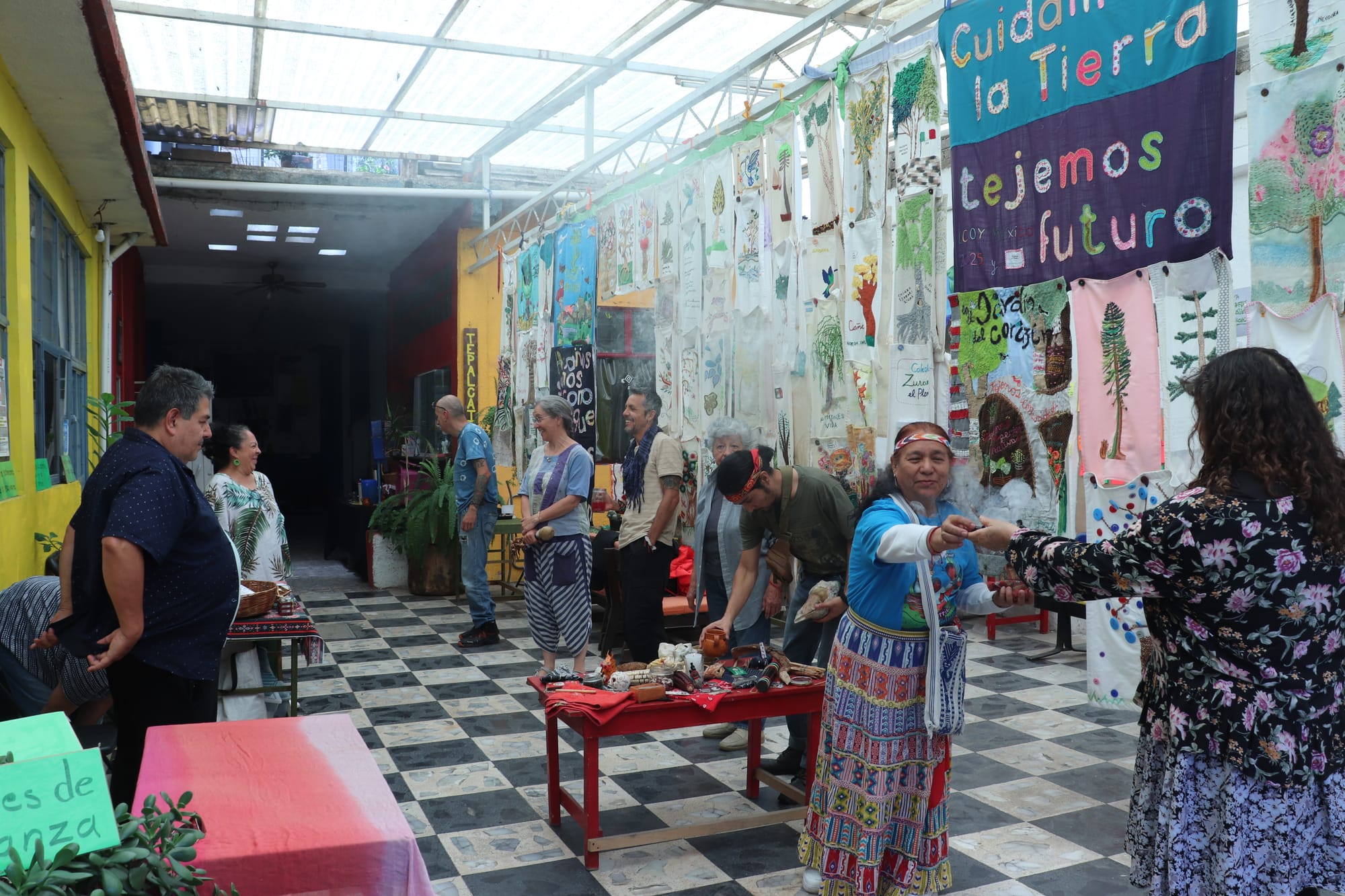
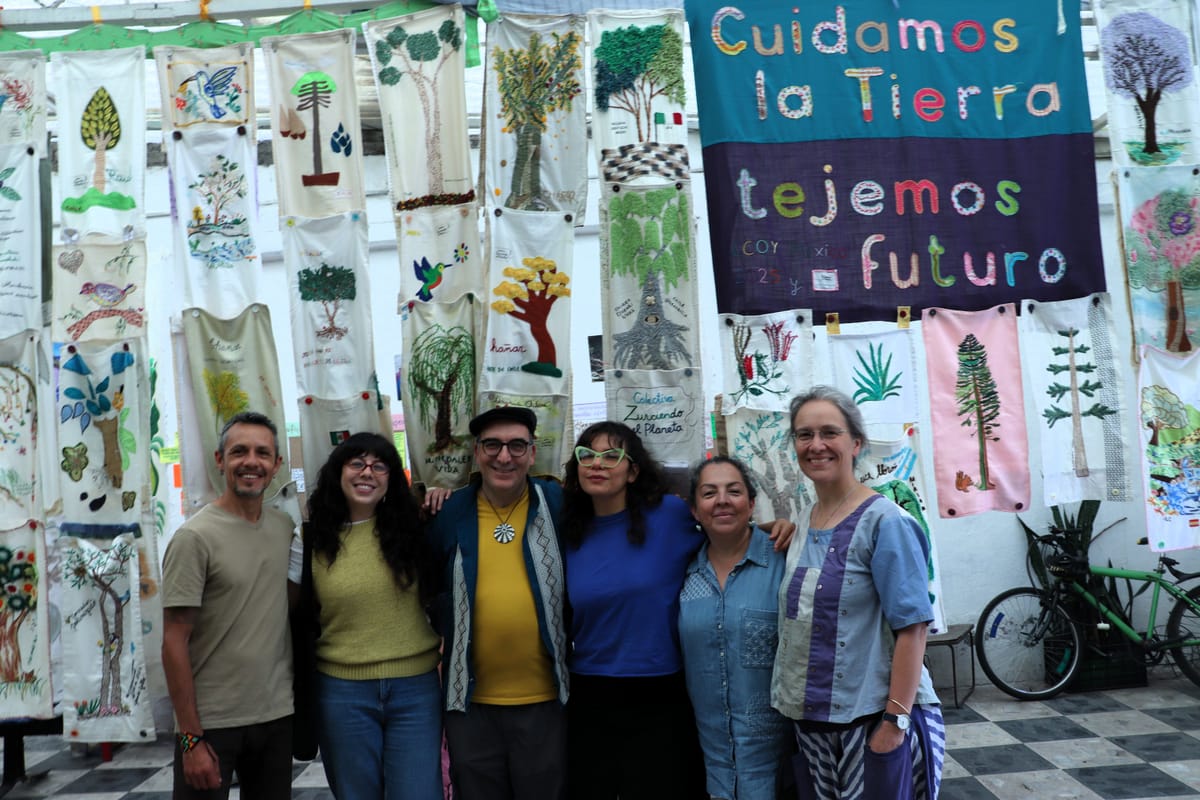
El lado de artivismo fue bajo el cuidado de Zurciendo el Planeta una colectiva de mujeres bordadoras parte del Hub México que ha participado con su exposición de bordados llamado: “Bosque de esperanza” en varios espacios de sensibilización al cambio climático paralelos a las COP de Glasgow (UK) y de Belem (Brasil) y la preCoP de Oaxaca para mencionar algunos.
También se proyectaron dos documentales como impulso a la reflexión: “Los sueños que compartimos” y “Tejiendo resistencia”. El primero referente al viaje de los zapatistas mexicanos en varios espacios de resistencia de Europa para tejer alianzas y hermanamientos intercontinentales y el segundo un corto documental sobre la situación de desplazamiento forzado por violencia del crimen organizado sobre su gente y su tierra nativa forestal de los Ñuu Savi en la Mixteca Alta de Oaxaca. Ita mujer indígena del pueblo Ñuu Savi e integrante de la organización de Red de Futuros Indígenas, vino a visitarnos para exponernos el caso de la comunidad desplazada, levantando también la voz y el entendimiento sobre el rol de las comunidades ancestrales que se presentan como solución viva a la crisis climática, al conservar la memoria biocultural de los territorios expresándose en su lengua, manteniendo sus buenas prácticas ambientales, como el cultivo de la milpa, y la protección de los bosques que sostienen el equilibrio y permite la preservación de la vida.
CD Nezahualcóyotl se construyó en un contexto desfavorable a la vida, un lago seco de sal, el esfuerzo social para transformarlo en una ciudad próspera nos ofrece una herencia cultural de resistencia exitosa encarnada en sus organizaciones y comunidades, que siempre han estado en transición para una vida mejor.
En una época como la nuestra donde la transición ecológica y social es inevitable y los escenarios son incierto y preocupantes, este legado y experiencia de lucha social para mejorar condiciones materiales de vida nos parece un hito a partir del cual el intercambio generacional puede revitalizar el propósito de poner otra vez la vida en el centro, no solo la humana, hacia un descenso creativo, alternativo a las tendencias suicidas del capitalismo en su fase terminal, transformando la visión de un inevitable colapso sistémico en horizontes compartidos de esperanza.
Un micelio colaborativo bajo el Bosque de Esperanza
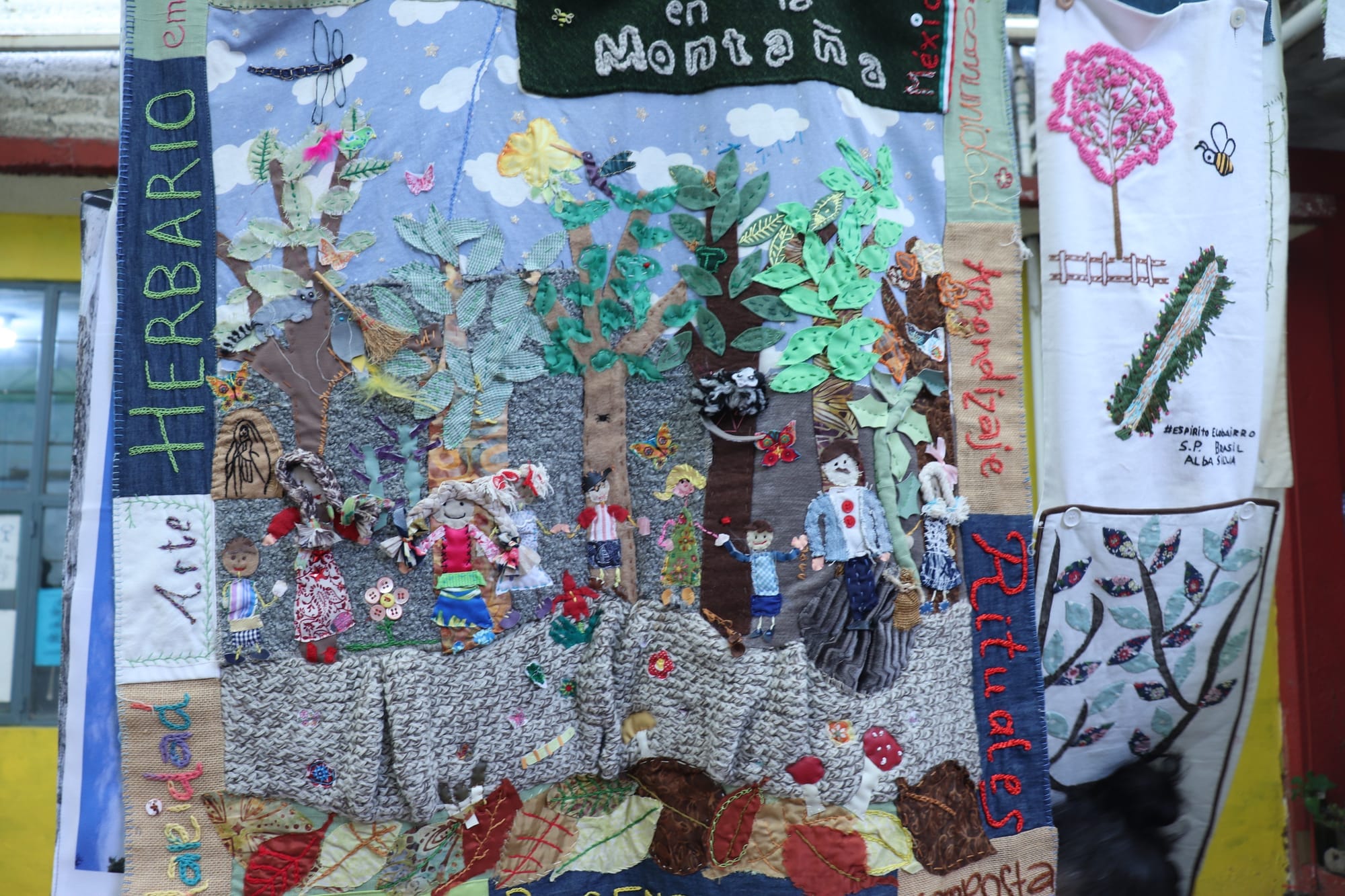
El Bosque de Esperanza con su llamado a ser como humanos bosques, nos ofreció un marco de arte, belleza, reflexión e inspiración congenial para introducirnos a la metáfora del micelio y a la importancia del tejido invisible de relaciones que mantiene próspero un ecosistema.
Así como las redes subterráneas de los hongos conectan las raíces de los árboles en los bosques compartiendo información y nutrientes, para fortalecer el tejido social podemos juntarnos, conectar acciones, fortalecernos reciprocamente, visibilizar retos y necesidades para el sostenimiento mutuo de procesos de cambio local.
El objetivo de la propuesta del Micelio Colaborativo es generar una plataforma y un directorio de redes, organizaciones y actores locales que intercambien habilidades y saberes y cubran recíprocamente bienes, servicios y necesidades para responder a lo desafíos presentes y futuros sobre alimentación, gestión de la naturaleza, salud, economía, energía, transmisión de saberes intergeneracionales e interculturales etc.
La metodología de facilitación fue desarrollada por el Hub de México para mapear bioregiones en cuencas hidrográficas y fortalecer alianzas y tejidos colaborativos de activismo regenerativo para el cambio, todavía está en fase de experimentación piloto, Micelio Neza fue una primera etapa que esperamos poder replicar pronto en otros contextos.
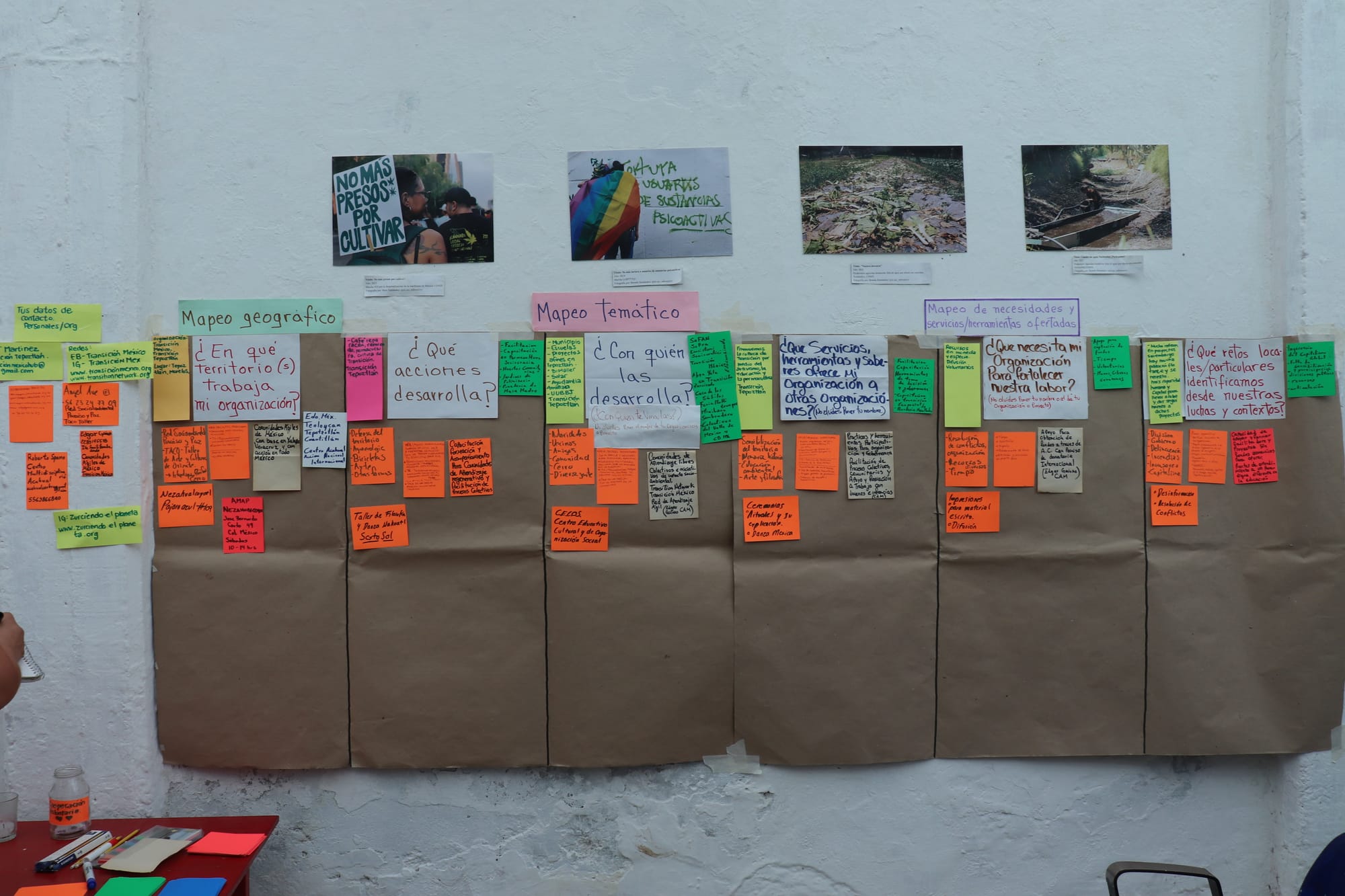
En tres intensos días generamos un espacio de cuidados abierto a los representantes de más de 15 organizaciones locales que dejaron insumos por el mapeo colectivo, y participaron de varias actividades, la exposición, las proyecciones, las charlas, los círculos de bordado, la feria de economía solidaria.
Aunque la participación no fue la esperada, las conexiones generadas con espacios facilitados y dinámicas convivenciales fueron muy significativas, y sembraron las esporas para el fortalecimiento del micelio colaborativo futuro.
Nos dimos cuenta de la importancia de crear espacios presenciales de reconocimiento, valorización de las experiencias previas de las formas de autoorganización local, personas y organizaciones que han trabajado y trabajan con el territorio y las comunidades desde décadas haciendo transición ecosocial sin saber que existe un movimiento global de transición.
La propuesta ha fortalecido el nodo mexicano de transición llenándolo de propósito, esperanza y alianzas. Estamos trabajando para sistematizar la metodología para que pueda replicarse en otros territorios de México y de Abya Yala.
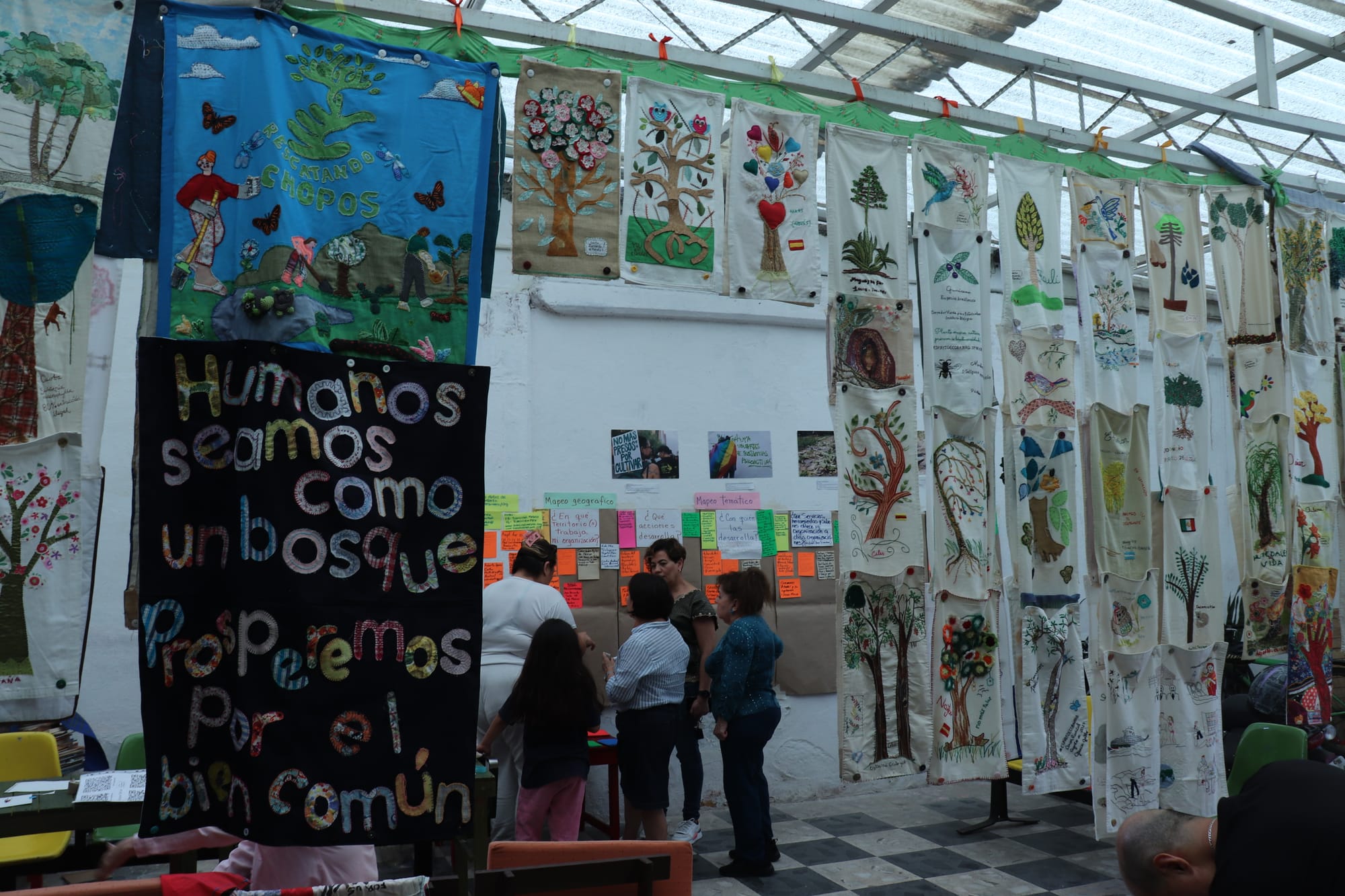
Así que con la emoción aún viva de un fin de semana esperanzador aún inspirados de la experiencia de ser naturaleza viva nos preguntamos:
¿Y si invertimos más en crear espacios presenciales donde conocernos y articularnos en colaboraciones para imaginar juntos y fortalecer nuestras relaciones?
¿Y si nos valorizamos y nos inspiramos los unos de las prácticas y acciones de los otros?
¿Y si tejemos más conexiones ecosistémicas, fortaleciendo la interdependencia y la complementariedad entre nuestros colectivos?
Juntos sí podemos crear un tejido invisible de relaciones significativas, un micelio de esperanza que puede sostenernos y regenerar nuestros contextos de vida.
Roberto Spano (Transición México) y Marco Aguilar (Casa de las Sábilas)
Collaborative mycelium and forests of hope in Mexico
What if?
On Sunday, July 5, Mexico’s run in the 2026 World Cup came to an end.
However, hope and the dream of other possible worlds remain alive for Mexican communities that, day in and day out, fight with courage and passion to correct systemic injustices and inequalities and to protect life in all its forms—in one of the countries most affected by violence, environmental conflicts, and climate change.
Throughout the World Cup, one of the most frequently repeated motivational phrases among Mexican fans was: “What if?”… offering hope to the team and the Mexican people.
They say that dreaming costs nothing; however, in Mexico, it is not a matter of money, but rather a life choice—in a country with a harsh reality yet a deep connection to ancestral roots, re-emergence, resilience, and creativity.
For us at Transición México, “Y si sí?” reminds us not only of Rob Hopkins’ “What If,” but also of the dreams and aspirations of many struggles waged by Indigenous peoples, rural, and urban communities to create other possible worlds through radical imagination and the care of life—often through actions driven more by “corazonadas” (a hunch or intuition), as they say here, than by real and conscious support from economic and political power.
Here, it has long been known that the power of love from true hearts is the bravest, most powerful, and most effective way to move toward another reality…
a change that cannot be stopped—radical, inexhaustible, invincible.
From the Bed of a Salt Lake to a Thriving Community
So let’s turn to us and our event: Micelio Neza, which took place on June 26, 27, and 28 at the Casa de las Sábilas in Ciudad Nezahualcóyotl. This satellite city of Mexico City, with a population now exceeding one million, is situated on the dried-up bed of Lake Texcoco. It originated in the 1940s as one of the world’s largest informal settlements, alongside Iztapalapa and Chalco. This settlement has been the destination for many waves of internal migration, especially from Indigenous peoples in other states and from Oaxaca, with a still-significant presence of the Ñuu Savi people. It has been a stigmatized and marginalized place for many decades, but its population has fought tenaciously to be recognized, improve their living conditions, and gain access to services—a struggle that continues today with more environmentally conscious and inclusive approaches that incorporate other perspectives.
La Casa de la Sábilas is one of the city’s many spaces of resistance, where for more than 10 years it has hosted a solidarity economy fair that brings together prosumers from the northeastern part of the metropolitan area to exchange products and services using a social currency called the “sabila.”
It was within this context that the Micelio Neza proposal emerged as a space for hybridizing artivism with the participatory mapping and coordination processes facilitated by the transition team.
The artivism aspect was led by Zurciendo el Planeta, a collective of women embroiderers affiliated with Hub México, which has participated with its embroidery exhibition titled “Bosque de esperanza” (Forest of Hope) in various events raising awareness about climate change held in parallel with the COPs in Glasgow (UK) and Belém (Brazil), as well as the pre-COP in Oaxaca, to name a few.
Two documentaries were also screened to encourage reflection: “The Dreams We Share” and “Weaving Resistance.” The first documented the journey of Mexican Zapatistas to various sites of resistance across Europe to forge intercontinental alliances and sisterhoods, while the second was a short documentary on the forced displacement of the Ñuu Savi people from their native forested lands in the Mixteca Alta region of Oaxaca due to violence perpetrated by organized crime. Ita, an indigenous woman from the Ñuu Savi people and a member of the Indigenous Futures Network, came to visit us to present the case of the displaced community, while also raising awareness and fostering understanding of the role of ancestral communities as a living solution to the climate crisis, by preserving the biocultural memory of their territories through their language, maintaining their sound environmental practices—such as milpa farming—and protecting the forests that sustain ecological balance and enable the preservation of life.
CD Nezahualcóyotl was built in an environment hostile to life—a dry salt lake—and the social effort to transform it into a prosperous city offers us a cultural legacy of successful resistance embodied in its organizations and communities, which have always been in transition toward a better life.
In an era like ours, where ecological and social transition is inevitable and the outlook is uncertain and troubling, this legacy and experience of social struggle to improve material living conditions strikes us as a milestone from which intergenerational exchange can revitalize the purpose of once again placing life—not just human life—at the center, moving toward a creative descent that offers an alternative to the suicidal tendencies of capitalism in its terminal phase, and transforming the vision of an inevitable systemic collapse into shared horizons of hope.
A Collaborative Mycelium Beneath the Forest of Hope
The Forest of Hope, with its call for us to be like forests as human beings, offered us a setting of art, beauty, reflection, and inspiration—perfect for introducing us to the metaphor of the mycelium and the importance of the invisible web of relationships that keeps an ecosystem thriving.
Just as the underground networks of fungi connect the roots of trees in forests, sharing information and nutrients, we can come together to strengthen the social fabric by coordinating actions, supporting one another, and bringing challenges and needs to light—all to sustain local processes of change.
The goal of the Collaborative Mycelium initiative is to create a platform and directory of local networks, organizations, and actors who exchange skills and knowledge and mutually provide goods, services, and support to address present and future challenges related to food, nature management, health, the economy, energy, and the transmission of intergenerational and intercultural knowledge, among others.
The facilitation methodology was developed by the Mexico Hub to map bioregions within watersheds and strengthen alliances and collaborative networks of regenerative activism for change; it is still in the pilot phase. Micelio Neza was a first step that we hope to replicate soon in other contexts.
Over three intense days, we created a nurturing space open to representatives from more than 15 local organizations, who contributed ideas to the collective mapping effort and participated in various activities, including the exhibition, film screenings, talks, embroidery circles, and the solidarity economy fair.
Although participation was lower than expected, the connections forged through facilitated spaces and communal activities were very meaningful and planted the seeds for strengthening the collaborative mycelium of the future.
We realized the importance of creating in-person spaces for recognition and appreciation of past experiences with forms of local self-organization, as well as the people and organizations that have been working with the territory and communities for decades to bring about an eco-social transition—without even knowing that a global transition movement exists.
This initiative has strengthened the Mexican transition network, infusing it with purpose, hope, and alliances. We are working to systematize the methodology so that it can be replicated in other regions of Mexico and Abya Yala.
So, with the excitement of a hopeful weekend still fresh and inspired by the experience of being living nature, we ask ourselves:
What if we invest more in creating in-person spaces where we can get to know one another and collaborate to imagine together and strengthen our relationships?
What if we value and draw inspiration from one another’s practices and actions?
What if we weave more ecosystemic connections, strengthening the interdependence and complementarity among our collectives?
Together, we can create an invisible web of meaningful relationships—a mycelium of hope that can sustain us and regenerate the contexts in which we live.
Roberto Spano (Transition Mexico) and Marco Aguilar (Casa de las Sábilas)
![[MULTILINGUAL] Envolvimento da comunidade: o potencial de uma peça de teatro](/content/images/size/w720/2026/10/featured-image-quinta-oficina-WhatsApp-Image-2026-10-15-at-12.44.47--14-.jpeg)